Showing posts with label score: 2. Show all posts

Sunday, 1 March 2015

Reading Journal #6: Catching Up


As predicted, I simply didn't have time to post during the week, and unfortunately I didn't get to visit many blogs either. By the time I have taught all day, attended meetings, got Giles home, cooked dinner, eaten dinner, given Giles his bath, put him to bed and sorted out everything for the next day, including planning and marking, I'm not in much shape for anything! Happily, one of the things I am in shape for is reading, so I've still been steadily going through books. Here's what I have read over the past two weeks or so:

Bad Pharma by Ben Goldacre is a non-fiction expose of the pharmaceutical industry and how trials, biased publications and access to doctors' training can lead to drugs being prescribed incorrectly, and patients not always getting what is the best for them. Prior to reading this, I had heard about the pharmaceutical industry in the USA, but had naively thought that we were more protected here in the UK, because we have the NHS and our medical system isn't for-profit. Goldacre quickly disabused me of this notion, pointing out how missing data, where nine unsuccessful trials could be buried and one successful one published, skews prescribing habits in all countries. It turns out that our regulators are no good at enforcing their own rules, that doctors can be paid to add their names to papers they did not write, and that drugs reps are allowed way too much sway over GPs. The single scariest fact in the book was that drugs are rarely if ever compared against the best available treatment, only against a placebo. This means we have no idea which drugs are the most effective for a whole host of common treatments.

Bad Pharma is well researched and it helps that Goldacre is a UK trained doctor, but at times his rhetoric was a bit over the top. I could have done without lots of the repeated anger, especially in a book as long as this one. It did however make me appreciate my own GP, who prescribes generic medications rather than the fancier branded ones that have the exact same ingredients, and who has explained this to me before prescribing. Bad Pharma covers an important topic and is well researched and written, so I would recommend it if you don't mind a bit of repeated anger on the part of the author.  3.5 out of 5

After non-fiction, I always need a bit of palate-cleansing fiction.  I've read White Teeth and On Beauty by Zadie Smith, and liked them both, so I decided it was time to pick up N-W. It tells the story of four Londoners from the same area - Leah, who is trying to avoid growing up and starting a family; Natalie, who has worked hard to leave her working class roots behind; Felix, who is trying to start again, and Nathan, who is angry.

Reviews of N-W seem to be very mixed, with readers tending to rank it lower than her other books. This is mainly due to the experimental writing style; parts of this novel are written in numbered sections, in fragments of sentences and in lists. Personally I loved that Smith had chosen to write like this, as she is definitely talented enough to pull it off.  The chaotic writing style matched the chaotic lives of the characters and I was hooked within a few pages. This book was challenging to read at times and the style didn't always work, but I found it thoroughly engrossing and a realistic portrait of London today.  3.5 out of 5.

And finally, an audio-book.  I was excited to start China Dolls by Lisa See, as See is one of my favourite historical fiction authors. Shanghai Girls in particular is up there with the best historical fiction I've read, and I've never read a bad book by her. Until now. China Dolls is the story of Ruby, Helen and Grace, who meet when they are auditioning to become dancers in a Chinese night-club in 1930s San Francisco. They soon become firm friends, and the narrative follows them through several decades, as they move through disappointments and traumatic times. Each is hiding a powerful secret.

To start with what I liked - I had no idea about the way 'Orientals' were treated in America at this time, and it was fascinating to learn about the 'Chop Suey Circuit' and the interment camps for American citizens of Japanese descendants during WW2. I liked the epic-ness of the story, how it covered many decades and events and gave a real sense of time passing. However, the three main characters were a major let-down. The only one I could ever really like was Grace, which wouldn't have been a problem if their storylines weren't so unbelievable.  Ruby, Helen and Grace kept on and on hurting each other, and their friendship seemed based only on jealousy and a common race. I just couldn't comprehend how they kept forgiving each other some pretty unforgivable things, and why they were so keen to hurt each other. It completely ruined what could have been an interesting novel, if only the portrayal of female friendship was more nuanced.  2 out of 5 stars.

So that's me almost up to date.  I've also finished The Bronte Myth by Lucasta Miller, but as it has led directly on to a reread of Jane Eyre, I'm going to save it for a joint post another time.  What have you been reading lately?

Monday, 17 March 2014

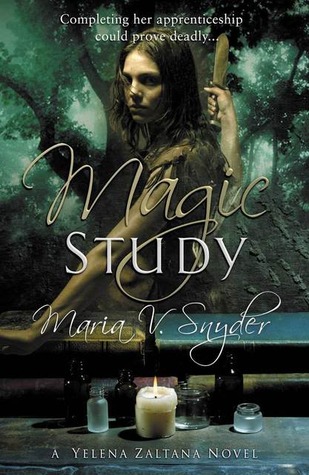
Magic Study by Maria V. Snyder


Last year I read Snyder's Poison Study, the story of a young woman given a reprieve from a death sentence in order to become a food taster.  I thought it was a well written lighter fantasy novel with good world building, an interesting plot and a romance that didn't dominate the whole book.  Therefore I was keen to pick up the second book in the trilogy, Magic Study, but unfortunately it was a bit of a let down.

At the start of Magic Study, Yelena is taken to meet her family in Sitia, where magic is still valued, and she can be guided to develop her potential.  But meeting her family isn't all she imagined it to be; Yelena struggles to feel a connection with the unfamiliar lifestyle of her parents and her brother is outwardly resentful and hostile.  Even though her life in Ixia was fraught with danger, she starts to miss the comfort of a structured and ordered society, in which all of the rules are clear. When she journeys to the citadel to be taught magic, her feelings of disconnection grow.  To make matters worse, a rogue magician starts capturing and torturing young women with magic skill, and Yelena is drawn into the attempt to stop him.

Ultimately, I didn't enjoy Magic Study, especially compared to Poison Study.  The main character, Yelena, had seemed to become a completely different person.  In Poison Study she was somewhat headstrong and reckless, but her actions were always thought through.  In Magic Study, she seems to delight in blundering from one horrible situation to another, sometimes on purpose, never thinking about what she is doing.  Most of the book is taken up with her either moping around missing Ixia (where they want to kill her!) or recklessly plunging head-first into a dangerous situation despite her being warned against doing so by every single responsible person in the novel, including a talking horse!  There's a lot of her being kidnapped and then miraculously using her magic to escape, which felt convenient and like lazy plotting.  I was also uncomfortable with the way that rape and rape threats were used in the novel.

Unforutunately, Yelena wasn't the only character who had become a completely different person.  Valek, her love interest from the first novel, and the master of spies in Ixia, is now basically reduced to being a love-sick puppy.  In the first novel, he is morally ambiguous, cold and calculating, but in Magic Study, all this has gone and it seems like the only thing he cares about is Yelena, which is completely out of character.  I found this frustrating and annoying, as why go to all the trouble of developing a more complicated relationship if you are only going to simplify it in this way in the sequel?

As you can tell, I wasn't a fan of Magic Study. I will say that it was easy to read and contained some interesting action sequences, but this wasn't enough to redeem it for me.  I definitely won't be continuing on with the trilogy.

Source: Personal copy
First Published: 2006
Score: 2 out of 5

Thursday, 29 August 2013

A Reliable Wife by Robert Goolrick


In 1907, rural businessman Ralph Truitt places the following advert in the newspaper; "Country businessman seeks reliable wife.  Compelled by practical reasons.  Reply by letter."  He is answered by Catherine, who claims to be a 'simple, honest woman', the daughter of missionaries.  She arrives by train in the middle of winter, but isn't who she claims to be.  Catherine thinks she is leading Ralph through her own devious scheme, but little does she know that he also has plans and secrets of his own.

I really wanted to like A Reliable Wife, which I read with Elena from Books and Reviews.  I love gothic fiction, so the setting and plot of this book appealed. Unfortunately, I disliked the book almost from the first chapter and although it improved towards the middle, it never became a good read.  The plot itself was fine; it required a little stretching of the imagination in terms of how the main characters all ended up linked, but I could have done that.  Instead, the main issues were with the writing and the characterisation.

Taking the writing first, it just felt so amateurish.  Goolrick tried to make every sentence into a heartfelt statement, with the effect that some of the chapters ended up feeing a bit silly and over the top.  He was a fan of long, overly descriptive sentences followed by very short ones, which again I suppose was for effect, but it didn't really work.  Even worse than this, Goolrick couldn't keep the perspectives straight in the different chapters.  Each chapter was from the point of view of one of three characters, but every now and again someone else's thoughts would find their way in, which was jarring.  For example, when Catherine is returning to Ralph after some time away, we get a lot of description of how she is feeling and then a random sentence about how Ralph 'was struck by her calm'.  How would Catherine know this?  It's a bit of a pet peeve when writers do this, write from one perspective but then can't stick to it.  It ruins the flow of the reading experience.

The other issue I had was the characterisation.  Goolrick's characters simply don't act how people would act in the real world.  Catherine was the most fully formed, she had motivations for her behaviour and seemed to act in a realistic way.  But Ralph and his son simply didn't feel like real people.  Ralph especially, no one would be that calm and forgiving throughout the novel, given the situations Goolrick put him in.  It's almost as though Goolrick wanted the plot to go a certain way, so he invented characters to fit with that, not stopping to consider whether they were realistic.  

So on the whole, I wasn't a fan of A Reliable Wife! As I said, the middle section was better than the beginning and the end and the plot had potential.  It was just a shame about the writing.


Source: Personal copy
First Published: 2009
My Edition: Abacus, 2010
Score: 2 out of 5

Tuesday, 6 August 2013

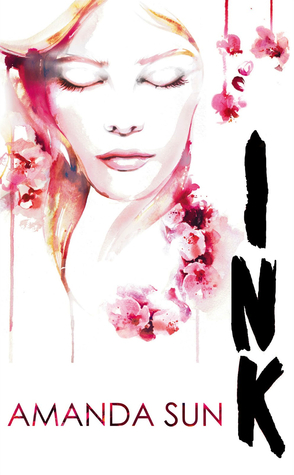
Ink by Amanda Sun


After the death of her mother, Katie moves half way across the world to live with her aunt in Shizuoka, Japan.  With only three weeks' worth of Japanese lessons and reeling from the tragedy, Katie struggles to fit in at school and in the new culture.  One day, she overhears an older student called Tomohiro breaking up with his girlfriend, who responds by ripping pages from his sketchbook.  As the papers fall to the floor, Katie sees something shocking - the ink drawings are moving.  Obsessed by this, Katie becomes determined to find out what secret Tomohiro is hiding, whatever the cost.  Soon she becomes caught up in a power struggle among the Kami, Japanese Gods, that could have deadly consequences.

I was drawn to Ink because I'm always on the look out for fantasy novels that use other cultures and their mythologies to underpin the plot.  Ultimately, I found Ink to be underwhelming, but it wasn't without positive features.  Sun studied Asian History at university and has spent time travelling through Japan, and her love of Japan came across on every page.  Lots of little details were added to the plot, with the result that the reader gets a really good 'feel' for Japanese culture.  Katie changes into school slippers in the morning, watches cherry blossom trees flower and eats authentic Japenese food.  Japan was almost a character in the novel and I loved that.  The mythology of the Kami also made a refreshing change as I have never come across them in a novel before.  

Whilst Ink had positive elements, I felt like it was let down by the romance between Katie and Tomohiro, who was a stereotypical bad-boy with a hidden secret.  Despite only just meeting him, Katie fell in love almost instantly and made a series of bad decisions all because she loved him.  Even when he was horrible to her, when she found out what his friends were mixed up in and even when her being around him could actually hurt her, she couldn't leave him alone.  I found it so frustrating because all the elements of a fantastic novel were here at the beginning of the book, only for the romance to take centre stage.  I don't mind a bit of romance, but it needs to be a better one than this for me to enjoy it.  I wanted more adventure, more mythology, more insight into the Kami, more ink drawings coming alive and less of Katie angst-ing over Tomohiro and how dangerous yet needy he was.

All in all, Ink had promising moments but was a bit of a let down overall.

Source: From the publisher via Netgalley.
Published: June 2013
Score: 2 out of 5

Sunday, 30 September 2012

Meet Me at the Cupcake Cafe by Jenny Colgan

I'm not the biggest fan of chick-lit but every now and again, when life is stressful, I crave something light and fluffy to read and chick lit is usually what I turn to.  In this offering by Jenny Colgan, Issy is a thirty something working in admin for a real-estate agency who loves to bake the recipes passed on by her baker grandfather.  When she is made redundant from her job, Issy decides to take the plunge and use her redundancy pay-out to open up a cupcake cafe in Stoke Newington.  But running a business isn't easy and Issy has long working hours, a lack of customers and red tape to deal with, alongside working out what to do about her cut-throat property developer boyfriend Graeme.

I'm not an expert on chick lit by any means, but this book was far from the best in the genre.  The basic plot was an interesting one, and I loved how the recipes Issy used were included at the start of each chapter but overall, Meet Me at the Cupcake Cafe was missing a hefty dose of realism. I'm not saying I expect chick-lit to deal with heavy issues all the time, there's nothing wrong with a bit of escapism, but this was ridiculous.  Issy straight away finds a location for her shop, magically has just the right amount of money, is able to open in a matter of weeks despite everything needing a re-fit, gets the first bank loan she applies for, meets the perfect employee by chance and has no issues with health and safety regulations, licencing etc.  If opening a business was really that easy, everyone would do it.  It was also astounding how quickly Issy was able to go from struggling to make ends meet to turning a generous profit.  There was no real sense of the worry involved in starting up a business.

The characterisation was lazy too.  Issy was relatable but almost everyone else was a stereotype from the bad boy boyfriend to the responsible 'other man' looking after his baby brother, to the snobby yummy mummies with designer prams, to the resentful council estate Mum who over-feeds her baby boy with junk, to the builders only wanting bacon sandwiches and commenting on 'posh birds'.  Colgan was clearly trying to say something about class issues but it came across as very clumsy and simplistic.  Colgan does attempt to give these characters some depth by the end of the novel but doesn't quite succeed.  Even the romance part of the novel was lacking as it relied on Issy being completely ignorant about how uncaring Graeme was, which was so obvious in the text that it made Issy look a bit stupid.

My review so far of this book has been very harsh.  It wasn't all bad - Meet Me at the Cupcake Cafe was easy to read and certainly provided some escapism.  But I just don't see why books should be allowed to be so uninspiring just because they are chick lit.  Next time I crave something from this genre, I think I'll stick to Marian Keyes.

Source: Personal copy (kindle)
First Published: 2011
Score: 2 out of 5

Sunday, 1 January 2012

Smut by Alan Bennett


I'm going to start this review by stating that I am a big Alan Bennett fan (The Uncommon Reader is amongst my favourite books), so I had high expectations for this collection of two new novellas and jumped at the chance to read and review them via NetGalley.  Smut contains the stories "The Greening of Mrs Donaldson" and "The Shielding of Mrs Forbes" and both are about the secrets behind the net curtains of middle-class England.

The Greening of Mrs Donaldson is about a widower who takes on a job as a 'demonstrator' at the local hospital, which involves her pretending to have various illnesses so that medical students can practise their diagnostic skills.  She also rents out a room in her house to students and this signals a kind of sexual awakening/liberation.   The Shielding of Mrs Forbes, the novella I preferred, is about a middle class, middle aged woman who believes that everything in her family is normal, despite having a gay married son who is being harassed by a police officer and a daughter in law that's having a secret affair with her husband, and who isn't as stupid as Mrs Forbes believes.

Smut was a big disappointment for me.  While there were elements of satire and humour in both novellas, Bennett's writing felt flat, not razor sharp like it usually does. Neither story really hooked me in and whilst I could take a stab at inferring all of the themes that Alan Bennett was covering in the novellas, this lack of an interesting and engaging story was too big of a flaw for me to get past.  The things that happened in the stories seemed random, especially in The Greening of Mrs Donaldson.  I probably wouldn't be as harsh in my review if not for that fact that I really am an Alan Bennett fan, and have read much better from him.  I would advise readers new to Bennett to start somewhere else.

Verdict: For me, a disappointing collection of two novellas lacking the satire and humour of the author's previous works.
Source: From NetGalley, in exchange for an honest review.
Score: 2 out of 5  

Smut is released in the US on the 3rd January 2012.  It is already available in the UK.

Tuesday, 6 December 2011

The Lovely Bones by Alice Sebold


I usually don't read books that attract a lot of hype.  When they are in the middle of that bubble of buzz, my expectations are raised so high that rarely does the book actually live up to it.  I've found that if I let the hype subside with time and read the book as just another book, I have more chance of enjoying it.  So it was probably about time that I dusted off my copy of The Lovely Bones and gave it a shot.

Susie Salmon is a normal high school girl who is brutally raped and murdered at the age of fourteen.  Unable to leave her family and friends, she watches their lives afterwards, desperate both the see how the world carries on without her and for them to realise who the murderer is.

I should start this review by stating that I enjoyed the first half of this book very much.  I liked that Sebold reveals who the murderer is straight away and instead focuses on Susie's family and how they try to carry on with life after her death.  The emotions and actions of the characters at this point felt realistic and the impact was occasionally powerful.  I liked the scene where Susie's sister, Lindsey, is forced to sit through an interview where her principle expresses his condolences and the way she looks through people to avoid having an emotional reaction.

I also enjoyed some of the characters, especially Susie's glamorous Grandmother, who tries to help the family carry on functioning.  Some of the other characters I could have done with seeing less of, particularly Ruth, the child-genius-lesbian who could sense death; I felt that she was very cliche and predictable.

So there I was, enjoying my reading - until I got to the end of the book.  I'm not going to give away the ending in case some of you haven't read the book, but something very silly and unbelievable happened and it completely ruined the book for me.  Took away all credibility from the story and I felt annoyed to have invested so much time in the book only for this paranormal inspired ending to happen.  I know I'm supposed to feel touched and moved, but I completely didn't.  I was just annoyed.

Verdict: Good first half, shame about the silly ending. 
Source: Owned
Score: 2 out of 5 (2 points for the beginning sections).

Saturday, 27 August 2011

Mary and Elizabeth by Emily Purdy

Also published as The Tudor Throne by Brandy Purdy.

This book was an impulse buy.  I was in the supermarket and there was a 2 for £7 offer going on.  As I am a fan of historical fiction, I got it.  From the cover and the synopsis on the back cover it promised to be about the sisterly relationship between Mary and Elizabeth Tudor as they grow up and England changes.  I hadn't heard of the author and had read none of her work before.

I saved this book for the plane ride on the way home, thinking it would be a nice light read to pass the time.  And it was, but it was also a lesson against impulse purchases.  Starting with the death of Henry VIII, it follows Mary and Elizabeth through the reign of their brother Edward, through Mary's reign and ends as Elizabeth becomes Queen.  Written in the first person, each chapter tells the point of view of an alternate sister, meaning that we get to read both sides of the story.

This novel was not for me.  I like my historical fiction to stay relatively close to fact, although I can understand a little artistic license.  But this book was the most sensational piece of historical fiction I have ever read.  Every rumour about the Tudor period was treated as fact and the pages were filled with scandal after scandal.  And because of this, I really didn't like the way Purdy wrote the two central characters.  Elizabeth was man-hungry and slept with practically everyone; Mary was a silly immature girl who was happy to betray her country in order to sleep with her new husband.   Now, I'm no prude and I know history only tells us the boring bits, but Purdy took it way too far.

The only good thing I could get out of all of the sensationalism was by telling myself that maybe Purdy was making a point about the power play between men and women and how women had to resort to their sexuality to gain power.  And how men held all the power in intimate relationships as well as in society.

I didn't think the writing was bad, and I liked how we got to see the viewpoints of both the women, I just think this book could have been a lot more than it was.  Plenty of interesting topics were just glossed over - their differences in religion, Mary's experiences growing up cut out of the succession and forced to be Elizabeth's maid, Elizabeth's role in the plots against Mary, Mary's treatment of Protestants during her reign.  I would have liked to read more about these, and about the relationship between the two sisters, and less about sex and scandal.

Verdict: A sensational story that strays too far from fact.
Score: 2 out of 5
Source: Bookshelf

Friday, 17 December 2010

Ramesses by Joyce Tyldesley

I chose this book because I love Egypt.  I've loved it ever since I first learned about it back in my primary school days, and now, many trips to the British Museum later, I still love it.  I also get to teach it for an entire term every spring, and it's my favourite thing to teach.  I chose this particular author as I've read one of her books before (a tie-in to a BBC series about Egyptology pioneers) and found it to be both informative and well written.

Synopsis: Joyce Tyldesley presents what history knows about Ramesses, one of Egypt's most famous pharoahs.  Using a number of different sources, she separates myth from fact.

Score: 2 out of 5

You know how some non-fiction books are so well written and lively and engaging that you feel like you're reading a fantastic work of fiction and you just can't put them down?  This book wasn't like that.  In fact, this book was the opposite - it managed to make a fascinating topic that I already had some knowledge of seem dull and it was a battle to get to the end.

Part of the problem was that Tyldesley had organised the book thematically, with chapters such as 'Ramesses the Husband' and 'Ramesses the Warrior'.  This meant there was no overall arc to the book, making it hard to place the various events and leaving me with no clear impression of what Ramesses was actually like.  Whilst I appreciate that much about his life is not known, I would still rather have had what is known organised chronologically.

The book also couldn't decide whether it wanted to be academic or popular non-fiction.  The other book of hers I've read Egypt: How a Lost Civilisation was Rediscovered was clealy supposed to be a popular non-fiction book.  There was an attempt to make the writing lively.  Ramesses was different; there were notes at the end of each chapter, a further reading list, and way too much scholarly detail.  At one point she spent about 30 pages outlining the names and lives of all of Ramesses children, grandchildren, and even great-grandchildren.  And the history of all his scribes, advisers etc were also included, down to their position of birth and where they died.  That kind of stuff is too much for the interested but not that knowledgeable reader.

All this is not to say there was nothing I enjoyed about the book.  There was some interesting facts about his family life (it seems he married practically all of his female relations) and about the way society in Egypt was organised.  Ramesses was also a master of propaganda, and modern politicians could learn from him.  Even now he is remembered as a great warrior pharaoh, but his 'victories' seemed to have been largely made up.  And his famous statues either plagarised or stolen from previous pharoahs.

To sum up: only really for the serious Egyptologist or those that enjoy very winding family trees.

Friday, 29 October 2010

Perfume by Patrick Suskind

Perfume by Patrick Suskind

I had high hopes for this book as it was recommended to me by a friend,  someone who I usually share the same reading taste with.  It sounded like an original adult fairy tale, something I would love.

Synopsis: Jean-Baptiste Grenouille is born in 18th century Paris with an extraordinary sense of smell.  As he has no scent of his own, he is driven further and further in his quest to create the perfect scent.

Score: 2 out of 5

Unfortunately, I found this book to be silly.  I did enjoy the writing style and how the author described the setting and the people in a fairy-tale way, but it was just too silly for me.  I am prepared to suspend belief for a good story, but this seemed to have been plucked out of the air in a pretentious kind of way and not thought through properly.

The main problem I had (aside from the silly ending, which I won't spoil for others who want to read it) was that Grenouille was just not a developed character at all.  He didn't change or react to anything around him and although I could tell Suskind wanted him to be an anti-hero, I just didn't care what happened to him.  Some of the secondary characters were far more interesting and developed; the wet nurse, Richie, Baldini.  Grenouille seemed more like a plot device than a real person.

The 'magician's apprentice' chapters where Grenouille was learning his craft were interesting and it was a quick easy read.  Just one I was happy to be finished with.

Have you read this book?  If so, I would love to know whether you agree with me or not.

Friday, 15 October 2010

The Drowned World by J.G. Ballard

The Drowned World by J.G. Ballard

 I don't particularly read sci-fi (though I loved Michael Moorcock's 'Behold the Man') and got this book as my free book in a 3 for 2 deal at Waterstone's.  I just thought it sounded worth a shot.  It's my first Ballard.

Synopsis: Fluctuations in solar radiation mean that the ice-caps have melted and temperatures reach up to 150C.  Most of the cities of the Northern Hemisphere are submerged in tropical lagoons populated with prehistoric animals and massive bugs of all kinds.  The main character, Kerans, is a scientist sent to study the animal life forms but soon gets caught up with all kinds of people.

Score: 2 out of 5.

I liked the premise of this book, and indeed the initial third or so of it was amazing.  I liked the scenario of the increase in temperature leading to all of these prehistoric animals in a kind of de-evolution and thought I was in for a fantastic adventure story, in the style of Conan Doyle's 'Lost World'.  I wanted battles with giant iguanas and crocodiles as enormous as blue whales!

But there wasn't actually much of a story at all.  The main character was very passive (intentionally) and the book just kind of drifted with no purpose.  I get that this was because humanity and the world as a whole were drifting with no purpose, but it didn't make for fun reading. The sections on what happens to humanity when civilisation is stripped away were interesting, and all the looting and plundering seemed applicable to life now.

The main problem for me that this book appears to have been written in a psycho-analytic time.  Don't get me wrong, I did a psychology degree, but I have no time for the "collective unconscious" or "regressing to the womb" or other such Freudian arguments.  Ballard seemed to be arguing that the heat was activating some kind of genetic memory we all have of the time of our ancestors, and this was captivating and entrapping the main characters, making them seek out hotter lagoons.  It made no sense!  If I was Kerans I wouldn't be thinking "Hmm, 150C is a little mild, I'm going to leave this nice air-conditioned scientific facility with all the food provided and venture south where it is even hotter and I will have no resources whatsoever!"  Despite the shortness of the book, there was a lot of waffle about this.  A bit disappointing, really.

To summarise:  I liked the idea, but not enough pace or story. 

Has anyone read any other books by Ballard?  I want to read 'Empire of the Sun', but this one's put me off a bit!