My two 1001 Books projects have got off to a flying start. From my adult list, I picked up Michel Faber's Under the Skin, which I received for Christmas. I was already a Faber fan before starting this novel, the fourth of his that I have read. And it's completely unlike the others, being dramatically different in tone and content to his more famous work The Crimson Petal and the White.
The story opens with Isserley, who spends her time driving along the roads of the Scottish Highlands, looking to pick up male hitch-hikers, but only the large, muscular ones. Apart from that, there's nothing else I could say about this novel without ruining how unexpected, different, surprising and chilling it is. There's so much I could rave about, particularly concerning Faber's brilliant use of language, but the reveal in this book is so wonderful that I wouldn't want to spoil it for anyone. Just trust me when I say that it is an amazingly gripping book, one that will lodge into your brain. There's one scene in particular that I can not get out of my head, and that has made me completely re-evaluate a certain aspect of my life. Under the Skin is a book that seeks to challenge and confront, and it does so very cleverly. It's a book I will remember and think about for years to come. If you like thrillers, sci-fi, or books about ethical issues, you really need to pick this one up. 5 out of 5 stars.
From my children's list, my first selection was Lian Hearn's Across the Nightingale Floor, mainly because it was readily available in my library. The main character, Takeo, is a member of a secretive religious group called the Hidden in a fantasy world based on Japan, when he witnesses the massacre of his friends and family. Escaping with the assistance of the mysterious Lord Otori, Takeo comes to learn more about his past, and the supernatural talents he has inherited from his ancestors. When he discovers who is responsible for the massacres of the Hidden, and for the autocratic rule large parts of the island are suffering under, he becomes involved in a plot to assassinate the tyrannical Lord Iida.
Across the Nightingale Floor is best described as a crossover novel between YA and adult. It's shelved in the adult section of my library but the two main protagonists are teenagers, and a lot of the plot deals with Takeo finding out who he is and what is important to him. What I liked about the novel was that Hearn didn't shy away from darker issues or pretend that everything was always going to be OK. Death and grief are handled sensitively but straight-forwardly, without talking down to the reader at all.
I enjoyed reading Across the Nightingale Floor, as it's always good to find fantasy set in non-Western contexts. I liked reading about the belief systems of the people in Hearn's worlds, and the different approaches to marriage and politics. Although the beginning and end sections of the novel were pacy and engaging, the plot did seem to lag in the middle, and sometimes I had trouble keeping track of who was related to who, and what others thought of them, as there was much in the way of intrigue going on. Still, I enjoyed it enough to want to continue with the series. 3.5 out of 5 stars.
Showing posts with label sci-fi. Show all posts
Sunday, 18 January 2015
Wednesday, 7 January 2015
World War Z by Max Brooks
World War Z is about a zombie apocalypse, but rather than being told as a narrative, Brooks has instead written a faux-history book. In this world, humanity has only just come out of a devastating global war with zombies, and the 'author' is someone who has worked on a UN report into the war, examining the spread of and human response to the zombies. Upon being instructed to leave everything personal out of the final report, he decides to use his material to make a popular history book. And thus we get World War Z, a collection of interviews with the movers and shakers of the war, covering the initial outbreak in China through to the post-war reconstruction efforts.
I really wanted to like World War Z. It was a favourite with my husband, and I think the premise of the novel is very clever. I like the idea of it being a history book rather than a story, and it allows Brooks to bring in stories from people all around the world. We get to be there when a doctor arrives on the scene of the first outbreak, when Israel decided to shut themselves off completely, when the bold decision was made to abandon parts and populations of whole countries, in order to save the few and avoid the total destruction of humanity. I liked the descriptions of what it was like to face the zombies, and to be on the run from them.
Unfortunately, there were a few things that stopped me from enjoying World War Z. Although it was a quick read and never hard to get through, it ultimately disappointed me. The first problem was the lack of tension. The 'history book' conceit of the novel means that you know that everyone who is narrating their account survives. No matter how dangerous the situations they find themselves in, no matter how slim the chance of survival seems, you know they are going to survive, and this ruins it a bit. Another issue was that all of the accounts were of people who made key decisions or were in key places. Of course, that is who would make it into a history book if this were to happen, but I missed the run of the mill accounts of everyday people. I can only think of one like this, and it's a shame there wasn't more.
However, the main problem I had with World War Z is that it was too focused on being technical and clever. Brooks is very concerned with how the outbreak spread, the politics of the different countries and their reactions to it (and these were extremely stereotypical, another negative) and the military responses. There are pages and pages of descriptions of weapons, and of arguments between different forces on effective responses and which weapons should be scrapped. I can't deny that Brooks' scenario is plausible, and he has obviously thought everything through carefully, but I missed the emotional connection. I didn't want to read about weapons and battle tactics, I wanted more human impact, more of the feelings that would come with your world being turned upside down. Perhaps diary entries of those that couldn't cope, or stories from families who had lost members could have been included, anything to make it more emotionally engaging.
Overall, the history book format is both the strength and weakness of World War Z. It's a clever idea, and Brooks' scenarios are extremely plausible but it also completely destroys the tension and the emotional connection to the story.
Source: Personal copy
First Published: 2006
Score: 2.5 out of 5
I really wanted to like World War Z. It was a favourite with my husband, and I think the premise of the novel is very clever. I like the idea of it being a history book rather than a story, and it allows Brooks to bring in stories from people all around the world. We get to be there when a doctor arrives on the scene of the first outbreak, when Israel decided to shut themselves off completely, when the bold decision was made to abandon parts and populations of whole countries, in order to save the few and avoid the total destruction of humanity. I liked the descriptions of what it was like to face the zombies, and to be on the run from them.
Unfortunately, there were a few things that stopped me from enjoying World War Z. Although it was a quick read and never hard to get through, it ultimately disappointed me. The first problem was the lack of tension. The 'history book' conceit of the novel means that you know that everyone who is narrating their account survives. No matter how dangerous the situations they find themselves in, no matter how slim the chance of survival seems, you know they are going to survive, and this ruins it a bit. Another issue was that all of the accounts were of people who made key decisions or were in key places. Of course, that is who would make it into a history book if this were to happen, but I missed the run of the mill accounts of everyday people. I can only think of one like this, and it's a shame there wasn't more.
However, the main problem I had with World War Z is that it was too focused on being technical and clever. Brooks is very concerned with how the outbreak spread, the politics of the different countries and their reactions to it (and these were extremely stereotypical, another negative) and the military responses. There are pages and pages of descriptions of weapons, and of arguments between different forces on effective responses and which weapons should be scrapped. I can't deny that Brooks' scenario is plausible, and he has obviously thought everything through carefully, but I missed the emotional connection. I didn't want to read about weapons and battle tactics, I wanted more human impact, more of the feelings that would come with your world being turned upside down. Perhaps diary entries of those that couldn't cope, or stories from families who had lost members could have been included, anything to make it more emotionally engaging.
Overall, the history book format is both the strength and weakness of World War Z. It's a clever idea, and Brooks' scenarios are extremely plausible but it also completely destroys the tension and the emotional connection to the story.
Source: Personal copy
First Published: 2006
Score: 2.5 out of 5
Wednesday, 26 March 2014
Kindred by Octavia Butler
"I never realised how easily people could be trained to accept slavery."
Dana is moving into a new apartment with her husband when she starts to feel dizzy and nauseous. The next thing she knows, she is in nineteenth-century Maryland, rescuing a white boy who turns out to be her ancestor, as well as the son of a slave-owner. Although her visit to the past is brief, Dana finds herself called back more often and for longer, and with each trip the danger intensifies. For nineteenth century Maryland isn't a safe place for a black woman, especially one used to modern life. But as Dana spends more time in the past, she feels herself changing as the reality of slavery wears her down, threatening the life she has built in the present.
I was expecting Kindred to be very good, as I've seen many positive reviews of it and know it to be highly regarded, but it went well beyond my expectations. Kindred isn't just a good book, it's a truly excellent and thought provoking one. Butler takes the simple premise of a black woman going back to the slavery era and fleshes her out by adding all of these extra dimensions and complications. Dana has a white husband, and her ancestor is white. Her relationship with Rufus, her ancestor, is complex, as she deplores the way slaves are treated on his property, but can't help but have a bond with him. She finds her views changing with the reality of life for slaves, at one point advising others to keep their heads down, to not fight, despite this going against everything she believes in. The fact that Kevin, her husband, also goes back in time at one point was also an interesting plot device, and one allowed their relationship to be explored fully.
What I loved most of all about Kindred is that Butler doesn't shy away from any of these complications. Of course slavery was wrong, but Butler really explores what it might have been like at the time, how reality and the choices of life were never simple for slaves. We see why slaves might choose to be raped rather than run away, we witness their horrific punishments, and to a certain extent we get to see a modern woman conditioned to accept slavery through her experience in the society. Rufus remains morally ambiguous, treating different slaves in different ways and being a realistic product of his time. It would have been easy for Butler to demonise him, but she didn't. Reading Kindred really made me think and reminded me that no issue is simple. Slavery is rightly shown to be horrific, but gritty and complicated too.
As well as being thought provoking, Kindred is also a gripping read, with a fast paced plot that escalates quickly and builds up tension throughout. I read it in just two days, which is unheard of at the moment! It's a book I'd recommend to anyone, whether you are interested in sci-fi/time travel or not. And I can't wait to pick up more of Butler's books in the future.
Source: From the publisher, in exchange for an honest review.
Publication Date: In this edition, March 2014
Score: 5 out of 5
Monday, 3 February 2014
Brave New World by Aldous Huxley
"Murder kills only an individual. And what is an indiviudal when we can make a new one with the greatest ease? Unorthodoxy threatens more than the life of a mere individual; it strikes at Society itself."
In this dystopian classic, humans are bred rather than born. Using eggs harvested from a small proportion of women allowed to be fertile, embryos are created and then conditioned according to which class they will join; from Alpha-Pluses, who are allowed some amount of intelligence, to Epsilon-Minuses, who are cloned and subjected to oxygen deprivation to stunt their development. Emotions are viewed as suspect and the experience of emotional pain has been completely removed from human experience through conditioning and the availability of soma pills. When everything you want is freely available and your wants and desires have been carefully controlled to reflect your circumstances, feelings become irrelevant.
But Bernard Marx does feel unhappy. Slightly different from his Alpha peers (perhaps due to an accident during the embryo development process), he longs for more than mechanically induced pleasure. He desires solitude, meaningful relationships and for a way to express his soul. When he takes Lenina Crowe on a trip to a Savage reservation, where humans have been left to their own devices, he begins to question everything he knows even more. Is a life with pain in it more inherently valuable than a manufactured one without it?
I enjoyed Brave New World. It contains a lot of themes that you see explored in later dystopian novels, but at the time it really was a trail-blazer. Huxley's rather depressing vision of the future is well thought out, and you can't fault his world building skills. I enjoyed the philosophical questions about the role of emotions and pain bought up in the later sections of the book, and I appreciated that Huxley didn't present a clear answer. It's easy to say that human life had lost it's value in Huxley's dystopia, that pain is at the heart of what makes us grow and develop as humans, but at the same time even Bernard began to long for soma when faced with an actual experience of emotional pain. Reading Brave New World made me think about what it is to be human, and how unpleasant experiences can shape us just as much as pleasant ones.
At times, Brave New World felt a little dated, very much a twentieth century novel. The whole process of conditioning was based on behaviourist psychology, which was cutting edge in the 1930s, but it no longer seems like a plausible base for world building now. There is much fretting about big society, and Communism hangs over the text like a 'big bad wolf'. It's also not a book to pick up if you are after a strong plot; Huxley's strength is very much his ideas and the way he makes you think.
Despite this, Brave New World was always enjoyable to read. I sped through it in a matter of days and can certainly see why it is a classic of the genre. It's an important book that is truly thought provoking.
Source: Personal copy
First Published: 1932
Score: 4 out of 5
In this dystopian classic, humans are bred rather than born. Using eggs harvested from a small proportion of women allowed to be fertile, embryos are created and then conditioned according to which class they will join; from Alpha-Pluses, who are allowed some amount of intelligence, to Epsilon-Minuses, who are cloned and subjected to oxygen deprivation to stunt their development. Emotions are viewed as suspect and the experience of emotional pain has been completely removed from human experience through conditioning and the availability of soma pills. When everything you want is freely available and your wants and desires have been carefully controlled to reflect your circumstances, feelings become irrelevant.
But Bernard Marx does feel unhappy. Slightly different from his Alpha peers (perhaps due to an accident during the embryo development process), he longs for more than mechanically induced pleasure. He desires solitude, meaningful relationships and for a way to express his soul. When he takes Lenina Crowe on a trip to a Savage reservation, where humans have been left to their own devices, he begins to question everything he knows even more. Is a life with pain in it more inherently valuable than a manufactured one without it?
I enjoyed Brave New World. It contains a lot of themes that you see explored in later dystopian novels, but at the time it really was a trail-blazer. Huxley's rather depressing vision of the future is well thought out, and you can't fault his world building skills. I enjoyed the philosophical questions about the role of emotions and pain bought up in the later sections of the book, and I appreciated that Huxley didn't present a clear answer. It's easy to say that human life had lost it's value in Huxley's dystopia, that pain is at the heart of what makes us grow and develop as humans, but at the same time even Bernard began to long for soma when faced with an actual experience of emotional pain. Reading Brave New World made me think about what it is to be human, and how unpleasant experiences can shape us just as much as pleasant ones.
At times, Brave New World felt a little dated, very much a twentieth century novel. The whole process of conditioning was based on behaviourist psychology, which was cutting edge in the 1930s, but it no longer seems like a plausible base for world building now. There is much fretting about big society, and Communism hangs over the text like a 'big bad wolf'. It's also not a book to pick up if you are after a strong plot; Huxley's strength is very much his ideas and the way he makes you think.
Despite this, Brave New World was always enjoyable to read. I sped through it in a matter of days and can certainly see why it is a classic of the genre. It's an important book that is truly thought provoking.
Source: Personal copy
First Published: 1932
Score: 4 out of 5
Classics Club: Book 21/72
Tuesday, 3 December 2013
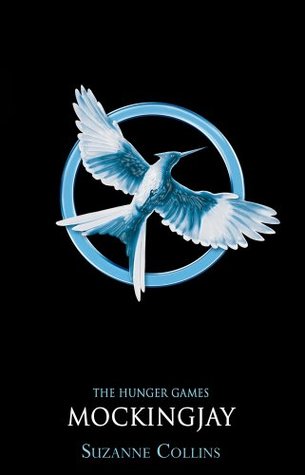
Mockingjay by Suzanne Collins (Hunger Games #3)
After watching the Catching Fire film, I was extremely keen to pick up Mockingjay and find out what happens to all of the characters in the final volume of the trilogy. My expectations were high, as I enjoyed The Hunger Games and simply loved Catching Fire, which I thought was the better book of the two. Be warned: there are spoilers in this review.
Mockingjay starts almost right where Catching Fire left off, with Katniss settling into District 13 and coming to terms with the destruction of her home district, 12. Peeta has been captured by the Capitol, although Gale has managed to rescue Katniss' mother and Prim and bring them to 13. Katniss is supposed to be playing the role of the figurehead of the revolution, but she is uneasy with the implications of this and struggles with what she should do. Meanwhile, the war rages on and it becomes apparent that Peeta is being tortured under the authority of President Snow, maybe even beyond recognition.
I had mixed feelings about Mockingjay. I so wanted to like it, and it did have many positive elements, but ultimately I closed the book feeling a bit let down. To start with the positives; I enjoyed seeing what District 13 was like and the military fashion in which the people there had prepared themselves for war with Snow. I like that Collins didn't shy away from the brutality of war, and that there were quite a few darker scenes included, especially later in the book. War is merciless, and Collins most certainly gets that message across. Katniss' confusion at what role she should play came across as genuine, and it felt realistic for someone who may have had a big role to play symbolically, but who hadn't been involved in any strategic planning etc. I'm glad Collins didn't go down the route of having a super-Katniss save the world. And the twist where Katniss shoots someone different at the end was clever indeed, I did not see that coming!
Unfortunately, there were negatives to go alongside these positives. Plot-wise, I liked that Peeta had been tortured in such a way to corrupt his memories and turn him against the rebels. However, after all these detailed passages about how new and permanent this hijacking torture method was, he seemed to recover at crucial points pretty conveniently and quickly. Also, Katniss had a tendency to get herself injured at key moments, which means that too often Collins told us what happened rather than showed us. Katniss is acquitted at the end and all that gets is a paragraph from Haymitch - I wanted to actually see it happen and I was frustrated with the action scenes being cut off so abruptly. The pods in the city were just silly and felt like an unnecessary nod to the earlier Hunger Games plots. But most of all, although I liked that war was shown as being brutal, Collins did too much without enough impact. I wanted to feel the deaths and I just didn't, and I never felt the emotion of being in a war properly.
On the whole, Mockingjay is still a good book. It was certainly a page-turner and I did enjoy it, it was just a bit of a let down after how strong the previous two volumes in the trilogy were. It's worth picking up to find out what happens in the end, but be prepared that it may not be as amazing as you are hoping.
Source: Personal copy
First Published: 2011
Score: 3.5 out of 5
Mockingjay starts almost right where Catching Fire left off, with Katniss settling into District 13 and coming to terms with the destruction of her home district, 12. Peeta has been captured by the Capitol, although Gale has managed to rescue Katniss' mother and Prim and bring them to 13. Katniss is supposed to be playing the role of the figurehead of the revolution, but she is uneasy with the implications of this and struggles with what she should do. Meanwhile, the war rages on and it becomes apparent that Peeta is being tortured under the authority of President Snow, maybe even beyond recognition.
I had mixed feelings about Mockingjay. I so wanted to like it, and it did have many positive elements, but ultimately I closed the book feeling a bit let down. To start with the positives; I enjoyed seeing what District 13 was like and the military fashion in which the people there had prepared themselves for war with Snow. I like that Collins didn't shy away from the brutality of war, and that there were quite a few darker scenes included, especially later in the book. War is merciless, and Collins most certainly gets that message across. Katniss' confusion at what role she should play came across as genuine, and it felt realistic for someone who may have had a big role to play symbolically, but who hadn't been involved in any strategic planning etc. I'm glad Collins didn't go down the route of having a super-Katniss save the world. And the twist where Katniss shoots someone different at the end was clever indeed, I did not see that coming!
Unfortunately, there were negatives to go alongside these positives. Plot-wise, I liked that Peeta had been tortured in such a way to corrupt his memories and turn him against the rebels. However, after all these detailed passages about how new and permanent this hijacking torture method was, he seemed to recover at crucial points pretty conveniently and quickly. Also, Katniss had a tendency to get herself injured at key moments, which means that too often Collins told us what happened rather than showed us. Katniss is acquitted at the end and all that gets is a paragraph from Haymitch - I wanted to actually see it happen and I was frustrated with the action scenes being cut off so abruptly. The pods in the city were just silly and felt like an unnecessary nod to the earlier Hunger Games plots. But most of all, although I liked that war was shown as being brutal, Collins did too much without enough impact. I wanted to feel the deaths and I just didn't, and I never felt the emotion of being in a war properly.
On the whole, Mockingjay is still a good book. It was certainly a page-turner and I did enjoy it, it was just a bit of a let down after how strong the previous two volumes in the trilogy were. It's worth picking up to find out what happens in the end, but be prepared that it may not be as amazing as you are hoping.
Source: Personal copy
First Published: 2011
Score: 3.5 out of 5
Tuesday, 22 October 2013
Oryx and Crake by Margaret Atwood
Snowman is possibly the only human left in a post-apocalyptic world. He lives alongside the Children of Crake, who have multi-coloured skin, live entirely off vegetation no human could digest, and give off a citrus scent. But it wasn't always like this. Snowman used to be Jimmy, the son of a scientist who worked at a corporation specialising in splicing different parts of animals together to create entirely new beings. For example pigoons, who contain multiple organs that can be harvested simultaneously for human transplantation. Bought up in a privileged class, in a Compound away from the chaos of the rest of the world, Jimmy meets Glenn (Crake), a genius with his own ideas for the future. Whilst Jimmy seems destined for mediocrity, Crake is head-hunted by different corporations and drags Jimmy along on his journey to the highest reaches of the biotechnology world. Both fall in love with Oryx, a mysterious girl from the pleeblands who they first come across on a child pornography website. Through fragments of the past, we slowly build up an account of the apocolapyse and the creation of the Children of Crake.
Wow, what a book! Oryx and Crake had me captivated from the opening chapter and honestly, I was simply stunned by just how good and clever it was. I could not read it fast enough and I couldn't stop thinking about the dystopian society Atwood had created, even when I wasn't actually reading it. Take my word for it, this is an amazing, amazing book.
What makes it so good is that Atwood combines the cleverness of her dystopian society and apocalypse with a fast moving plot (that's only revealed in fragments) and interesting characters. Little clues are sprinkled throughout the chapters and it's only when you get near the end and everything comes together that you realise just how clever the whole thing is. There's a lot of dystopia around at the moment, but you'll be hard pressed to beat the dystopian society that Atwood creates. I can believe that bio-technology will lead to us altering the genetic make-up of different creatures and even creating new ones altogether. The role of the internet in society has been carried to the extreme, to the point where live executions, assisted suicide and child pornography are all readily available. As sad as it is, this isn't too much of a stretch to believe either. I can also believe that the privileged classes would increasingly segregate themselves in a more violent world, leaving the poorer elements of society to suffer in isolated areas. Atwood's dystopia is mighty depressing, but it's just believable enough to make it genuinely scary.
Crake is a fabulous character too. We see him through Jimmy's rather gullible, easily led eyes, so the clues to his real personality and motivations are few and minor. Jimmy is a good main character in the sense that he is easy to relate to, as he isn't a distant genius like Crake. Although Oryx doesn't necessarily add too much to the plot, the information about her past is fascinating and helps to build up our vision of the society.
What I am basically saying is that if you haven't read this book, you need to! It took me two days and I would have done it in one, given the opportunity. I have already informed my husband that I will be most disappointed if The Year of the Flood and Madaddam are not in my stocking come Christmas Day! Go and read this book!
Source: Personal Copy
First Published: 2003
Score: 5 out of 5
Wow, what a book! Oryx and Crake had me captivated from the opening chapter and honestly, I was simply stunned by just how good and clever it was. I could not read it fast enough and I couldn't stop thinking about the dystopian society Atwood had created, even when I wasn't actually reading it. Take my word for it, this is an amazing, amazing book.
What makes it so good is that Atwood combines the cleverness of her dystopian society and apocalypse with a fast moving plot (that's only revealed in fragments) and interesting characters. Little clues are sprinkled throughout the chapters and it's only when you get near the end and everything comes together that you realise just how clever the whole thing is. There's a lot of dystopia around at the moment, but you'll be hard pressed to beat the dystopian society that Atwood creates. I can believe that bio-technology will lead to us altering the genetic make-up of different creatures and even creating new ones altogether. The role of the internet in society has been carried to the extreme, to the point where live executions, assisted suicide and child pornography are all readily available. As sad as it is, this isn't too much of a stretch to believe either. I can also believe that the privileged classes would increasingly segregate themselves in a more violent world, leaving the poorer elements of society to suffer in isolated areas. Atwood's dystopia is mighty depressing, but it's just believable enough to make it genuinely scary.
Crake is a fabulous character too. We see him through Jimmy's rather gullible, easily led eyes, so the clues to his real personality and motivations are few and minor. Jimmy is a good main character in the sense that he is easy to relate to, as he isn't a distant genius like Crake. Although Oryx doesn't necessarily add too much to the plot, the information about her past is fascinating and helps to build up our vision of the society.
What I am basically saying is that if you haven't read this book, you need to! It took me two days and I would have done it in one, given the opportunity. I have already informed my husband that I will be most disappointed if The Year of the Flood and Madaddam are not in my stocking come Christmas Day! Go and read this book!
Source: Personal Copy
First Published: 2003
Score: 5 out of 5
Friday, 25 March 2011
The Island of Doctor Moreau by H.G. Wells
I really want to love sci-fi. I love the ideas behind sci-fi books but usually when I get around to reading the actual books, I'm disappointed. As the only sci-fi book I've ever really enjoyed is The War of the Worlds, I decided to give The Island of Doctor Moreau a go.
Synopsis: Edward Prendick is stranded on an island with the sinister Doctor Moreau, who uses a painful process of vivisection, transfusions and classical conditioning to 'humanise' animals, turning them into beasts that can walk and talk.
This was obviously a book with many different levels. On the most simple level, it was a very good story with lots of action. Although it was easy for the modern reader to guess what was happening very early on and to guess how things would turn out, that probably wouldn't have been true for when the book was first published.
On to the more complex levels - much of the text seemed to be an argument about nature versus nurture. Dr Moreau altered the brains and bodies of the animals but with time their animal instincts started to win against the new human ones. Wells also seemed to be making the same point about human character.
I really enjoyed the science parts, especially when Dr Moreau was having his long monologue about why he would do that to animals and how he did it. It was definitely part Dr Mengele but some of his remarks foreshadowed science - for example that the brain is more plastic than the body and that the brain can be 'retrained'. I studied neuroscience at university so the geek in me loved those parts.
One criticism I would make is that it was very much an 'idea' or 'issue' book, at the expense of story and character. Prendick is just a plot device to expose Moreau to the reader, not a real fully formed person. Although the story is easy and enjoyable to read with lots of action, it is very simple without many arcs.
Verdict: I sci-fi book I actually really enjoyed!
Score: 4 out of 5
Synopsis: Edward Prendick is stranded on an island with the sinister Doctor Moreau, who uses a painful process of vivisection, transfusions and classical conditioning to 'humanise' animals, turning them into beasts that can walk and talk.
This was obviously a book with many different levels. On the most simple level, it was a very good story with lots of action. Although it was easy for the modern reader to guess what was happening very early on and to guess how things would turn out, that probably wouldn't have been true for when the book was first published.
On to the more complex levels - much of the text seemed to be an argument about nature versus nurture. Dr Moreau altered the brains and bodies of the animals but with time their animal instincts started to win against the new human ones. Wells also seemed to be making the same point about human character.
I really enjoyed the science parts, especially when Dr Moreau was having his long monologue about why he would do that to animals and how he did it. It was definitely part Dr Mengele but some of his remarks foreshadowed science - for example that the brain is more plastic than the body and that the brain can be 'retrained'. I studied neuroscience at university so the geek in me loved those parts.
One criticism I would make is that it was very much an 'idea' or 'issue' book, at the expense of story and character. Prendick is just a plot device to expose Moreau to the reader, not a real fully formed person. Although the story is easy and enjoyable to read with lots of action, it is very simple without many arcs.
Verdict: I sci-fi book I actually really enjoyed!
Score: 4 out of 5
Saturday, 20 November 2010
The Hitchhiker's Guide to the Galaxy by Douglas Adams
Last Christmas when I received my Sony Reader, it came with the first chapter of Hitchhiker's Guide to the Galaxy as a teaser. Much to my surprise, I really enjoyed it and decided to read the whole book when I got a chance. Almost a year later, I finally got around to it!
Synopsis: Arthur Dent is saved by his friend Ford when the Earth is completely destroyed to make way for an intergalactic bypass. With only the interactive Hitchiker's Guide to the Galaxy for help, they find themselves caught up in a series of highly improbable adventures.
Score: 3 out of 5
First off, I very much enjoyed the irony and humour of the book. There was one section in particular when Adams was satirising philosophers that had me genuinely laughing out loud. The humour added to the pace of the book nicely, keeping things ticking along without getting boring. The main character, Arthur, was an "everyman" and very easy to relate to and root for. The secondary characters were interesting too, if not fully well rounded.
There was just something about the book that put me off - it seemed crammed full of in-jokes that people enjoy because they are an in-jokes rather than because they are actually funny. Like some kind of exclusive club. Yes, it was slightly amusing for the answer to life, the universe and everything being '42' but I just didn't get why it has become such a big thing in popular culture.
In some ways, Adams was very clever in the book. The Hitchhiker's guide, an interactive book where users add their own content, could be thought of as foreshadowing Wikipedia (and Adams was writing back in 1972). If only his plot showed the same creativity too. The improbability generator just seemed like a very convenient way to get the characters out of some very sticky situations without actually thinking it through. If there are any massive fans out there, please don't hate me for this!
So whilst the book was a light, enjoyable read, it's not one I would read again, and nor will I be reading any of the sequels. It's rare for me to say this, but I much preferred the film adaptation to the book.
Synopsis: Arthur Dent is saved by his friend Ford when the Earth is completely destroyed to make way for an intergalactic bypass. With only the interactive Hitchiker's Guide to the Galaxy for help, they find themselves caught up in a series of highly improbable adventures.
Score: 3 out of 5
First off, I very much enjoyed the irony and humour of the book. There was one section in particular when Adams was satirising philosophers that had me genuinely laughing out loud. The humour added to the pace of the book nicely, keeping things ticking along without getting boring. The main character, Arthur, was an "everyman" and very easy to relate to and root for. The secondary characters were interesting too, if not fully well rounded.
There was just something about the book that put me off - it seemed crammed full of in-jokes that people enjoy because they are an in-jokes rather than because they are actually funny. Like some kind of exclusive club. Yes, it was slightly amusing for the answer to life, the universe and everything being '42' but I just didn't get why it has become such a big thing in popular culture.
In some ways, Adams was very clever in the book. The Hitchhiker's guide, an interactive book where users add their own content, could be thought of as foreshadowing Wikipedia (and Adams was writing back in 1972). If only his plot showed the same creativity too. The improbability generator just seemed like a very convenient way to get the characters out of some very sticky situations without actually thinking it through. If there are any massive fans out there, please don't hate me for this!
So whilst the book was a light, enjoyable read, it's not one I would read again, and nor will I be reading any of the sequels. It's rare for me to say this, but I much preferred the film adaptation to the book.
Friday, 15 October 2010
The Drowned World by J.G. Ballard
I don't particularly read sci-fi (though I loved Michael Moorcock's 'Behold the Man') and got this book as my free book in a 3 for 2 deal at Waterstone's. I just thought it sounded worth a shot. It's my first Ballard.
Synopsis: Fluctuations in solar radiation mean that the ice-caps have melted and temperatures reach up to 150C. Most of the cities of the Northern Hemisphere are submerged in tropical lagoons populated with prehistoric animals and massive bugs of all kinds. The main character, Kerans, is a scientist sent to study the animal life forms but soon gets caught up with all kinds of people.
Score: 2 out of 5.
I liked the premise of this book, and indeed the initial third or so of it was amazing. I liked the scenario of the increase in temperature leading to all of these prehistoric animals in a kind of de-evolution and thought I was in for a fantastic adventure story, in the style of Conan Doyle's 'Lost World'. I wanted battles with giant iguanas and crocodiles as enormous as blue whales!
But there wasn't actually much of a story at all. The main character was very passive (intentionally) and the book just kind of drifted with no purpose. I get that this was because humanity and the world as a whole were drifting with no purpose, but it didn't make for fun reading. The sections on what happens to humanity when civilisation is stripped away were interesting, and all the looting and plundering seemed applicable to life now.
The main problem for me that this book appears to have been written in a psycho-analytic time. Don't get me wrong, I did a psychology degree, but I have no time for the "collective unconscious" or "regressing to the womb" or other such Freudian arguments. Ballard seemed to be arguing that the heat was activating some kind of genetic memory we all have of the time of our ancestors, and this was captivating and entrapping the main characters, making them seek out hotter lagoons. It made no sense! If I was Kerans I wouldn't be thinking "Hmm, 150C is a little mild, I'm going to leave this nice air-conditioned scientific facility with all the food provided and venture south where it is even hotter and I will have no resources whatsoever!" Despite the shortness of the book, there was a lot of waffle about this. A bit disappointing, really.
To summarise: I liked the idea, but not enough pace or story.
Has anyone read any other books by Ballard? I want to read 'Empire of the Sun', but this one's put me off a bit!
I don't particularly read sci-fi (though I loved Michael Moorcock's 'Behold the Man') and got this book as my free book in a 3 for 2 deal at Waterstone's. I just thought it sounded worth a shot. It's my first Ballard.
Synopsis: Fluctuations in solar radiation mean that the ice-caps have melted and temperatures reach up to 150C. Most of the cities of the Northern Hemisphere are submerged in tropical lagoons populated with prehistoric animals and massive bugs of all kinds. The main character, Kerans, is a scientist sent to study the animal life forms but soon gets caught up with all kinds of people.
Score: 2 out of 5.
I liked the premise of this book, and indeed the initial third or so of it was amazing. I liked the scenario of the increase in temperature leading to all of these prehistoric animals in a kind of de-evolution and thought I was in for a fantastic adventure story, in the style of Conan Doyle's 'Lost World'. I wanted battles with giant iguanas and crocodiles as enormous as blue whales!
But there wasn't actually much of a story at all. The main character was very passive (intentionally) and the book just kind of drifted with no purpose. I get that this was because humanity and the world as a whole were drifting with no purpose, but it didn't make for fun reading. The sections on what happens to humanity when civilisation is stripped away were interesting, and all the looting and plundering seemed applicable to life now.
The main problem for me that this book appears to have been written in a psycho-analytic time. Don't get me wrong, I did a psychology degree, but I have no time for the "collective unconscious" or "regressing to the womb" or other such Freudian arguments. Ballard seemed to be arguing that the heat was activating some kind of genetic memory we all have of the time of our ancestors, and this was captivating and entrapping the main characters, making them seek out hotter lagoons. It made no sense! If I was Kerans I wouldn't be thinking "Hmm, 150C is a little mild, I'm going to leave this nice air-conditioned scientific facility with all the food provided and venture south where it is even hotter and I will have no resources whatsoever!" Despite the shortness of the book, there was a lot of waffle about this. A bit disappointing, really.
To summarise: I liked the idea, but not enough pace or story.
Has anyone read any other books by Ballard? I want to read 'Empire of the Sun', but this one's put me off a bit!
Subscribe to:
Posts (Atom)