Showing posts with label egypt. Show all posts

Monday, 3 June 2013

Sipping from the Nile by Jean Naggar


Sipping from the Nile was my first pick from my book jar, which is basically a jar that contains folded up bits of paper with books from your TBR pile written on.  When you feel overwhelmed with choice, you select randomly from the book jar, to take the decision out of your hands (you can see the original idea at Alex in Leeds' blog). All over my half term break, I was extremely indecisive when it came to reading; I kept picking things up, reading a few pages then putting them down again and it was getting annoying! So I decided to take charge of the situation by reading one book from my book jar then moving on to my Classics Club spin pick.

Jean Naggar comes from a wealthy Jewish family who had lived in Cairo for centuries.  The early parts of Sipping from the Nile deal with an extravagant, sheltered childhood, as Jean and her family live comfortably in a large house overlooking the Nile.  Servants take care of her every material need, she is sent to a prestigious English boarding school and the family summer in Europe, away from the stifling Egyptian heat.  The initial chapters are full of Sephardic Jewish rituals and there's an overwhelming sense of a large and close-knit family.  But after the Suez crisis in 1956, when Britain, France and Israel tried to stop the nationalisation of the vital Suez Canal, the atmosphere in Egypt changes for Jean's family.  After surviving the horrors of World War Two, the Jewish Egyptian population comes under threat due to anti-Israeli and anti-Jewish sentiment.  Eventually, Jean's family is forced to leave Egypt after some danger and the world of her childhood vanishes forever.

Sipping from the Nile is a very well written memoir.  Naggar conjures up the atmosphere of upper class childhood perfectly and the love she clearly has for Egypt comes off of every page.  Although the chapters dealing with boarding school and time abroad are also well written, the memoir truly comes to life when Naggar is writing about Egypt and the traditions of her family.  I learned a lot about Sephardic Jews and felt like I was completely immersed in Naggar's world, a feeling that was helped by the photographs scattered through each chapter.  

I must admit that whilst I was reading, I spent a lot of time waiting for the Suez crisis to turn up.  For a book whose by-line is 'my exodus from Egypt', this event doesn't actually occur until quite late in the game, at least two thirds of the way through.  Whilst the initial section dealing with her childhood felt leisurely and a bit over-long, the sections dealing with how it felt to leave Egypt behind could have been explored further.  I appreciated the final chapters where Jean and her own family return to Egypt, but I wanted to know more about the intervening years, more about what it felt like to be unwelcome in your home land.

Sipping from the Nile is a decent, well written memoir about an interesting community.  I enjoyed it, but it didn't set my world on fire.

Source: Personal copy (kindle)
First Published: 2012
Score: 3.5 out of 5

Monday, 25 March 2013

The Rape of the Nile by Brian Fagan


"During the past two thousand years Ancient Egypt has effectively been destroyed, both by the Egyptians themselves and by a host of foreigners, many of them arriving in the Nile Valley in the name of science and nationalism.  The loss to archaeology is incalculable, that to Egyptian history even more staggering.  As a result of the looting and pillage of generations of irresponsible visitors, the artifacts and artistic achievements of the Ancient Egyptians are scattered all over the globe, some of the most beautiful and spectacular of them stored or displayed thousands of miles from the Nile." 
(From pages 11-12)

Ever since I was a little girl, I've loved learning about Ancient Egypt.  I remember trips to the British Museum with my Mum to gawp at the Rosetta stone and writing my name in hieroglyphs at primary school.  Later, at university, I studied Egyptian language as part of a linguistics unit and I've read countless books on the Ancient Egyptians themselves.  The story of the European rediscovery of the Nile Valley in the eighteenth and nineteenth century is an exciting one, full of Indiana Jones type figures, such as Giovanni Belzoni.  But in The Rape of the Nile, Fagan challenges the actions of Western treasure seekers and archaeologists.  Who gave them the right to remove the artifacts from Egypt and keep them in foreign museums?

It's hard to argue with Fagan's arguments as there is some shocking behaviour on the part of early Egyptologists in the book.  Whilst Fagan does cover tomb robbing and looting through Ancient Egyptian to Islamic times, the real pillage only starts with the arrival of Westerners in the form of Napoleon's expedition.  We read about tombs being blown open with dynamite (and a near miss with one of the great pyramids), reliefs scraped off walls and my personal favourite,  a sarcophagus being chopped in two as the whole thing was harder to transport.  The early treasure seekers had little more than the desire to acquire exotic things, so there was no attempt at scientific recording or archaeology.  So much was lost.

Fagan does balance his argument with stories of the pioneers who tried to make archaeology in Egypt more scientific and less about the treasure seeking, but it all comes too little too late.  Egypt doesn't get a fully functioning national museum until late in the day and the patronising 'we can look after them better than you' attitude continues to this day.  I read an early edition of this book (1977) but I know there is a more up to date one out there - it would be interesting to see what Fagan makes of the modern argument that Western museums should return some of their treasures to Cairo, put forward by people like Hawass.  However, the benefit of reading the 1977 edition (pulled out of the reserve stacks of the library) was that it was a beautiful copy, hard back with illustrations on most pages. 

I loved this book, but I can appreciate that some people might find it a little dry.  Fagan has an engaging writing style but the book is fairly detailed and you would need a keen interest in Egyptology before starting in order to enjoy it properly.  It's one I would recommend though, it's got a good balance of the history of what happened to Egypt in modern time and of the moral issues surrounding Egyptology.

Source: Library
First Published: 1975
Score: 4.5 out of 5

Read Alongside:
Egypt: How A Lost Civilization was Rediscovered by Joyce Tyldesley (link to goodreads): I read this one pre-blogging and it's a great introduction to the big personalities in the European rediscovery of Egypt, Carter (who found Tut), Champollion (who deciphered hieroglyphs) and Belzoni (who collected the treasures of the British Museum).

Thursday, 12 July 2012

Jasmine Nights by Julia Gregson


Saba Tarcan is a half-Turkish girl living in Wales during World War Two who dreams of using her voice to escape her mundane surroundings.  She auditions for ENSA and is delighted to be offered the chance to travel to the Middle East and be a part of performances to boost troop morale in the desert, even though her father threatens to disown her.  Saba plunges in head first, eager to soak up all the experiences life has to offer her, including a romance with injured fighter pilot Dom.  When she is approached by the secret service for a mission she is uniquely qualified for, Saba is seduced by the idea of doing something exciting and important, oblivious to the danger the offer also entails.  But life during war is not a fairy tale, and Saba and Dom are both in for some hard lessons.

Jasmine Nights is all about the naivety of youth.  Saba and Dom both think they are untouchable, that nothing will happen to them, that hardships and suffering are for others but never for themselves.  They both throw themselves willingly into dangerous situations, thinking of the glamour and adventure rather than the consequences.  Saba is entranced by the glitter and shine of wartime Egypt, the praise she receives for her voice, the beautiful dresses and the chance to finally live her dream.  She ignores warnings given by everyone around her and behaves as if her life is a Hollywood movie in which she has the starring role.  Dom has already been shot down once but willingly requests a move to an active company so he can continue to fly.  They fall completely, dramatically in love and trust in a happy ever after ending.

The first half of the novelwas like this and I was starting to question whether Jasmine Nights would be a book for me.  Where was the grit?  The realism?  But as I read into the second half and Saba became more involved with her spying mission, the grit gradually seeped in and both Saba and Dom learned some hard lessons indeed.  The technique of making the first half so light and glamourous was a success as it provided a great contrast with the events nearer the end of the book.  The final sections were gripping to read and I think Gregson was clever to structure the novel in the way she did.

Overall, I did think there was too much romance.  I don't mind reading about characters falling in love and it was well written, but in this book what I really wanted to read about was Saba's role in the secret service.  I knew that women served as spies during World War Two and I find this completely fascinating.  I wanted the character of Mr Cleeve, Saba's agent/boss, to be further developed, especially his reaction in the aftermath of events at the end of the book.  For someone intelligent, Saba shows remarkably little curiosity about the secret service - I wanted her to find out more so I could be in on the secret too!  Altering the balance slightly away from romance would have made this novel work better for me.

All in all, I enjoyed Jasmine Nights. The setting of WWII Egypt was of course wonderful and I was satisfied with the ending.  I just found the first half a bit too light and fluffy and a bit too long.

Source: From the publisher (Simon and Schuster) via Netgalley
First Published: 5th June 2012
Score: 4 out of 5

Wednesday, 28 September 2011

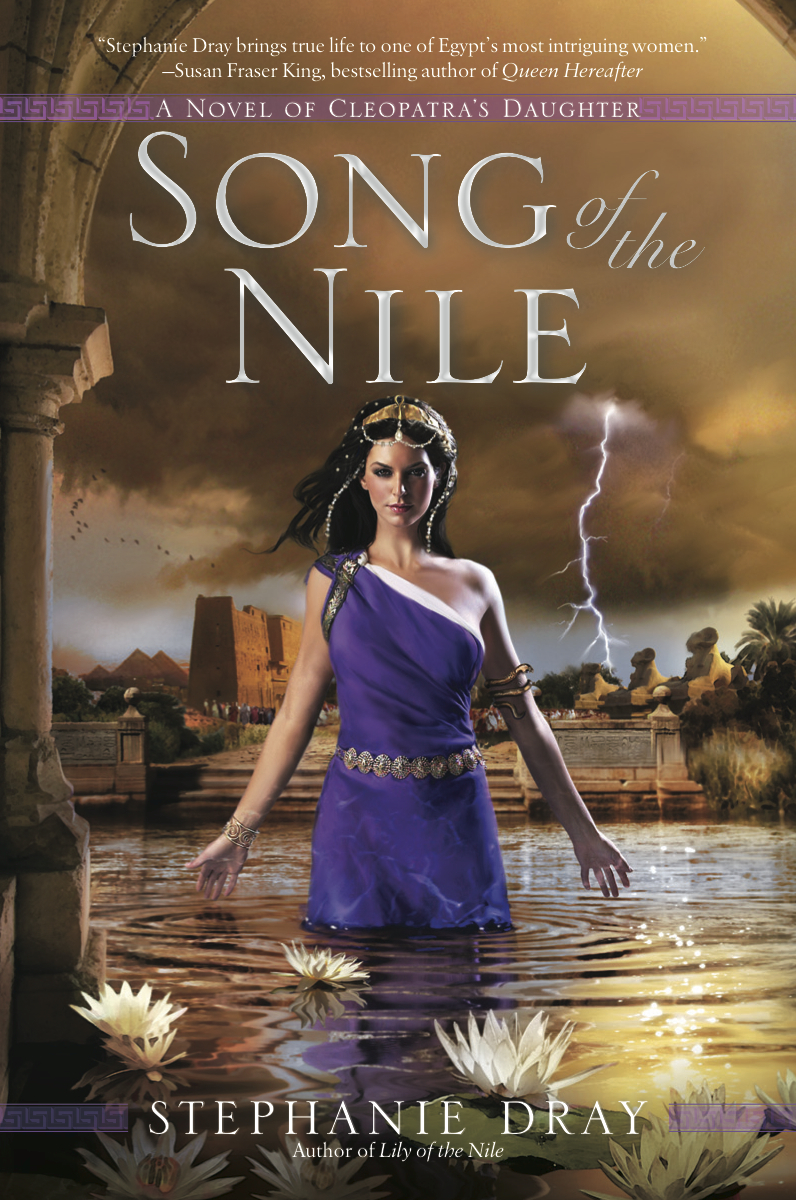
Song Of The Nile by Stephanie Dray

Song of the Nile is part two in Stephanie Dray's historical fiction series about Selene, Cleopatra's daughter.  I read part one, Lily of the Nile, recently (review) and Song of the Nile picks up the story with Selene's marriage to Juba, which leads to her becoming Queen of Mauritania.   But her ultimate ambition is still to become Queen of Egypt and Selene must plot harder than ever if she is to have any chance of achieving it.

Having Lily of the Nile fresh in my mind meant that it was easy for me to make comparisons between the two.  I felt that both the writing and the characterisations were much stronger in Song of the Nile.  Selene goes through some quite unpleasant experiences during the course of this book, and I thought Dray did a good job of capturing the emotions that would arise.  The court politics and intrigue were dealt with realistically.

I also very much enjoyed Selene's characterisation.  Too often I read historical fiction novels in which the royal characters are depressingly normal and humble.  But Selene was a proper Queen; she was haughty, spoilt, ambitious, demanding and not afraid to show it.  It was refreshing because that's probably how she was in real life.

Despite the good writing and characterisations, I did have some issues with the story.  Dray states in her introduction that this is more a work of fiction than a fictional biography, but I found some of the events unbelievable.  And I'm not talking about the supernatural devices, but the remarkable coincidences to bring some of the main characters together at the right time.  I just don't believe that Helios would have always been able to find Selene.  When I feel that way about a book, it's hard for me to get over it and enjoy the other elements.

So this is a bit of a mixed review.  I thought the book started off strong but soon become a bit over the top.  I do think Dray is a good writer with a talent for characters, but ultimately this wasn't the book for me.

Score: 2.5 out of 5
Source: From the author, in exchange for an honest review.

Friday, 17 December 2010

Ramesses by Joyce Tyldesley

I chose this book because I love Egypt.  I've loved it ever since I first learned about it back in my primary school days, and now, many trips to the British Museum later, I still love it.  I also get to teach it for an entire term every spring, and it's my favourite thing to teach.  I chose this particular author as I've read one of her books before (a tie-in to a BBC series about Egyptology pioneers) and found it to be both informative and well written.

Synopsis: Joyce Tyldesley presents what history knows about Ramesses, one of Egypt's most famous pharoahs.  Using a number of different sources, she separates myth from fact.

Score: 2 out of 5

You know how some non-fiction books are so well written and lively and engaging that you feel like you're reading a fantastic work of fiction and you just can't put them down?  This book wasn't like that.  In fact, this book was the opposite - it managed to make a fascinating topic that I already had some knowledge of seem dull and it was a battle to get to the end.

Part of the problem was that Tyldesley had organised the book thematically, with chapters such as 'Ramesses the Husband' and 'Ramesses the Warrior'.  This meant there was no overall arc to the book, making it hard to place the various events and leaving me with no clear impression of what Ramesses was actually like.  Whilst I appreciate that much about his life is not known, I would still rather have had what is known organised chronologically.

The book also couldn't decide whether it wanted to be academic or popular non-fiction.  The other book of hers I've read Egypt: How a Lost Civilisation was Rediscovered was clealy supposed to be a popular non-fiction book.  There was an attempt to make the writing lively.  Ramesses was different; there were notes at the end of each chapter, a further reading list, and way too much scholarly detail.  At one point she spent about 30 pages outlining the names and lives of all of Ramesses children, grandchildren, and even great-grandchildren.  And the history of all his scribes, advisers etc were also included, down to their position of birth and where they died.  That kind of stuff is too much for the interested but not that knowledgeable reader.

All this is not to say there was nothing I enjoyed about the book.  There was some interesting facts about his family life (it seems he married practically all of his female relations) and about the way society in Egypt was organised.  Ramesses was also a master of propaganda, and modern politicians could learn from him.  Even now he is remembered as a great warrior pharaoh, but his 'victories' seemed to have been largely made up.  And his famous statues either plagarised or stolen from previous pharoahs.

To sum up: only really for the serious Egyptologist or those that enjoy very winding family trees.

Thursday, 16 December 2010

A Bit of Poetry

I'm reading about Egypt at the moment and it's reminded me of one of my favourite poems.  I don't read much poetry in general, but when I find a poem I like it really stays with me.


Ozymandias by Percy Bysshe Shelley

I met a traveller from an antique land
Who said: two vast and trunkless legs of stone
Stand in the desert.  Near them, on the sand,
Half sunk, a shattered visage lies, whose frown,
And wrinkled lip, and sneer of cold command
Tell that its sculptor well these passions read
Which yet survive, stamped on these lifeless things,
The hand that mocked them, and the heart that fed:
And on the pedestal these words appear: 'My name is Ozymandias, king of kings:  Look on my works, ye mighty, and despair!'
Nothing beside remains.  Round the decay
Of that colossal wreck, boundless and bare,
The lone and level sands stretch far away.