Thursday, 9 August 2012

The Fellowship of the Ring by J.R.R. Tolkein

I posted earlier in the week about my initial experience with Lord of the Rings, how I found it slow paced and too broad after falling in love with the films.  With this reread, I approached the book differently and stopped expecting it to have the same qualities as the film.  I was expecting a slower pace and actually, I was looking forward to finding out all the little facts about Middle Earth and it's history that Tolkien likes to sprinkle through his books.

Most people are familiar with the story, so there will be spoilers in this post.  In The Fellowship of the Ring, the first volume of Lord of the Rings, Frodo the Hobbit is left a powerful ring by Bilbo.  Gandalf the wizard thinks he has an idea of what the ring is but is captured by the person he seeks advice from.  This leaves Frodo and his friends with the responsibility of getting away from Sauron's servants, who want to claim the ring for their master.  On their way, they are helped by a "fellowship" of creatures, most notably Aragon, a man descended from Kings.  But the ring begins to cause tension in the group and ultimately it is Frodo alone who must decide what to do with his burden.

My first reaction on finishing the book was "I missed so much last time!".  I honestly think I spent too long hoping for action that I missed much about the characters and messages of the book; I rushed it when really this is a book to read slowly.  Although there is a story and the characters are engaging, this novel is all about the world that Tolkien has created.  Reading slowly, I could picture all of the wonderful settings (Lothlorien especially) and in that sense, it was a magical experience.

There's a lot of wisdom in this book, and a lot of messages that are great to learn.  Fellowship is about trying your best even when the chance of success is slim and doing the right thing in difficult circumstances.  It's about accepting that life isn't fair and that even though many things are beyond your control, you can choose the right course and make the most of what you have.  It's about adventure and openness and above all, being a decent human being.  Some of my favourite parts:

"The world is indeed full of peril, and in it there are many dark places; but still there is much that is fair, and though in all lands love is now mingled with grief, it grows perhaps the greater." (Haldir).

" 'I wish this need not have happened in my time,' said Frodo.
'So do I,' said Gandalf, 'and so do all who live to see such times.  But that is not for them to decide.  All we have to decide is what to do with the time that is given us.' "

I wasn't expecting this fantasy book to make me think so much about life, but it did.  It made me think about doing the right thing, about being able to look myself in the mirror at the end of the day and be proud of the choices and decisions I have made.  The easy way isn't always the right way.  So although I had some criticisms of the book (not enough focus on characters, it took too long for the hobbits to reach Rivendell), I loved the essence of it, if that makes sense?  I'm very glad I picked it up again and took the time to read it properly.

But the songs - still not for me!  I tried, I really did, but in the end I had to skip a few.  Sorry Tolkein fans!

Source: Personal copy
First Published: 1954
Score: 4.5 out of 5

Monday, 6 August 2012

Empires of the Indus by Alice Albinia

Summary (from back cover):
The Indus rises in Tibet, flows west across India, and south through Pakistan.  For millennia it has been worshipped as a god; for centuries used as a tool of imperial expansion.  Following the river upstream and back in time, Empires of the Indus takes the reader on a voyage through two thousand miles of geography and more than five thousand years of history.


Thoughts:
It's not often I copy a summary into my reviews but in this case the back cover sums up the book perfectly.  Albinia starts in Pakistan and works her way up the course of the river, meeting the people that currently live around it and also informing us of the history of the river, from the partitioning of India right back to prehistoric times. I was very excited to start this one as travel and history are two of the non-fiction genres I enjoy and I was interested to see whether Albinia could pull off a fusion of the two.

For the most part, Empires of the Indus is a very successful book.  Albinia clearly loves her subject matter and is very well read in terms of the history of the different peoples and nations.  I must admit to enjoying the travel parts of the book more than the history parts, mainly because Albinia could speak several of the languages of the area, meaning that she could talk directly to people and present their stories.  As a woman travelling through strict Muslim and Hindu areas, she also got access to women's stories that were often just as fascinating as the men's.  Albinia writes about what it is like to wear a burqa, to travel through the lawless regions of Pakistan, to arrive at a place without knowing anyone at all and having nowhere to stay.  She is an adventurous traveller and one of the themes of the book was how hospitable all of her hosts were, no matter where she went.  Even in the "terrorist breeding grounds" of Pakistan and Afghanistan, Albinia was greeted warmly and people were always keen to welcome her to stay in their homes and share their food with her.  Would that happen in the West?

As I read this book, I realised how little I knew about some of the countries featured in it, especially Pakistan.  I had always imagined Pakistan as a solely Muslim country.  But Albinia uncovers other sides of Pakistan, for example the Sheedi, descendants of a freed African slave, that blend Islam with their own cultural traditions.  I learned that perhaps I had been stereotyping some countries in the area, and that the real situation is far more complex than I had realised.  I enjoyed the chapter that included a history of Sikhism as this is something I knew relatively little about.

Some of the history was a little dense.  I knew a bit about the general history of the area before starting this but did find it hard to keep some of the rulers and invaders straight.  Although the book is roughly 300 pages long, it felt a lot longer at times as some chapters were heavy on the history and required a mental slog to get through.  I became used to this as I read through the book and consequently found the later chapters 'easier' than the first.

I'm going to end with my favourite passage from the book;
"I press my nose against the burqa and stare out into the world.  I see a young man with a pink rose tucked behind his ear sitting on a boulder, his AK47 lovingly upholstered in blue and pink stickers.  I see sand-coloured fortresses, the sky cloudless blue behind them.  I see graveyard after graveyard fluttering with flags of jihadi martyrs.  I see a gun on every male shoulder.  And I see no women at all - not grannies in burqas, not even a little girl."

Source: Library
First Published: 2008
Score: 4 out of 5

Saturday, 4 August 2012

On Rereading Lord of the Rings


The first book I am going to read for the Classics Club is J.R.R. Tolkien's The Fellowship of the Ring, first part of Lord of the Rings (I know technically it's all one book but I am counting them as three because I can!).  This will be a reread for me, the second time I've read it and I'm hoping to enjoy it a lot more than I did the first time.

My history with Lord of the Rings started when I was about 10 or so.  My Mum is a reader too and she recommended that I try The Hobbit, as she enjoyed it as a child.  Her previous recommendations of classics had led me to some of my favourites, A Little Princess and The Secret Garden, so I was excited to try it.  But I just couldn't get into it.  Over the next few years I kept checking it out of the library every now and again, hoping to finally get what all the fuss was about, but I would always get about fifty or so pages in and then be defeated.

I think part of the problem was that The Hobbit was my first try at fantasy.  I never was into big, world-building epics as a child so the book was completely out of my comfort zone.  I also was conscious that it was an 'important' book and felt a bit guilty for not immediately liking it or being able to read it, which didn't help.  Eventually I stopped trying with The Hobbit and thought that was the end of my experience with Tolkien.

When the films came out, I didn't go to see them or get caught up in the hype, I just assumed they weren't for me.  But then when I met my boyfriend (now husband) at 17, I soon found out he was a big fan of the films.  After much nagging and stalling, I finally watched all three in the extended version and was completely swept away by them.  It took me some time to get used to the world building and different creatures (I still didn't read fantasy then) but I just loved the story behind them.  I've seen the films countless times now and think of them as perfect comfort watching.

So it was with high expectations that I started Fellowship of the Ring the first time I picked it up.  And coming from the films, I was honestly a bit disappointed (don't shoot me, Tolkein fans!).  I found the book frustratingly slow moving and didn't appreciate the passages about nature or the history of the different creatures - I just wanted action!  I finished Fellowship, and indeed the whole trilogy but my overall impression was underwhelming, I think I have them all as a 3 out of 5 on goodreads.  If you asked me what was better, books or films, I would have said films.

So the time is ripe for a reread.  I'm changing my expectations as I go into this book, I know it will be more slow moving than the films, and having read a lot more fantasy since my first try, I'm looking forward to reading more about Middle Earth in general rather than just the central characters.  I don't mind a bit of meandering.  Unfortunately I will never be able to picture the characters as anything other than their film versions but I'm hoping to experience the wider scope of the books properly.  Wish me luck!

I know these books are special to a lot of people, what's your experience with Lord of the Rings?

Friday, 3 August 2012

A Brighter Fear by Kerry Drewery


Don't judge this one by the cover.  It may look bright and cheerful but A Brighter Fear is a hard-hitting account of the Iraq war through the eyes of seventeen year old Lina.  We first meet Lina in Baghdad in 2003, where she is living with her father in the prelude to the American-led invasion.  Lina describes a culture of repression, where people are scared to even think negative thoughts about the regime, let alone express them ("a lifetime of being allowed no opinion but the right one").  Lina has experience of this threat as her lawyer mother was taken away by the secret service years ago and no one has heard anything about her since.  As the bombs start to fall, Lina shelters in the basement with her Papa during the night but attempts to live a normal life throughout the day.

But normal has ceased to exist.  As a Christian, Lina is shunned by her former friends as it would be dangerous for them to be seen with her.  Her father takes on a job interpreting for the US army, making him a target.  When she continues to walk around with her hair uncovered, Lina is the victim of an acid attack.  Through Lina we hear of rape, torture and see dismembered bodies abandoned by the roadside.  Interspersed with all this is the story of what happened to Lina's mother, Sacha, when she was taken by the secret police, starting with horrific torture scenes.

So A Brighter Fear isn't your average young adult novel.  I really appreciated it's boldness at setting down what the Iraqi war must have been like to actually live through.  If I had read this as a teenager, I would have found it even more shocking than I did as an adult.   I also appreciated how Drewery refrained from making this a black and white novel, she showed the shades of grey involved in the conflict.  Lina and her family hate Saddam due to what happened to her mother so initially they welcome the invasion.  But the trigger-happy soldiers and the fact that "we all look the same to them" makes Lina reconsider.  There's never any 'good guys' or 'bad guys' in the sense of the conflict and that struck me as realistic - who can be a good guy in a war situation?  Drewery writes about fear very well and we see Lina's attempts to overcome her fear, something that made her relatable;

"I was living a horror film with no end credits in sight.  But this wasn't a film, or a dream, or a story.  This was life.  And I couldn't just press the off button, or wake up, or slam the pages shut.  I had to live it."

Despite all these positive elements, I think the 'love story' between Lina and an American soldier was a mistake.  It came across as an add-on to the real story, an attempt to make the book more appealing to it's intended audience (it's even the tag-line of the novel despite it playing a minor role in the story).  I get that Lina didn't have any friends, that she would cling to any escape clause from her life, but it could have been written as a friendship rather than an impossible love story.  There are a few times where Lina and Steve manage to meet despite impossible circumstances, and these situations felt contrived.

But overall, I was pleasantly surprised by A Brighter Fear.  It was bold and direct and had a lot to say about the Iraq war without shying away from the unpleasant aspects or simplifying it.  A job well done.

Source: From Harper Collins UK, via Netgalley
First Published: 2012
Score: 3.5 out of 5

Thursday, 2 August 2012

My Favourite Classic - Dracula

The question for August over at The Classics Club is 'What is your favourite classic book?'  Like everyone else, I'm sure, I had a hard time thinking of the one classic that I like better than all the others I've read.  I loved Anna Karenina for the scope of the book and how epic it was, Emma will always be a favourite because of Emma herself, Villette by Charlotte Bronte spoke to me about the kind of person I am and I adored A Little Princess as a child.  But in the end I decided to think about which classic I revisit the most often and which gives me the most pleasure as I read it - not which classic is the most important, but which one I enjoy the most.

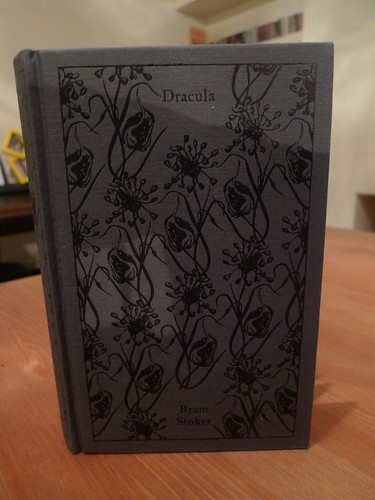
And my answer is Bram Stoker's Dracula. I have so many happy memories associated with reading this book; I remember being thirteen and curled up in the dark, frightened for Jonathan Harker trapped in Dracula's castle.  I remember using this book as a distraction during the stress of finishing my university exams.  I remember testing out my kindle with an e-copy of one of my favourite books.  I remember my husband (then boyfriend) buying me the lovely Penguin edition you see to the right and above all, I remember getting utterly caught up in the story each time I pick it up.

So what is it about Dracula that makes me love it so much?  I love the format of the book, with the different journals, letters, newspaper clippings and even a ship's log.  I find they break up the text and make it easier to relate to the different characters (I also love this about Wilkie Collins' novels).  I love that it's a bit of a sensation novel, not written to make a point about the world but simply to entertain and scare.    I enjoy the adventurous aspect of a 'band of heroes' getting together to rid the world of a horrible monster by piecing together all of the different clues.

I'm a big fan of gothic fiction anyway, but Dracula, with it's Transylvanian forests, crumbling castles and swooping bats, is the best of the genre.  It appeals to that part of us that likes to be scared.  Although Dracula isn't scary for us now as it would have been for the original readers, it's deliciously creepy and the part where Dracula crawls down the castle walls as a horrified Jonathan Harker looks on still gives me the chills.

Of course, I know that Bram Stoker never actually visited Eastern Europe and to be honest, the rest of his books are probably best avoided (and I've tried a few).  The treatment of women also leaves a lot to be desired, as 'precious' Mina finds herself overcome with men who only desire to protect her from the big bad monster even though she has lots of good ideas to contribute.  I know these things logically, but that never stops me from getting swept along with events and enjoying the story.

Dracula is my favourite classic due to the combination of horror and a classic rip-roaring adventure.  What's your favourite classic?

Wednesday, 1 August 2012

The Classics Club - My List


I've been debating joining the Classics Club for a while.  I love the idea of it and definitely want to add more classics to my reading, but I tend to react negatively to pressure and having to read certain books in a specific time frame.  With that in mind, I've chosen the most generous time frame (5 years) and restricted myself to 72 books.  I wanted to make it 70, as I like a nice round number, but I couldn't think of two to drop!  I'm not going to beat myself up about this or think of the time frame, I'm just going to use it as a spur to read (or reread) these classics as soon as possible.

Without further ado, my list:
(Titles in bold will be rereads)

1. Little Women - Louisa May Alcott
2. A Handmaid's Tale - Margaret Atwood
3. Emma - Jane Austen
4. Mansfield Park - Jane Austen
5. Northanger Abbey - Jane Austen
6. Persuasion - Jane Austen
7. Pride and Prejudice - Jane Austen
8. Sense and Sensibility - Jane Austen  
9. Peter Pan - J.M. Barrie
10. The Tenant of Wildfell Hall - Anne Bronte
11. Wuthering Heights - Emily Bronte
12. Jane Eyre - Charlotte Bronte
13. Villette - Charlotte Bronte
14. The Good Earth - Pearl Buck
15. A Little Princess - Frances Hodgson Burnett
16. O Pioneers! - Willa Cather
17. The Awakening - Kate Chopin
18. The Woman in White - Wilkie Collins
19. A Tale of Two Cities - Charles Dickens
20. Great Expectations - Charles Dickens
21. Hard Times - Charles Dickens
22. Little Dorrit - Charles Dickens
23. Oliver Twist - Charles Dickens
24. Out of Africa - Isak Dinesen
25. Crime and Punishment - Fyodor Dostoevsky
26. The Lost World - Sir Arthur Conan Doyle
27. Rebecca - Daphe Du Maurier
28. The Count of Monte Cristo - Alexandre Dumas
29. Cranford - Elizabeth Gaskell
30. Tender is the Night - F. Scott Fitzgerald
31. The Beautiful and the Damned - F. Scott Fitzgerald
32. Madame Bovary - Gustav Flaubert
33. Lord of the Flies - William Golding
34. King Solomon's Mines - H. Rider Haggard
35. Tess of D'Urbervilles - Thomas Hardy
36. The Scarlet Letter - Nathaniel Hawthorne
37. Les Miserables - Victor Hugo
38. Their Eyes Were Watching God - Zora Neale Hurston
39. Brave New World - Aldous Huxley
40. Goodbye to Berlin - Christopher Isherwood
41. Turn of the Screw - Henry James
42. The Portrait of A Lady - Henry James
43. Daisy Miller - Henry James
44. One Flew Over the Cuckoo's Nest - Ken Kesey
45. Kim - Rudyard Kipling
46. The Painted Veil - W. Somerset Maugham
47. Moby Dick - Herman Melville
48. The Bluest Eye - Toni Morrison
49. The Bell - Iris Murdoch
50. 1984 - George Orwell
51. Burmese Days - George Orwell
52. Titus Groan - Mervyn Peake
53. Gormenghast - Mervyn Peake
54. Titus Alone - Mervyn Peake
55. The Bell Jar - Sylvia Plath
56. Bonjour Tristesse - Francoise Sagan
57. Anthony and Cleopatra - William Shakespeare
58. Othello - William Shakespeare
59. The Tempest - William Shakespeare
60. East of Eden - John Steinbeck
61. Cannery Row - John Steinbeck
62. Grapes of Wrath - John Steinbeck
63. Dracula - Bram Stoker
64. The Hobbit - J.R.R. Tolkein
65. The Fellowship of the Ring - J.R.R. Tolkein
66. The Two Towers - J.R.R. Tolkein
67. The Return of the King - J.R.R. Tolkein
68. The Adventures of Huckleberry Finn - Mark Twain
69. Around the World in Eighty Days - Jules Verne
70. The Color Purple - Alice Walker
71. The Picture of Dorian Gray - Oscar Wilde
72. Orlando - Virgina Woolf

My list isn't attempting to be representative of different time frames, styles or countries, it's just a list of books that appeal to me.  There is a notable absence of George Eliot books and only one Thomas Hardy, because I haven't enjoyed these authors in the past.  Hemingway and I don't get along.

When putting this list together, I suprised myself with how many rereads I included.  I tend not to reread, but as I looked at my classics shelf I starting thinking "ooh, I want to read that one again" or "I wonder if that improves on a rereading".  I shall be rereading both old favourites (Dracula, 1984) and books that I read as a teenager that didn't set my world on fire (Crime and Punishment). I want to find out if experience and a bit more maturity will help.  Some classics I've read recently I won't be rereading, especially Anna Karenina.  I loved that book, but will probably wait more than five years before picking it up again.

I'm anticipating that Moby Dick and Les Miserables will take quite some time and effort to read, so I've tried to balance classics like these with shorter and more modern ones so the project doesn't feel like a slog.

Have you read any of the books on my list I've not read before?  Am I in for a treat?

The new classics club website can be found here

Tuesday, 31 July 2012

The Lifeboat by Charlotte Rogan


It's 1914 and newlywed Grace Winter is travelling to New York on board the Empress Alexandra when it begins to sink.  Her husband, Henry, manages to secure a place for her on a lifeboat that is already over capacity.  As the days pass and those on board the lifeboat wait to be rescued, they come to the realisation that for anyone to live, some of them will have to die.  The passengers break into groups and malicious gossip starts to spread as everyone tries desperately to save themselves at the expense of others.  Grace has to decide which dominant personality she will support -  Hardie, a sailor, or the powerful Mrs Grant, who already has the backing of all the women on board.  Grace ends up on trial for murder in New York, but did she commit the crime?

I thoroughly enjoyed The Lifeboat and sped through it in just two days.  It's a short, tightly paced novel where not a word is wasted.  I tend to enjoy books that examine human nature in times of difficulty, so it was fascinating to see how the passengers changed as the threat to their survival increased.  We may all think of ourselves as considerate and humane, but no one truly knows how they will react in a situation like this until it happens and for some of the passengers, the veneer of civilisation was stripped away completely.  It became about power politics, about being in a group of passengers that could command power over everyone else.  Of course, the view of humanity wasn't completely bleak, but it was the most survival-minded that lived long enough to be rescued.

Rogan's writing was simple but effective. I appreciated that she dove straight into the story rather than filling the first few chapters with background about Grace.  Starting with Grace in jail was a good hook, it made me want to read on to find out whether she deserved to be there or not.  I also liked how Rogan made Grace an unreliable narrator; the story is set up as though you are reading her diary, but there are quite a few gaps and errors in her account that are contested by other passengers later on.  If anything, I wanted to see this theme further developed - I wanted it made very clear that Grace was not to be trusted and I wanted some closure as to who exactly was telling the truth at the end.

One criticism I will make of this book is that it was a bit tame.  Maybe it's because I've read Jamrach's Menagerie recently, which also deals with survival after a shipwreck, but Rogan seems to shy away from what survival would actually entail.  Grace complains of hunger and weakness but we never really feel the desperation and despair of the lifeboat passengers.  I was expecting things to get a lot more grim than they did before the survivors were rescued.  Jamrach's Menagerie was a bold, direct look at survival at all costs, The Lifeboat was more polite and more focused on the moral implications and decisions rather than the physicality of surviving.  Out of the two, I preferred Jamrach's Menagerie although I still enjoyed The Lifeboat.

Overall, I found The Lifeboat to be an impressive debut novel and I'll be looking out for the next book that Charlotte Rogan writes.

Source: Library
First Published: 2012
Score: 4 out of 5