There's nothing like settling down to revisit an old favourite, is there? When I pick up Inkheart, I'm taken back to when I was at university, still living at home with my Mum and Dad. One Christmas, I received all three books that make up the Inkheart trilogy in my stocking and I devoured them all within a week. I literally did nothing apart from lay on the sofa and eat leftover Christmas treats with my nose stuck in these books until I had finished all three. Even though I'm now twenty-six, married and definitely not living with my parents anymore, picking up these books brings back all the magic of the first time I read them.
Twelve-year-old Meggie lives with her bookbinder father Mo after the disappearance of her mother in mysterious circumstances when she was only three. They are visiting a relative, book collector Eleanor when a strange man called Dustfinger arrives, claiming that Mo read him out of a book called Inkheart. What follows is a good old-fashioned adventure as Meggie and Mo race to stop the villain of Inkheart, Capricon, from destroying all the remaining copies and wreaking a terrible vengeance on his enemies. Along the way, they are assisted by Eleanor, the author of Inkheart, Fenoglio, and Farid, a young boy read out of the pages of A Thousand and One Nights.
Here's the thing: I know Inkheart isn't exactly the finest literature and I know that the plot is a little silly at times (the Shadow being a case in point), but none of that stops me from loving the book so much that even thinking about it makes me smile. Who amongst us hasn't read a book and wanted the characters to come out of the book? I know I have and I love that the entire story revolves around the love of books and in particular, the love of all the classics I loved so much as a child (Peter Pan, Arabian Nights etc). In fact, the thing I enjoy most about Inkheart is the tone; it feels like the old-fashioned books I devoured when I was young. There's a good dose of adventure, a straightforward good vs evil plot and a hint of magic. Picking it up feels like picking up an Enid Blyton novel,Treasure Island or Peter Pan. Although Meggie is in for a lot of suffering, it's due to the danger she faces and the world of the book is like a lovely bubble I like to sink into every now and again.
This isn't really a proper review as I'm not going to be critical. I understand this book isn't for everyone but I absolutely love it and I'm already looking forward to making time for a reread of Inkspell and Inkdeath over the next few weeks. For me, Inkheart is escapist adventure at its best.
Source: Personal copy
Edition: Chicken House, 2004
Score: 5 out of 5
Showing posts with label adventure. Show all posts
Saturday, 1 December 2012
Saturday, 16 June 2012
A Lady Cyclist's Guide to Kashgar by Suzanne Joinson
I love to travel. I don't get a chance to do it very often, so armchair travelling is often the next best thing. As soon as I heard about A Lady Cyclist's Guide to Kashgar, I knew I would have to read it and was thrilled to be approved for a copy on Netgalley.
A Lady Cyclist's Guide to Kashgar is a dual narrative story set in the past and the present. In 1923, Evangeline (Eva) and her sister set out on a missionary trip to the Silk Road city of Kashgar, which has a fusion of Chinese and Islamic culture. But Eva is only pretending to be a missionary; she dreams of becoming an adventurer like her hero Richard Burton and of writing a best-selling account of her travels. In the present day, Frieda works for a think tank travelling around various Arab countries and producing reports. Returning to London after another long trip she finds Tayeb sleeping by her door and a letter informing her of an inheritance from someone she has never heard of.
A Lady Cyclist's Guide to Kashgar contains many elements that I generally love in fiction - a dual narrative, historical fiction elements, Islamic culture, travel and feminism/independent women. I was expecting to love it and it completely lived up to my expectations. After a bit of a slow start the pace picked up and I was soon completely engrossed in what would happen to Eva and Frieda. What I loved most was the way the author's love of travel completely suffused the whole novel and how Eva grew up reading travel books, just like I did;
"It was reading her descriptions of the candles and lights and the mysterious glittering interiors, the tapirs, silks, the jewels and hangings that had inspired my desire to travel."
As with any dual narrative book, one story was stronger than the other. Whilst I enjoyed reading about Frieda, it was Eva's story that captivated me. The woman in charge of their missionary trip, Millicent, has no concept of sensitivity to local culture and the three women soon find themselves in danger, forcing Eva to confront the darker side of travel ("despite a childhood of examining maps and reading adventure stories, I realise I am quite terrified of the desert"). I just flew through Eva's sections of the book.
Although I subjectively loved this book, I can see that it's not without fault. At times it feels like Joinson is trying to do too much, commenting on travel, motherhood, women's rights, prejudice against Muslims, alternative childhoods, cults and adultery. Some readers won't connect with Frieda's story. But despite all of this, I just loved A Lady Cyclist's Guide to Kashgar and would recommend it to anyone who enjoys travel books or historical fiction.
Source: From Bloomsbury, via Netgalley
Published: 4th June 2012
Score: 4.5 out of 5
Read Alongside:
1. The Sandalwood Tree by Elle Newmark - Another dual narrative travel story, this one set in India. One of the stories centers around two unconventional Victorian women and India is a character in it's own right.
2. The Mistress of Nothing by Kate Pullinger - Sally travels to Egypt with her mistress, Lady Duff Gordon and finds the restraints of Victorian society slightly loosened. Wonderful descriptions of Egypt.
A Lady Cyclist's Guide to Kashgar is a dual narrative story set in the past and the present. In 1923, Evangeline (Eva) and her sister set out on a missionary trip to the Silk Road city of Kashgar, which has a fusion of Chinese and Islamic culture. But Eva is only pretending to be a missionary; she dreams of becoming an adventurer like her hero Richard Burton and of writing a best-selling account of her travels. In the present day, Frieda works for a think tank travelling around various Arab countries and producing reports. Returning to London after another long trip she finds Tayeb sleeping by her door and a letter informing her of an inheritance from someone she has never heard of.
A Lady Cyclist's Guide to Kashgar contains many elements that I generally love in fiction - a dual narrative, historical fiction elements, Islamic culture, travel and feminism/independent women. I was expecting to love it and it completely lived up to my expectations. After a bit of a slow start the pace picked up and I was soon completely engrossed in what would happen to Eva and Frieda. What I loved most was the way the author's love of travel completely suffused the whole novel and how Eva grew up reading travel books, just like I did;
"It was reading her descriptions of the candles and lights and the mysterious glittering interiors, the tapirs, silks, the jewels and hangings that had inspired my desire to travel."
As with any dual narrative book, one story was stronger than the other. Whilst I enjoyed reading about Frieda, it was Eva's story that captivated me. The woman in charge of their missionary trip, Millicent, has no concept of sensitivity to local culture and the three women soon find themselves in danger, forcing Eva to confront the darker side of travel ("despite a childhood of examining maps and reading adventure stories, I realise I am quite terrified of the desert"). I just flew through Eva's sections of the book.
Although I subjectively loved this book, I can see that it's not without fault. At times it feels like Joinson is trying to do too much, commenting on travel, motherhood, women's rights, prejudice against Muslims, alternative childhoods, cults and adultery. Some readers won't connect with Frieda's story. But despite all of this, I just loved A Lady Cyclist's Guide to Kashgar and would recommend it to anyone who enjoys travel books or historical fiction.
Source: From Bloomsbury, via Netgalley
Published: 4th June 2012
Score: 4.5 out of 5
Read Alongside:
1. The Sandalwood Tree by Elle Newmark - Another dual narrative travel story, this one set in India. One of the stories centers around two unconventional Victorian women and India is a character in it's own right.
2. The Mistress of Nothing by Kate Pullinger - Sally travels to Egypt with her mistress, Lady Duff Gordon and finds the restraints of Victorian society slightly loosened. Wonderful descriptions of Egypt.
Wednesday, 13 June 2012
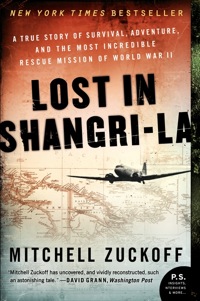
Lost in Shangri-La by Mitchell Zukoff
Lost In Shangri-La is a true life adventure story. In 1945, a group of American service men and women stationed in Dutch New Guinea got on a plane with the intention of seeing the mysterious 'hidden' valley of Shangri-La. They never made it - their plane crashed into the jungle and only three survived. Surrounded by hostile terrain, potentially unfriendly natives and with life-threatening injuries, they began battling to survive. Lost in Shangri-La chronicles what happened afterwards from their meetings with tribespeople who had no previous interaction with the outside world to the daring rescue mission put into place to try to save them.
I thoroughly enjoyed Lost in Shangri-La. It was a rare case of a non-fiction book where both the content and the writing exceeded expectations. What happened to the three survivors was fascinating and I found it hard to put the book down, so keen was I to find out what would happen to them next. This is one of those true stories you couldn't make up, full of adventure from the moment the plane crashed into the jungle.
I was also impressed with Zuckoff's writing style. He relays the events clearly and at a good pace, adding background information but not overwhelming the reader with it. I especially appreciated the sections where the survivors interact with the native tribespeople - Zuckoff included the impressions of the survivors and the natives, making it easy to see the frequent miscommunication. Given the amount of research Zuckoff had conducted and the fact that he had travelled to New Guinea to interview the native population, these sections fascinated me. The survivors were thought of as spirits descended from the sky heralding the end of their civilisation as it currently existed.
Whilst all of the book was written at a brisk pace, I much preferred the earlier sections straight after the crash as there was a greater sense of tension due to the danger the survivors found themselves in. I did enjoy reading about the resuce mission but at this point the danger had passed so I was less invested in the text. I would also liked to have read a bit more about what happened to the natives after the survivors left; Zuckoff does let us know what life is like for them now but I wanted the details - how did their way of life finally change forever?
Lost in Shangri-La is one of the most engaging non-fiction texts I've read for quite some time. It will appeal to anyone who enjoys a good adventure story.
Source: TLC book tours
First Published: 2011
Score: 4.5 out of 5
Want to read more?
The rest of the tour stops can be found here.
I thoroughly enjoyed Lost in Shangri-La. It was a rare case of a non-fiction book where both the content and the writing exceeded expectations. What happened to the three survivors was fascinating and I found it hard to put the book down, so keen was I to find out what would happen to them next. This is one of those true stories you couldn't make up, full of adventure from the moment the plane crashed into the jungle.
I was also impressed with Zuckoff's writing style. He relays the events clearly and at a good pace, adding background information but not overwhelming the reader with it. I especially appreciated the sections where the survivors interact with the native tribespeople - Zuckoff included the impressions of the survivors and the natives, making it easy to see the frequent miscommunication. Given the amount of research Zuckoff had conducted and the fact that he had travelled to New Guinea to interview the native population, these sections fascinated me. The survivors were thought of as spirits descended from the sky heralding the end of their civilisation as it currently existed.
Whilst all of the book was written at a brisk pace, I much preferred the earlier sections straight after the crash as there was a greater sense of tension due to the danger the survivors found themselves in. I did enjoy reading about the resuce mission but at this point the danger had passed so I was less invested in the text. I would also liked to have read a bit more about what happened to the natives after the survivors left; Zuckoff does let us know what life is like for them now but I wanted the details - how did their way of life finally change forever?
Source: TLC book tours
First Published: 2011
Score: 4.5 out of 5
Want to read more?
The rest of the tour stops can be found here.
Friday, 24 February 2012
Jamrach's Menagerie by Carol Birch
Myself and any books short-listed for the Booker prize usually don't get on so I was a bit hesitant to read Jamrach's Menagerie at first. But it has so many elements I was interested in that I had to eventually give it a go; Victorian London - check, wild animals - check, adventure - check, focusing on squalor rather than riches - check. Plus, I am from the East End of London myself and all of these features combined made me excited to start this book.
It's the tale of Jaffy Brown, a young boy who one day encounters a tiger walking down the street. Despite being carried in the jaws of the the tiger, he is unharmed and his bravery catches the eye of Jamrach, wild animal dealer. Soon Jaffy's life is transformed as he is offered steady work and opportunities start to come his way. He accepts a position on a whaling ship hunting down rumours of a dragon but has no idea of what lies in store for him...
Above all else, Jamrach's Menagerie is a good, old-fashioned, rip-roaring adventure story and I loved it. From the very first lines I was transported back to Victorian London in all the filth and stench of the docks areas and working class population. The sights, smells and tastes were so evocative that sometimes I had to look up from the book and physically remind myself of what the here and now actually is. That rich writing continued all throughout the book, even when Jaffy is at sea. The beautiful sunsets, tropical islands and acres of space are described so cleverly by Birch that I almost feel as though I know what it would be like to be a sailor.
At times, this descriptive writing takes you to places you would rather not go to. I went into this book without knowing what the shocking element of it was (and if you don't know, I'm not going to spoil it), so was completely captivated when events at sea started to unfold. I didn't realise how invested I was in Jaffy as a character until things started to go wrong for him and it's not an exaggeration to say that I was on the edge of my seat, turning the pages of the book as fast as I could. I lost sleep in order to find out what would happen next, and I'm someone who needs sleep to function.
I've seen reviews of this book stating that it didn't 'deserve' to be on the Booker short-list, that it was all about controversy and that's what caught the eye of the judges. I can't comment on the Booker selection, but what this book is is a well-written, well-paced, fascinating adventure story with some sensational elements. It's a lot fun to read, in the same way Treasure Island or King Solomon's Mines are and it's the perfect book to completely lose yourself in.
I borrowed this book from the library, but will be purchasing a copy so I can reread it in the future.
Verdict: Fun adventure story that will keep you gripped. Highly recommended.
Source: Library
First Published: 2011
Score: 5 out of 5
Monday, 9 May 2011
Between Two Ends by David Ward
Have you ever loved a book so much that you wanted to live in inside of it?
This is the premise of Between Two Ends. Yeats, the teenage protagonist, must find out how to get into Arabian Nights to rescue Shari, who has been trapped inside the book for decades and now thinks she is Scheherazade, the legendary queen who tells a story every night to stop her head being chopped off.
There are lots of similarities with the Inkheart trilogy, but Between Two Ends is lighter, doesn't take itself too seriously and is a simply a fun adventure. I love the Arabian Nights (you can see my review here) and the idea of going into a world of genies, sand, enchantment and grand viziers is a great one if you love escapism.
There were some lovely touches too. Yeats gets to the world of Arabian Nights in a boat swimming on a sea of words. He spends time pondering if you can get killed in a story if you aren't a main character. If you forget who you really are, you can get trapped in a story forever. Time passes at different rates in story world and the real world.
However, other parts just didn't tie together. The whole thing between Shari and Yeats' father and how that had an impact on Yeats' parents marriage was never explained to my liking and didn't seem like a plausible explanation for Yeats risking his life. The book was a bit short and I could definitely have read some more action in Arabian Nights, and would have liked Yeats to explore a bit further, rather than just rush in and out. The way they break the enchantment on Shari seems a bit too convenient. Yeats is apparently the luckiest boy ever
Verdict: Great piece of escapism, like reading Indiana Jones.
Score: 3.5 out of 5
Received from NetGalley in exchange for an honest review.
Publisher: Abrams Books
Available: Now!
Which book would you escape in to?
This is the premise of Between Two Ends. Yeats, the teenage protagonist, must find out how to get into Arabian Nights to rescue Shari, who has been trapped inside the book for decades and now thinks she is Scheherazade, the legendary queen who tells a story every night to stop her head being chopped off.
There are lots of similarities with the Inkheart trilogy, but Between Two Ends is lighter, doesn't take itself too seriously and is a simply a fun adventure. I love the Arabian Nights (you can see my review here) and the idea of going into a world of genies, sand, enchantment and grand viziers is a great one if you love escapism.
There were some lovely touches too. Yeats gets to the world of Arabian Nights in a boat swimming on a sea of words. He spends time pondering if you can get killed in a story if you aren't a main character. If you forget who you really are, you can get trapped in a story forever. Time passes at different rates in story world and the real world.
However, other parts just didn't tie together. The whole thing between Shari and Yeats' father and how that had an impact on Yeats' parents marriage was never explained to my liking and didn't seem like a plausible explanation for Yeats risking his life. The book was a bit short and I could definitely have read some more action in Arabian Nights, and would have liked Yeats to explore a bit further, rather than just rush in and out. The way they break the enchantment on Shari seems a bit too convenient. Yeats is apparently the luckiest boy ever
Verdict: Great piece of escapism, like reading Indiana Jones.
Score: 3.5 out of 5
Received from NetGalley in exchange for an honest review.
Publisher: Abrams Books
Available: Now!
Which book would you escape in to?
Subscribe to:
Posts (Atom)