Sunday, 4 November 2012

Sunday Salon: On Buying A House


Last week was the half term break for teachers and students here and it didn't come a moment too soon.  We had an unusually long first half term and we were all dead on our feet by the last Friday.  I cleared my desk, turned off my whiteboard, put everything in my cupboard and drove home without looking back.  I've not thought about work all week and it's been absolute bliss.  Because I've had such a good break, I'm looking forward to going back and getting stuck in again, recharged and ready to start over.

Most of our time this week has been taken up with house stuff.  I think I mentioned on here a few weeks back that we were putting in an offer on a house and the good news is that our offer was accepted about three weeks ago.  Since then, we've been finalising the mortgage with the bank, getting a solicitor, negotiating with the landlord to release us from our rental contract etc. etc. etc.

Things have felt like they are going very slowly but finally I can see the light at the end of the tunnel.  Our mortgage was agreed on Friday and the surveyor is going to the property next week.  Our solicitor is busily working on contracts.  I wish things could go quicker because I can't wait to live in the first house that will belong to us rather than someone else!

It's only a small house - a 2 bedroom terraced house in the center of town but good value for the very expensive area we want to live in!  What I like best about it is that it's built on the top of a hill overlooking a forest to the rear of the property.  So even though we are in the center of town (walking distance to the train station, library and shops), it still feels like you are away from the bustle, in your own world on top of a hill.  It's an upside down house too, with the bedrooms on the bottom floor and the living area upstairs.  I like that because it makes the most of the lovely views.  On each of our viewings, we could watch the squirrels running up and down the trees through the back windows.  At the moment we live in a lovely cottage on a very busy road so the peace and quiet will be much valued.

Today, we plan to continue sorting through our things and de-cluttering so we are ready to move.  Fingers crossed, we should be in by the end of the month!

Saturday, 3 November 2012

A Disobedient Girl by Ru Freeman

Latha is a servant girl, bought up alongside the daughter of a rich Sri Lankan family.  Exposed daily to the luxuries that wealth can bring, she resents her status as a servant and disobeys in small ways - stealing a bar of rose-scented soap for her own use or making extra lime juice to drink.  As she grows up, the differences between her and Thara become more apparent but their lives are so entwined that Latha has no option to break free.  Caught in a complex mix of love and hate and against the back drop of a violent civil war, her small acts of disobedience gradually grow larger, with consequences for everyone.  Told alongside Latha's story is that of Biso, a women fleeing an abusive husband with three small children in tow.   She hopes to make it to the hills to be taken in by an Aunt, but the war is escalating and her journey is rife with danger.

I really enjoyed A Disobedient Girl, mainly because of Latha herself.  I've seen reviews complaining that Latha is an unlikable main character as she's not the most moral of people.  And whilst that is true, I think this would have been a weaker book if Latha was simply written as a martyr.  I liked that she was stubborn, proud and determined not to take her situation lying down; she wouldn't roll over and accept things the way they were.  Throughout the book, Latha fought with whatever weapons she had available to her, even if that led to her doing questionable things, for example using sex to get back at her mistress early in the novel.  I loved her spirit and resourcefulness and her constant hope that she could make a better life for herself.   Even though she was in an impossible situation due to prejudice, she rarely gave in to bitterness.  Freeman is also a political journalist and this is very apparent in the way she writes about the situation Latha faced;

"There is was again: a proper servant.  That was all they had expected of her.  Despite her education, regardless of it, and her looks, she was supposed to be no more, no less.  Servant.  The thing that had concealed her intentions, her desires, her womanliness, her very soul."

I also enjoyed the dual narrative aspect of the book.  Chapters are alternated between Latha and Biso, and whilst it took me some time to get to grips with the fact that Latha's story unfolds over decades and Biso's only over a few days, the break in perspectives worked well.  I was happy with the link between the two characters when it was revealed and also felt the ending was in keeping with plot.  I also liked that the civil war stayed in the background of the story; too often it feels like authors from countries that have experienced war or political upheaval feel pressure to make this the center of their novels, like this is the only way people in the West will want to read their work.  The war in A Disobedient Girl is there, but only ever as a backdrop to the story of Latha and Biso.  I liked reading about other aspects of Sri Lankan life.  In the same way, I liked that Freeman didn't feel the need to explain every new thing to the reader, she just immersed us in Sri Lankan culture and let us find our own way.

The only criticism I would make of this book is that it was a bit over-long and slow at the start.  It seemed to be a long while before events started to happen and the middle section could have been edited down.  Other than that, it was a great read and I'll be keeping an eye out for any more books written by Freeman in the future.

Source: Library
First Published: 2009
Edition Read: Penguin UK, 2011
Score: 4.5 out of 5

Thursday, 1 November 2012

Beside the Sea by Veronique Olmi


Over the coming months, you'll see lots of reviews of books published by Peirene Press, a publishing house based here in the UK that specialises in translations of short books that have received accolades in other European countries.  Lyndsey from Tolstoy is my Cat and I are completing a readalong of sorts, for which we will be reading and reviewing nine Peirene books from three collections;  female voices, male dilemmas and small epics.  Although I have received these books from the publisher in exchange for a review, all the views expressed are my honest opinion.

On with the first book!  Beside the Sea was originally published in France and is the story of an unnamed mother struggling to cope with life.  She has two young sons but is slowly slipping further into the grasp of mental illness.  She can't organise herself to get her boys to school on time, often sleeps through the day, is unable to budget her benefit money to provide food and other essentials, is consumed with paranoia and can spend hours staring into space, doing nothing at all.  Social services, health visitors and psychiatrists are involved but the mother isn't feeling any better.  She decides to use all the money she has left for one last trip to the seaside with her boys, to make sandcastles and visit a funfair.  But the weather is bad, the town is muddy and the shopkeepers aren't pleased with her selection of small change.  She wants to keep her boys safe, but at what cost?

Beside the Sea is an incredibly powerful book.  I finished it a few days ago and still the events of the story are running through my mind.  The ending itself is rather predictable but that doesn't take away from the emotional punch you get as you read the last sections.  Beside the Sea was especially powerful for me as I am a primary school teacher who teaches in inner London and I've met many parents that are at least partly like the mother in the story, completely unable to cope with life for whatever reason.  In one passage, the mother is discussing her son's teacher, Marie-Helene, and it was eerily familiar;

"she's always asking questions, Why hasn't he got his plimsolls for gym?  What time does he go to bed because he's falling asleep in lessons?" p28

I've had that exact conversation many times and that's probably the reason why I engaged with this book so much. Be it mental illness or their own backgrounds, there are so many mothers like Olmi's out there and I was blown away by how well Olmi got under the skin of her character, by how well she exposed her thought processes.  Even though as a reader you can see the consequences on her two children, especially the oldest, Stan, who is trying to mother his own mother, you can't help but feel sorry for the unnamed narrator.  People are trying to help her but no one is addressing the root cause of her problems, that she can't cope with herself, let alone two children;

"I couldn't spend a full day on my feet, doing this and that, being friendly, polite and happy, no, I wouldn't make it through a whole day with my eyes open." p60

As I was reading the book, I kept thinking 'what could have prevented the ending from happening?'  I'm willing to bet the mother would have already had the whole gamut of help from social services, including parenting classes and counselling and everything they could offer, and with no prior history of harm, her children were probably considered to be at low risk.  How many parents like her are truly out there?  If you've had inadequate parenting how you can truly parent well yourself?  What can we do to help? Why do people look the other way from these kinds of social issues? Beside the Sea is a powerful book that raises more questions than it answers and I'm glad that I took the time to read it.

Source: From Peirene, in exchange for an honest review.
First Published: 2001, France
My Edition: 2010
Score: 5 out of 5

Wednesday, 31 October 2012

Days of Splendor, Days of Sorrow by Juliet Grey


Days of Splendor, Days of Sorrow is book two in Juliet Grey's Marie Antoinette series.  I read book one, Becoming Marie Antoinette, last year (my review) and very much enjoyed it, so I was pleased to be offered the chance to review the sequel.  Covering the period from Marie's ascension to the throne of France to the beginnings of the revolution, Days of Splendor, Days of Sorrow plants the seeds of the hardships to come.  Young, childless and kept away from the business of state, Marie Antoinette busies herself with parties, gambling and fashion, alienating a population struggling through economic difficulties.  Her attempts at gaining privacy offend the noble classes and although her heart is often in the right place, she lacks the common sense a good leader requires.   Her joy at finally giving birth to an heir is tempered by gossip and the Affair of the Diamond Necklace, which signals that the population of France is getting ready to challenge the monarchy.

I was very familiar with the history of Marie Antoinette before reading this or its predecessor as I have read and loved Antonia Fraser's biography of her in the past, so I was pleased to see how much Grey stuck to historical fact.  As with Becoming Marie Antoinette, the amount of research that had gone into Days of Splendor, Days of Sorrow, was admirable.  I love all of the little details in historical fiction and Grey includes enough of them to make the time period completely and utterly believable.  There are never any jarring anachronisms and I enjoyed all the little details about court etiquette and trends.  I also enjoyed the letters between Marie and her family members as they broke up the narrative nicely.

The character of Marie Antoinette was drawn well.  Grey manages a good balance between making you just sympathetic enough to like her but also showing why France didn't embrace her.  Marie comes across as exactly what she was, a young girl out of her depth with black and white morals that didn't translate well to being the Queen of France.  She is too easily led and thinks that simplistic gestures like donating a bit of money to charity can cover up her massive expenditure.  Grey shows how good intentions aren't always enough and Marie's lack of common sense about her friends and choices ends up starting her ruin. 

Despite these strengths, I had some issues with the pacing of the book.  It covers many years of Marie Antoinette's life and while the first half had a sedate pace, everything seemed rushed through nearer the end and this imbalance bothered me a bit.  There was too much detail about some events and not enough about others.  The whole Affair of the Diamond Necklace wasn't explained properly by Grey, which made the sections about it drag a bit.  Plus, I wasn't a fan of how suddenly other character's perspectives were included when the rest of the book had been written from Marie Antoinette's point of view.  Middle books can always feel a bit slow in places and there was a lot of build up in this novel which I'm sure will pay off in the final volume of the trilogy but which made this volume a bit long and clunky to read.

Overall an enjoyable book, but not quite as good as the first volume, Becoming Marie Antoinette. I'm looking forward to reading the final volume when it's released.


Source: Ebook provided by Historical Fiction Book Tours 
First Published: 2012
Score: 3.5 out of 5

Tour Information

Saturday, 27 October 2012

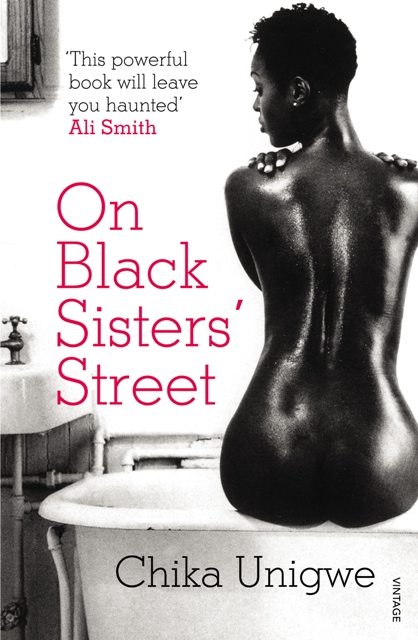
On Black Sisters' Street by Chika Unigwe


Black sisters' street refers to Zwartezusterstraat, a street in the red light district of Brussels famous for its African prostitutes.  Unigwe's story starts with three young women learning the news that the fourth woman they share a house with, Sisi, has been brutally murdered.  Although they have kept their distance from each other in the past, this news brings the three women together and they start to share their stories.   Efe had an affair with a married man as she thought this would lead to money and opportunity.  Abandoned after the birth of her son, she agrees to meet Dele, who offers her a new opportunity in Europe, a chance to provide for her son.  Ama is repeatedly raped by her step-father and seeking escape at any cost.  And Joyce is a Sudanese woman caught up in the war who thinks she has found happiness with a Nigerian man, only to have it snatched away by his prejudiced family.  All three are stateless and at the mercy of the madam and their debt to Dele, the man who arranged their transport to Belgium.   They dream of a life free again, but as Sisi learned, dreaming can come at a high price.

On Black Sisters' Street is a heavy-hitting book.  The stories of all four women contain suffering in lots of different forms and happiness is something only rarely snatched at between periods of hardship.  Although the women come across as smart and resourceful, circumstance has made them desperate enough to make a choice that hopefully most of us will never have to face - the choice to become an illegal sex worker.  And for three of the women it is exactly that - a choice.  Joyce is the only one who arrives in Belgium not knowing what is expected of her.   I really respected Unigwe for showing that prostitution can be something gone into with eyes wide open, rather than telling the 'easier' story of women smuggled to Europe ignorant of what their fate would be.  It made for a far more nuanced and subtle book.

Despite the sections dealing with life in Europe, On Black Sisters' Street is mainly a condemnation of the corruption and problems facing Nigeria.  Money, or the lack of it, is a powerful motivator for all the women, especially Sisi, who has a good degree but can't get a job as she doesn't know anyone who can pull the levers of power for her.  Facing a life of living without, she decides prostitution is a better bet than poverty.  Efe and Ama decide the same.  And in some ways, it does turn out to be a good bet - some of the women manage to repay their debts to Dele and go on to live a life that would have been impossible without prostitution.  Again, the inclusion of this by Unigwe makes for a more complicated book.  I'm glad she showed the shades of grey in the issues covered in the story.

Although there is much suffering in the story, Unigwe's writing keeps On Black Sisters' Street from being too depressing overall.  The characters are realists and there's always an undercurrent of hope that life will get better.  It must have been a hard balance to achieve and I'm impressed with Unigwe for managing it.  Overall, On Black Sisters' Street is a well written and sensitive examination of heavy issues and I would highly recommend it.

Source: Library
First Published: 2009
Edition Read: Vintage UK, 2010
Score: 4.5 out of 5

Monday, 22 October 2012

A Suitable Boy by Vikram Seth


I've finally finished it!  Three months and 1474 pages of tiny print later, I can consign A Suitable Boy to my 'read' shelf on goodreads.  This post will contain first a general review of the book without spoilers, then a discussion of the third section for the readalong.  The discussion part will contain spoilers, so steer clear if you haven't read or finished the book yet.

Review:
A Suitable Boy is the inter-connected tale of four families in post-independence India.  Although the central story is Mrs Rupa Mehra's quest to find a suitable husband for her daughter Lata, Seth's novel is more than that and is best described as a panoramic of Indian society.  From racial tension to religious festivals to adultery, ambition and politics, A Suitable Boy is an epic in every sense of the word.  The many individual stories are told alongside each other in nineteen parts and cover the human condition in all its forms.  I enjoyed reading about Savita's journey into motherhood, Pran's struggle to become an academic, the Nawab Sahib's bewilderment as the world he knew disappeared and the eccentric Chatterji family, who were more liberal and liked to speak in couplets.

If you have the time to invest in it, A Suitable Boy is a very rewarding book.  For me, it's up there with Gone with the Wind and Anna Karenina as a book that I will always remember.  Lata and the cast of characters feel like members of my friends and family; two days after putting this book down for good, I'm missing them.  Towards the end of the book when things start to happen and events get resolved, I was emotionally invested in the outcome each character would have.  Seth made me connect with each one (even if I didn't like them all) and I have a clear visualisation of what each character is about, which is not easy to pull off.  It felt almost like the book got into my soul.

As the scope of Suitable Boy is so broad, there's guaranteed to be something in it for each reader.  I'm a fan of multiple perspective books anyway and the rapid shifting between points of view stopped this long book from becoming tedious to read.  I'm in utter awe at the way Seth managed to wind all of his characters and events together without losing the impact of the story.  There are some plot points not resolved by the end and everything doesn't tie up nicely, but then it's not the kind of book where everything would.  A Suitable Boy does require an investment of time and effort but most definitely repays anything you put into it.

Discussion - Part Three (Spoilers):
I had mentioned in my review of Part Two that events were dragging and the book was becoming a bit of a slog - not so in Part Three!  Suddenly everything seemed to be happening at once and the pace was whirlwind by the last two or three hundred pages.

The main event was clearly Lata's marriage to Haresh.  I must admit to being disappointed with her choice, especially as it seemed to be one so clearly based on the head rather than the heart.  My opinions conicided with Malati's, who felt that Lata had turned down the gold and silver prize in order to settle for the bronze.  Whilst I agree that she could never have married Kabir, much as I liked him (the attitude of her family would have made their life very difficult), I had a soft spot for Amit.  There's one section where Lata is thinking about his poems and Seth writes something like 'they were already a part of her, without her knowing it'; from that point on I was rooting for Amit.  Lata's reasoning sold Amit short; I didn't find him selfish or demanding at all.  Besides, if anyone proposed to me with a beautifully written poem like that, I would certainly accept!  Haresh seemed very drab and unispiring compared to her other choices and it felt like Lata had chosen sensibly rather than for happiness. 

Religious tension was a theme throughout the whole book but it was really hammered home in this section with both the stampede at the Hindu event and the clashes between Hindus and Muslims when their festivals coincided.  I feel like Seth must feel strongly about clashes like this, as the sections dealing with them were powerfully written.  A message of the whole book seemed to be how futile religious quarrels are. I didn't expect events with Maan to take the turn they did, especially after he saved Firoz earlier in the story.  But I saw a different side to him and to Mahesh and this made me appreciate their characters more. 

The third part was my favourite of the three, mainly as so much happened and the pace was brisk.  I'm still reflecting on all the events and looking forward to the release of A Suitable Girl sometime in 2013, that follows Lata's search for a wife for her grandson eighty years after the events of Suitable Boy.  I hope Seth is on track and the book gets published on time.

Thanks to all the readalong participants for giving me the motivation to finally tackle this book; it had sat on my shelf for years prior to this.  I'm glad I finally got the chance to read and enjoy it.

Source: Personal copy
First Published: 1993
My Edition: Phoenix books UK, 1993 (purchased second hand)
Score: 5 out of 5

Sunday, 21 October 2012

Library Loot 1: October 17-23

Library Loot is a weekly event co-hosted by by Claire from The Captive Reader and Marg from The Adventures of an Intrepid Reader that encourages bloggers to share the books they’ve checked out from the library.  As someone who uses the library so much they don't have time to read the many unread books they own at home, I decided it was a good idea to start participating!  This week I visited the library in anticipation of finishing A Suitable Boy (which should be today, only 80 pages left!) and finally getting to start something else.  Half these picks were on my wishlist and half were from random browsing.


1. A Disobedient Girl by Ru Freeman - This is the story of Latha, a servant in Sri Lanka, whose life is tied to Thara, the spoilt daughter of the family she serves.  This book promises to tackle issues of class and prejudice whilst delivering an intense coming of age story in a volatile setting.  I chose A Disobedient Girl as it was already on my wishlist.
2. On Black Sisters' Street by Chika Unigwe - Four African women have come to Brussels to work in the red light district.  They are seeking the European promise of wealth but meet only struggle and hardship, including murder.  I first heard about this book on Willa's blog; it promises to be a difficult but important read.  I'll probably start this one after finishing Suitable Boy.


3. The Diving Pool by Yoko Ogawa - I've heard great things about Ogawa so when I saw this on the 'new to this library' stand, I picked it up and decided to take a chance.  I'm not familiar with Japanese literature at all but this collection of three novellas sounds deliciously creepy.
4. Comes the Night by Hollis Hampton-Jones - Another random pick.  Meade is a nineteen year old girl living in Paris who is emotionally and sexually obsessed with her brother, Ben Ho.  This promises to be dark and disturbing, perfect for this time of year. 


5. Mermaid by Carolyn Turgeon - This is an unusual pick for me, I even ventured into the fantasy section of the library for possibly the first time!  But it's a retelling of The Little Mermaid, one of my favourite fairy tales, so it's worth a shot.  I'm looking forward to trying this one.
6. 26a by Diana Evans - I picked this up from a stand recommending books to read during Black History Month.  It's a coming of age tale of Nigerian twin sisters growing up in northwest London.  It won the Orange Prize for New Writers, which is enough to make me bring it home for a while.

Have you read any of the books I picked out this week?