Sunday, 30 June 2013

Sam Sunday #20: Bookish Buys


We've had the plasterer round all weekend and today, it was my turn to get out of the house for a bit.  My Mum took me to a home ware discount shop we have here in the UK called Homesense.  I wasn't expecting to find bookish things there at all, so it was an even better surprise when I managed to grab myself one of the best book related bargains I've found all year - a set of 10 Penguin Red Adventure Classics, brand new, for £13 reduced from £79.


I love the Penguin Red editions, I already own the Around the World in 80 Days version, so I knew that the quality is great and the covers have a lovely vintage adventure feel.  Included in the collection are the following books:

1. Tarzan of the Apes by Edgar Rice Burroughs
2. The Riddle of the Sands by Erksine Childers
3. Greenmantle by John Buchan
4. The Thirty-Nine Steps by John Buchan
5. The Man Who Was Thursday by G K Chesterton
6. Treasure Island by Robert Louis Stevenson
7. The Prisoner of Zenda by Anthony Hope
8. Rupert of Hentzau by Anthony Hope
9. The Lost World by Sir Arthur Conan Doyle
10. Around the World in Eighty Days by Jules Verne.

How cool is that?  I love a good swash-buckling epic, so I can't wait to start The Prisoner of Zenda in particular.


While I was out, I also persuaded my Mum to stop in Waterstones, where I bought this journal to keep a track of my wishlist.  I had my wishlist saved on my laptop that broke, so I've decided that a paper copy is the best way to go this time.  Each page is divided into two columns, for author and title, so it should be practical as well as attractive.

Have you had any good bookish buys lately?

Friday, 28 June 2013

Blood of the Lamb by Sam Cabot


Father Thomas Kelly, a Jesuit priest, is happily based at a university when he is called to Rome by his former mentor.  A mysterious yet important document, the Concordant, has gone missing from the Vatican Library and must be recovered at all costs.  Kelly sets to work alongside an art historian, Livia, who claims to be representing a group who are just as interested in recovering the Concordant as the Vatican are.  But Livia has her own secrets, and the contents of the document are powerful enough to shake Kelly's faith to it's foundations.

Blood of the Lamb is marketed as The Historian meets The Da Vinci Code, so I was keen to get my hands on it as soon as possible!  There are certainly massive similarities with The Da Vinci Code; in both a male lead uncovers a deeply buried religious secret with the help of a female sidekick, but happily I found Cabot's writing much better than Brown's.  Despite there being a supernatural element to the story (the comparison to The Historian is a big clue), the mythology of the supernatural community felt authentic enough for the book to somehow pull off being realistic.

In addition to this, Cabot weaves in enough twists and turns to keep the reader on their toes.  I don't read many thrillers but I love intelligent, well written ones like this.  In fact, until about 97% of the way through the book, I was convinced that I had found a new favourite.  I loved everything about it, from the plot to the characters and the writing.  But then something happens in the end that stretches the credulity of the reader to breaking point and consequently, the whole story feels false.  The ending just went too far and unfortunately it ruined the book for me.  Honestly, it felt a bit silly.

The ending makes Blood of the Lamb hard to review and rate.  I do think the book had many, many positive features but they were ultimately over-shadowed by a bad ending.

Source: From the publisher, in exchange for an honest review.
Publication Date: 6th August 2013
Score: 3 out of 5

Tuesday, 25 June 2013

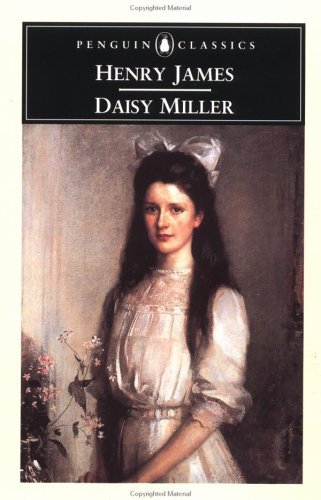
Daisy Miller by Henry James


Daisy Miller is the first book by Henry James I've read.  I have three books of his on my classics club list, as I love the sound of his themes, particularly the culture clash between the Old World (Europe) and the New World (America).  Daisy Miller seemed like the perfect introduction to his work as it's a short tale about a rich American girl who is criticised by the society in Italy for being too free and uninhibited.  The narrator, a young American ex-pat called Winterbourne, meets Daisy whilst she is travelling around Europe with her family.  He is quickly bewitched by her, mainly because she isn't bound by rigid social etiquette; she talks to him without being formally introduced and even agrees to an excursion to the nearby Chillon Castle un-chaperoned.  But Daisy's disregard of social conventions soon makes her the centre of gossip when she is seen out with a local Italian and refuses to take note of Winterbourne's 'well intentioned' warnings.

Daisy Miller was the perfect introduction to Henry James and I thoroughly enjoyed it.  Although the theme of 'free American girl comes up against European society living in the past' was fairly obvious, there was a good deal of subtlety in the way James wrote and I didn't feel as though I was being smacked over the head with the message.  This was mainly due to the ambiguity in the main characters; Daisy herself was forward yet innocent at the same time and Winterbourne, for all his high talk, only seemed to like Daisy as he suspected that she was a flirt and would therefore go rather further than other girls.  He may have gone on about upholding social standard, but his motivations were definitely less well intentioned than Daisy's;

"If therefore, Miss Daisy Miller exceeded the liberal margin allowed to these young ladies, it was probable that anything might be expected of her.  Winterbourne was impatient to see her again."

It was this hint of Winterbourne's creepy motives and his jealousy when his affections for Daisy aren't returned with the appreciation he thinks they deserve later in the book that make Daisy Miller such a good read.  There's enough irony and ambiguity in the book to make it thought provoking.  Of course some characters, like Winterbourne's disapproving Aunt, are more straight-forward, but I appreciated the complexity in the leads.

The only disappointment for me was the ending.  It seemed somewhat abrupt and the dramatic event that happened didn't fit with the rest of the story.  It was almost as if James didn't quite know how to resolve things for his characters, so he dealt with it in a rather sledge-hammer like way.  However, the themes and the beautiful writing more than make up for that.  I'm excited to read more novels by James now.

Source: Personal copy (kindle)
First Published: 1878
Score: 4 out of 5


Classics Club: book 11 of 72.
My full list can be found here.

Sunday, 23 June 2013

Sam Sunday #19: Joe's Christening

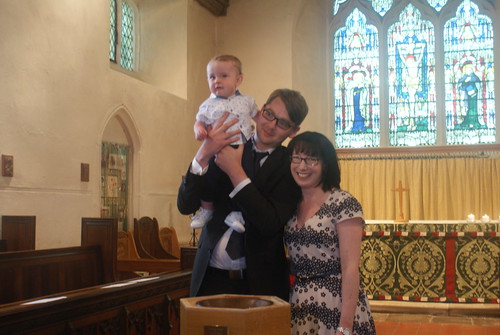
My nephew with his parents

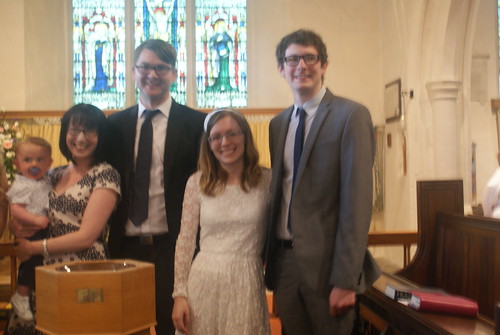
It's been a busy week.  Today was the Christening of my nephew, Joseph, and Tom and I were chosen to be two of his godparents.  It was kind of a strange experience as I wasn't raised as religious myself and because of this, I'm not at all familiar with Church services.  I was worried that I wouldn't know what to do or say!  After the service, we had a bit of a gathering around someone's house and it was nice to spend time with my family.


A bit of a blurry photo; I am in the white dress & my husband in the grey suit.

Apart from that, my weekend has been spent clearing out our main bedroom as we're getting it plastered next weekend and the plasterer is coming super early!  We have moved all of the furniture and our possessions, ripped up the carpet, dismantled the fitted wardrobes and the fitted blinds, removed the coving and skirting board and taken down the wallpaper.  It is literally now a blank shell; I can't wait for it to be plastered so we can decorate it the way we would like it.

I mentioned in my last Sam Sunday post that I've been having a tough time recently and to cheer me up, my husband bought me an iPad Mini in the week.  I've been eyeing the iPads ever since the original version first came out but as I had a laptop and a kindle already, I just couldn't justify it to myself.  But last week my laptop broke (the dreaded blue screen attacked!) and as my kindle is now almost three years old, I decided that it would finally be OK to have an iPad.  I love it already, the goodreads app is awesome and I can still blog on it as the bloglovin app makes commenting on other blogs very easy.  I have the kindle app of course but I think in the long run I'm still going to prefer my read kindle.  As I'm a total iPad newbie, I would appreciate any app recommendations and/ or tips for getting the most out of it.

This week, I've been reading:
 

Reviews posted:

Saturday, 22 June 2013

Maus by Art Spiegelman


Prior to picking up Maus, the only graphic novel I have ever read was the excellent Persepolis. I've never been into superheroes or comics, so I just never tried anything from the graphic novel sections of the library or bookshop.  But I had heard enough about them to know that Maus, about Spiegelman's father's experiences of the Holocaust, is considered a classic of the genre.  It even won the Pulitzer Prize.  So when I found myself in a reading slump and in need of something new, Maus seemed like a good option.

Maus opens with Spiegelman visiting his elderly father and asking him to recount his experiences.  It soon becomes clear that the father-son relationship isn't perfect, and the wartime sections are interspersed with modern day encounters.  Spiegelman senior was a bit of a wheeler-dealer and he was able to survive the Holocaust by a combination of luck and always staying one step ahead of the game, looking out for new ways to make himself useful, to do whatever was necessary to survive.  These same skills (keeping everything because you never know when it might come in handy, wasting nothing, learning to deal with extreme situations) later form a wall between father and son and make functioning in the real world and dealing with real relationships almost impossible.  The version of Maus I read contains both book one and two.

I just loved this book, and devoured it in less than a day.  I was worried that I would find the experience of reading a graphic novel difficult, but I soon got used to the format and in fact, started to appreciate how the pictures allow a different kind of story-telling.  When Spiegelman Sr is talking about his time in Czechoslovakia before the war, the arm band that Jewish citizens had to wear enters the pictures without any mention a couple of pages in, a subtlety that wouldn't be possible in an ordinary novel.  The technique of drawing the Jews as rats and the Nazis as cats also adds impact that is only possible in a graphic novel.  Furthermore, it helps that the pictures were simple but beautifully drawn:


But above all, Maus is an excellent book because it's a powerful account of a horrible period of history and hearing about it from one person's experience humanises it for the reader.  That we get to see that survival doesn't guarantee a happy ending makes it all the more powerful. I'm so glad that I was in a restless reading mood, otherwise I might never have got to read this book.

Source: Library
First Published: 1986 (vol 1) & 1992 (vol 2)
My Edition: Penguin Books, 2003
Score: 5 out of 5

Thursday, 20 June 2013

The Gods of Heavenly Punishment by Jennifer Cody Epstein


The firebombing of Tokyo during World War Two forms the centerpiece of The Gods of Heavenly Punishment, a novel that follows the lives of several people before and after the war.  Cameron is an American pilot, newly married, who takes part in the firebombing mission only for things to go wrong afterwards.  Yoshi is the daughter of a Japanese father intent on capturing Manchuria and a Westernised mother.  She gets caught up in the bombing and must deal with the consequences.  Anton is an architect who lived in Japan but who is now involved in designing Japanese buildings in America, so the military can practise destroying them.  The lives of all the characters intertwine as they are changed by one dramatic event, the firebombing.

From the cover of The Gods of Heavenly Punishment, I was expecting quite a gentle read, but it was anything but!  The actual firebombing itself is graphically described and the novel doesn't shy away from the grittier side of life.  There are no guaranteed happy endings for any of the characters and Epstein does a great job at showing how brutal war is, as the killing is indiscriminate.  In addition to this, the novel also deals with homophobia and how cities are permanently changed after war.  Yoshi was living comfortably before the attack but after the destruction, she is forced down paths she never expected she would have to go.

I was extremely impressed by the writing in The Gods of Heavenly Punishment.  Epstein has a lot of characters to deal with but she manages to keep them all distinct in the reader's mind and manages to give a sense of their personalities in a very short time.  This meant that the book quickly sucked me in and I rushed through it in only two days, as I couldn't put it down.  I'll definitely be getting hold of her other book, The Painter from Shanghai.

The only complaint I have with the book is that sometimes the links between characters felt contrived.  A bit like how everyone knows each other in Dickens' London, all of the characters in this story were linked in ways that just wouldn't happen in real life.  I don't mind a few coincidences, but there seemed to be a few too many of them.  Despite this, I really enjoyed reading The Gods of Heavenly Punishment and think it's a great example of a historical fiction book that can pack a punch.

Source: Review copy via Historical Fiction Virtual Book Tours
Published: 2013
Score: 4.5 out of 5

Read Alongside:
  1. Shanghai Girls by Lisa See - Another novel that examines the destruction of a city in Asia, as Japanese forces occupy Shanghai.  This one also doesn't shy away from portraying the gritty effects.
  2. Next to Love by Ellen Feldman - This one links in with the Cameron storyline.  What was it like for the families of American soldiers during World War Two and afterwards, when they returned home?

Monday, 17 June 2013

King Leopold's Ghost by Adam Hochschild


"What I do there is done as a Christian duty to the poor African; and I do not wish to have one franc back of all the money I have expended."

European colonisation of Africa during the nineteenth century is a common story but the Congo was somewhat of a unique case as it's owner was just one man, King Leopold of Belgium, as opposed to an entire country.  After convincing his fellow European heads of state that he was on a humanising mission to preserve the Congo and bring Christianity to it's inhabitants, Leopold was allowed to run it privately.  What he did was effectively create a whole system designed to exploit the resources of the Congo for his own personal wealth, including the Congolese themselves, some ten million of whom were murdered and countless others were maimed in the pursuit of rubber.  Cutting off hands became an acceptable punishment for not meeting your rubber quota. King Leopold's Ghost is a history of Leopold's rule and the campaign that eventually rose up against the cruelty and injustice.

I was somewhat familiar with the history of the Congo before starting this book, but it was still shocking to read.  I was expecting to read details about the exploitation of Africans, as unpleasant as that is, but what I wasn't expecting was how calculating and pre-meditated the whole thing was.  Leopold told bare-faced lies about developing the Congo and not wanting any money in order to obtain it, fully intending already to run it as a personal fiefdom.  Once he had it, he instigated an extremely barbaric and planned system that he went to great lengths to hide from the rest of the world, including bribing members of the press and hassling people that tried to tell the truth, to the extent that some of them committed suicide.  This was no accidental, time and place evil, this was the premeditated destruction of an entire country and a good chunk of it's population.  Ten million people deliberately murdered.  Many of the problems the Congo faces today can be traced back to Leopold's rule.  

Half of King Leopold's Ghost is dedicated to Leopold's rule and the other half to the campaign against it.  It was interesting how some witnesses were able to turn away from what was going on, justifying the cruelty with racism, and how others felt compelled to speak up, even when it had consequences for them personally.  The campaign against Leopold was one of the first international movements for what we would now call 'human rights' and was a fore-runner for organisations like Amnesty International. Of course, they were only campaigning for the Congo to be put under a 'better' colonial rule, but it was nevertheless a step in the right direction.

I did feel like Hochschild got a bit bogged down in the anti-Leopold campaign and there was a lot of keeping up with various campaigners that dragged a bit in the latter section of the book.  As Hochschild himself identifies, the book also suffers from a lack of Congolese voices, as people of the time either didn't think their voices worth recording or evidence was destroyed on Leopold's orders.  Despite this, King Leopold's Ghost is an excellent history book, well researched, readable and eye-opening.  I'm really glad that I read it.

Source: Library
First Published: 1999
My Edition: Pan Books, 2012
Score: 4.5 out of 5

Read Alongside:
1. The State of Africa by Martin Meredith - a general overview of Africa during and after European colonialism.  Great if you're new to African politics.
2. The Fear by Peter Godwin - Another example of one man terrorising and exploiting an African state, but in modern times.  Godwin travels in Zimbabwe during the elections that resulted in Mugabe returning to power, and witnesses torture and repression.