Friday, 3 May 2013

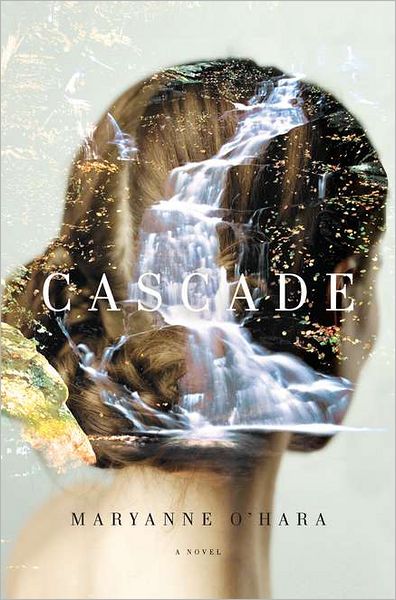
Cascade by Maryanne O'Hara

Desdemona Spaulding is a newly-wed living in the picturesque town of  Cascade, Massachusetts.  With her ageing father close to bankruptcy, Dez made a convenient marriage to Asa in order to save her father's pride and joy, his Shakespeare theater   But little did she know that her father would soon pass away and that she herself would meet Jacob Solomon, a fellow artist, and come to question the practical life she had chosen for herself.  The events of the novel take place against the backdrop of a town living with uncertainty; Boston is running out of water and Cascade is one of two towns that may be flooded in order to create a new reservoir.

Cascade is a quiet, bittersweet kind of novel.  It's very much character driven and focused on the choices real people have to make, between options that are on a sliding scale of desirability ("I'm sorry, but life is full of tough choices between less-than-perfect alternatives.").  The first half of the novel is quite slow paced, as the main characters are established and the attraction between Dez and Jacob becomes apparent.  Dez's husband, Asa, also has a lot of page time as it becomes clear that he's a decent person, just not the right sort of person for Dez.  I liked that O'Hara wrote him that way, and didn't take the easy option of making Dez's husband a monster, in order to excuse her adultery.

The pace of the novel picks up in the second half as all the characters have to live with the consequences of events that happen in the middle of the novel, as Cascade learns whether or not it is to be flooded.  Cascade is a hard book to write about as on paper, not much happens, but it's utterly compelling and contains some of the best characterisation I've seen for a long time.  Dez, Asa and Jacob felt completely real and the choices they make are flawed but understandable.  I'm sure that most readers will be able to relate to Dez's growing discovery that life isn't like a story with a guaranteed happy ending, but convoluted with twists, turns and falls.

The historical setting of the novel is well handled, and never overwhelms the main plot.  Although I enjoyed reading about Dez's adventures as an artist in more liberal New York, I liked all the little details about small town American life the best, like Dez mixing vanilla cokes at the soda fountain and participating in town meetings.   The historical elements of the story felt authentic, with no anachronisms.

On the whole, I'd definitely recommend Cascade to those who enjoy realistic, character-driven novels.  The writing was excellent and I'll certainly be looking out for anything else O'Hara writes.

Source: Historical Fiction Book Tours
Published: August 2012
Score: 4.5 out of 5

Wednesday, 1 May 2013

How to Read Literature by Terry Eagleton

Although I've never formally studied English Literature beyond A-Level, these kind of 'learn to read books properly' titles always appeal to me.  I read for pleasure alone and my reviews/posts about books are completely based on my personal experience, for which I make no apology.  In fact, my posts about classics and other 'literary' books tend to me more of a personal reaction than those about contemporary books as I know those books have already been analysed to death by minds more experienced than mine!  But the more I read classics, the more I want to find out about their context and how this can influence the way they are read and understood.  Unfortunately, How to Read Literature didn't really give me the experience I was after.

How to Read Literature started with an extremely long section on fine-detail analysis at the individual word and sentence level.  The illustrative examples were well chosen and the writing good, but this style of analysis doesn't appeal to me as it feels so over the top and analysis-for-the-sake-of-analysis.  Eagleton argues that it doesn't matter if an interpretation is 'fanciful' or not what the author intended as long as you can support it and this doesn't feel right to me.  Reading for me will never be about analysing individual word choices, even when I am seeking to read critically and objectively.

When Eagleton moved onto more broad themes of character analysis and literary style, I appreciated the book a lot more.  In particular, there was a section on interpreting the Harry Potter series that was great fun to read.  As in all texts of this kind, there was an emphasis on explaining themes and styles through examples.  Although I hadn't read all of the books Eagleton referred to, that didn't matter as the examples were fully explained and could stand alone.  I learned lots about styles such as modernism and realism, and this helped me to understand some classics I have already read a little better.

However, even when I was enjoying How to Read Literature, the cool, detached tone effected me.  Eagleton takes a purely objective view and this can read as quite harsh e.g. constantly reinforcing that characters are just pen and ink, literary worlds unreal ("Literary figures do not have futures, any more than incarcerated serial killers do.").  I don't believe you can or should fully take out the imagining part of reading, the illusion that you are stepping into a full, complete world, the connection you feel with certain characters.  Jane Eyre feels real when you read about her, and my imagination is utterly peopled with characters from my favourite novels.  Eagleton's approach may be more logical, but I could never read like that, and it stopped me from fully enjoying How to Read Literature.

Source: From the publisher, in exchange for an honest review.
First Published: 2013
Score: 2.5 out of 5

Sunday, 28 April 2013

Sam Sunday #13: The Arrival of Spring


After what felt like an extremely long winter, we've finally had some signs of spring this past week.  The sun was around for a few days, I was able to go to work without a coat and my vegetables are starting to grow. My tomato plants are getting taller, my chillies are sprouting and the onion shoots are greener by the day.  No sign of the wildflowers yet, but they were planted later than everything else so I'm still hopeful.

The arrival of spring has coincided with me feeling really great in myself this week.  I live on a bit of an emotional rollercoaster and lately it has been even more pronounced than usual, with the stress of moving house, the OFSTED inspection and other stuff in my personal life.  But this last week, I have felt myself evening out to content and that feels great, long may it continue!

I do have some great news to share this week too; I'm going to be a godparent to my wonderful nephew, who is now five months old.  To be honest, I don't really know what I'm supposed to do in that role as I don't have any godparents myself and am not religious.  But my sister and her husband are choosing to raise my nephew in a certain way and I respect that and will of course be ready for the June Christening.

This upcoming week should be a good one.  Two of our closest friends are just back from their honeymoon and we're having them round for dinner on Tuesday evening.  Next weekend is a long one, with the May Day bank holiday and I am very excited about the extra day off work, three day weekends are brilliant.

This week, I've been reading:
  

Reviews posted:
Under the Jewelled Sky by Alison McQueen (don't forget to enter my giveaway!)

Saturday, 27 April 2013

Poison Study by Maria V. Snyder

I've been on a bit of a fantasy kick ever since finishing A Dance with Dragons, so I've been experimenting with different types of fantasy books I would never have picked up before.  Poison Study is one of them.  It's the first volume in a trilogy following Yelena Zaltana, who lives in the realm of Ixia.  We meet Yelena as she is being removed from the dungeons, on her way to being put to death for committing murder.  But at the last moment, Yelena is offered a reprieve - she can live if she agrees to be the food taster for the Commander, who rules Ixia with an iron fist.  Yelena grabs her chance and the novel follows her through her training and beyond as she comes to grips with the complex political situation in the castle, all under the watchful eye of Valek, the master of spies.  When Yelena starts to show some signs of magical ability, the danger to her increases, as magic in Ixia is punishable by death.

Honestly, I expected to find Posion Study a bit tacky (I was judging from the cover!), a guilty pleasure kind of read, so I was surprised by how honestly good it was.  Yelena is a wonderful heroine and the fantasy elements are seamlessly woven into the plot.  Snyder manages to make the reader understand all about Ixia without having to actually tell us too much about it, something that is surprisingly difficult to pull off in fantasy.  The theme of political intrigue of course transfers over to real life very easily.

I loved reading about Yelena's training to become a food taster.  Snyder goes into a lot of detail about the different types of poisons and the methods that Valek uses to make her become aware of all of them, and I found it completely fascinating.  That kind of detail shows how well thought out Snyder's Ixia is.  Yelena's character undergoes a decent amount of development and the romance plays a back seat to the plot, both of which also work towards making Poison Study such a good read.

Of course, there were things about the book I didn't enjoy so much.  After watching the romance develop so slowly throughout the bulk of the text, I felt like it was resolved too quickly near the end.  The theory behind magic was introduced but never explained fully, although I'm hoping this will be developed later on in the trilogy.  Some of Yelena's new friends were just that bit too nice to be believable in the atmosphere she was living in.

On the whole, I was surprised by how much I enjoyed this title.  I'll definitely be picking up the next book in the series.

Source: Library
Score: 4 out of 5

Friday, 26 April 2013

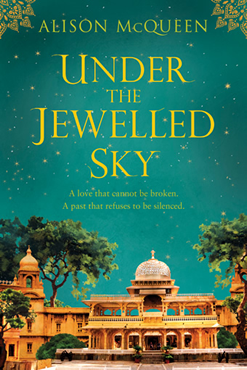
Under the Jewelled Sky by Alison McQueen: Thoughts and Giveaway

It's 1957 and Sophie Schofield is arriving in Delhi as the new wife of ambitious British diplomat Lucien Grainger.  Living in a specially designed ex-pat compound and mixing only with Brits trying to preserve the days of the Raj, Sophie finds herself yearning for the India she experienced as a teenager, living in the palace of a Maharaja with her doctor father.  The India she knew then, of heat and spices, is completely different from post-partition India, full of stifling social etiquette.  And the more she recalls the past, the more it becomes clear that it may not have left her at all.  Lucien doesn't measure up in any way to her first love, the Indian son of an employee of the Maharaji, and Sophie is soon caught up trying to keep the secrets that could bring her new life crashing down.

Under the Jewelled Sky was an enjoyable read.  Sophie is instantly likable as a main character and the book has a fast pace that makes it a quick and fun read.  It's obvious the author has a passion for India, as the beauty of the setting comes off clearly on every page.  McQueen is good at this kind of broad theme writing, as the decadence of the Maharaja and the absurdity of British diplomatic high society are also dealt with well.  I closed this book with a desire to visit India for myself.

Whilst I liked the themes of the book, particularly the issue of children born to parents of different race at this time, I wanted the book to be a bit more gritty than it was.  It left me with a nice cosy feeling (which is fine), but the skeptic in me was hesitant to believe all of the positive events.  For example, I couldn't believe that Sophie's mixed race child would even have been found by Jag's family in the carnage of Partition, let alone accepted so unequivocally by all family members.  McQueen does spend quite a bit of time writing about partition (one character is caught up in a camp), but I never truly felt the horror of the events.  The writing was very good, but I was seeking more balance and the positive atmosphere meant I was never scared for Sophie, even when events took a turn for the worse.  There was this sense that everything was pre-destined.

Despite this, Under the Jewelled Sky was perfect escapism.  It contains a good story set in an interesting setting, so is bound to appeal to fans of historical fiction.

Source: From the publisher, in exchange for an honest review.
Published: 25th April 2013
Score: 3.5 out of 5.


Thanks to the publisher, Orion Books, I am able to offer a giveaway of ten new women's fiction hardbacks.  The prize will include Under the Jewelled Sky as well as the latest books by Erica James and Kate Mosse. As the giveaway is hosted by the publisher, entrants must have a UK or Ireland address.  You don't have to be a blogger.  To enter, simply fill  out the form below:

Sunday, 21 April 2013

Sam Sunday #12: An Exhausting Week

I was absent from the internet for most of last week, busy having one of the most exhausting weeks I've had in a long time.  Most of you know that I'm a primary school teacher in the UK, and that I'm not allowed to discuss my job on the internet.  Well this week, we had OFSTED.  For the non-Brits, OFSTED are a national schools inspection service, who visit your school for two days and make a series of snapshot decisions on how good of a teacher you are and how good your school is.  Your teaching is judged in this way in a  twenty minute slot once every four years or so.  There are far-reaching and serious implications for the school (not least because the judgement lasts for years), so how you and the school do is crucial.

The things I could write this week, if I was allowed to write them!  All I will say is that I have been under a lot of stress and I'm now completely exhausted.  And my class have their SATs exams in just under a month, so I will need to keep the energy up.

This weekend I'm being kind to myself and having a proper break.  Yesterday was filled with gardening in the sun, reading, having a lie in, letting my husband cook for me and watching trashy TV shows.  Today I plan to do more of the same, plus watch the video lectures for my world history course on Coursera.  Thursday and Friday I had no room for anything in my head apart from teaching, so it's nice to slowly let other things back in :)

I've had less time for reading this week, but I'm pleased that I've finally managed to finish How to Read Literature by Terry Eagleton, as I've been working away at it for ages!  I had high hopes for it, but in the end it wasn't quite the book I thought it would be.  At the moment I'm reading an ARC of a historical fiction novel called Under the Jewelled Sky, for a blog tour I am participating in on Friday.  It's great escapism, so I'm definitely enjoying it.

This week, I've been reading:
  

Review posted:

Tuesday, 16 April 2013

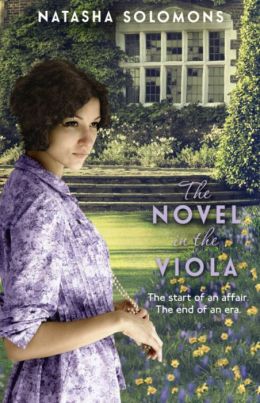
The Novel in the Viola by Natasha Solomons


[Also known as The House at Tyneford]

I picked up The Novel in the Viola for a light read, completely wanting a change of pace after finishing up George R.R. Martin's A Dance with Dragons.  It follows Austrian-born Elise Landau, youngest daughter of a mother who is a renowned singer and a novelist father.  Once rumours of the persecution of Jews start to reach Vienna, Elise's parents encourage her to place a newspaper advertisement in England, leading to Elise securing a job as a housemaid at Tyneford, on the South West coast of the UK.  With reassurances that her parents and older sister Margot will send for her as soon as they reach safety in the USA, Elise agrees to take up the post and becomes a somewhat unusual housemaid.  She doesn't fit in with the other servants or with the masters, and soon the old class distinctions at the house start to blur.  With war approaching and an unsuitable attraction to the master's son, Elise's arrival signals the beginning of the end for the way of life at Tyneford, and for the British class system as a whole.

The Novel in the Viola wasn't quite the light romance that I thought it would be.  It showed all signs of heading that way early on, but it also contained a healthy amount of hardships and personal battles for all of the characters.  I think I was influenced by Eva Ibbotson's The Secret Countess, a tale about a Russian countess who becomes a maid in England during the Russian Revolution and who has a much more satisfactory time of it than Elise does, decades later.  I was anticipating a fairy tale and it didn't quite work out in that way.

My first clue was that Elise was falling for Kit, the son of the owner of the house, far too soon in the story and things between them were remarkably uncomplicated.  In light romance novels, the couple don't usually get together until the end but Kit and Elise didn't take very long.  Additionally, there weren't enough meddling family members or serious love rivals!  The story is light and sweet at the beginning (in a good way), but as soon as the war arrives things get more serious.  Elise's parents told her they would be going straight to America themselves, but this turns out to be untrue and Elise is desperate to get them to safety.  Kit joins the navy and the D-Day landings are the culmination of months of worry for Elise and everyone at Tyneford.

I liked the way the novel focused on the death of the British upper-class way of life alongside Elise's story.  This happens mainly through the butler/ chief of household staff, Wrexham, a symbol of 'old,' you-will-have-your-tea-with-silverware-even-if-bombs-are-coming-through-the-ceiling Britain.  Even though the British end up winning the war, certain things were lost forever, whether for good or bad.  I know as a Brit myself this is something that I've grown up learning about in history lessons, Britain's declining role in the world after the war and the complete change in society that it brought about.

The Novel in the Viola could easily have missed the mark in several places (especially the ending), but it was always saved by Elise's strong narrative voice.  She's lively and a bit sarcastic, and she reminded me of Cassandra from I Capture the Castle;

"Feeling guilty for even thinking it, I wished that I could remember Mr Rivers carrying me in and Kit beside himself with worry.  It sounded quite charming, the way Mrs Ellsworth told it.  If only I hadn't rather spoilt things by being sick in Mr Rivers' shoes.  Violetta or Juliet or Jane Eyre would never have done such a thing."

On the whole, The Novel in the Viola is a solid, well-written book about the life of a Jewish maid in England during World War Two.  It might not have been the light book I thought it would be, but I enjoyed it just the same.

Source: Personal copy
First Published: 2011
Score: 4 out of 5

Read Alongside:
The Secret Countess by Eva Ibbotson - Russian countess is forced to work as a maid in England after the Russian Revolution and falls in love with the son of the house.  A well written fairy tale for a cold day.