Have you ever had one of those days where everything goes wrong? For Lucy Snowe, the narrator of Villette, her entire life is like one of those days. Having lost her family at a young age due to mysterious circumstances never quite revealed, she journeys alone to Villette where she becomes a governess for school-owner Madame Beck. Excelling at her work, she progresses to the station of teacher and has some emotionally fraught entanglements with the people around her.
In many ways, Villette was a difficult book to read. Lucy was a secretive narrator, holding some information back only to reveal it later and giving the reader few clues about her feelings. This meant I had to be paying close attention at all times to really get the best out of the book. But by the time I was half-way through, I was enjoying Lucy's reserve as it made any flashes of real feeling much more profound. I could also relate to this characteristic of hers; her pride and self-protection.
Another difficulty was the odd conversations written in French. I understand this adds authenticity but as someone who has never studied French (my school did German and Spanish), I worried that I missed some things. Bronte did provide just enough English in these sections for me to follow what was going on and it was only occasionally that French was used, but it was tricky for me.
So yes, this was a difficult book and it required much mental exertion but boy, was it worth it. Bronte's characterisation was simply flawless - very subtle but powerful. Somehow, without explicitly telling me much about each character, I felt as though I knew them as well as my friends. From Ginevra, Lucy's self-indulged and lively friend, to Madame Beck, a sneaky puppet-master with her eye at every keyhole, each character was fully formed. My favourite was Monsieur Paul, the literature teacher.
Bronte's wonderful writing meant I was connected to the characters, especially Lucy. So at certain points in the book, I was heartbroken right along with her. And this I think was the true power of the book - Bronte pulls you in and takes you right along with Lucy. All the other stuff faded into the background for me; the theological discussions, the morality and the pedagogy of teaching. That was all interesting too, but I was too busy living the book alongside Lucy.
Verdict: Not an easy read, but Villette repays any effort that you put into it.
Source: Kindle
Score: 4.5 out of 5
Tuesday, 20 September 2011
Sunday, 18 September 2011
Sunday Salon: Back to Work / Villette
You may have noticed that my posting rate has slowed considerably lately, and the reason for this is that I went back to work two weeks ago. After six long weeks of honeymooning and reading as much as I wanted to, it's been quite an adjustment getting back into the swing of busy every day life.
I've had a good start to this academic year. I have a new class, a new classroom to set up and I'm teaching in a year group that I've never taught in before. All this results in work being more time-demanding than it was last year, when I had a new class but in the same year group in the same classroom. It is nice to have a change and a bit of a challenge but it does encroach on my reading time.
Given that I've been so busy and my thoughts are all tied up with school, I don't really know why I decided that now would be the perfect time to read Charlotte Bronte's Villette. I'm making slow progress with it (my kindle declares I am now 69% done) but very much enjoying it so far. It's very deep and heart-felt, and it makes Jane Austen's books look positively light and fluffy. But after I finish it, I'm definitely up for something a bit easier to read.
Work should be settling down over the next few weeks as I get more used to my new working schedule, so I'm looking forward to reading and posting lots more soon.
Saturday, 10 September 2011
The Hundred Foot Journey by Richard C Morais
This book suffered from my high expectations because as soon as I got it out of the library, I couldn't wait to read it. Telling the fictional story of an Indian immigrant to first England, then France, who rises from kitchen apprentice to celebrated three-star Michelin chef, it ticked all of my reading boxes. Food - tick, other cultures - tick, immigrant experience - tick, faux-memoir -tick.
But unfortunately it was a mediocre book in many regards. I did like the central storyline but the book couldn't seem to decide whether it wanted to be a realistic 'autobiography' or a fairytale. As a result some of the situations felt very contrived and the main character, Hassan, had far too much luck to make the story credible.
Everything was much too happy too. There are some minor instances of prejudice but for the most part Hassan and his family fit in with rural France incredibly quickly and never miss home. Hassan gives up his native Indian cuisine in order to be a French chef without a second thought as he accepts immediately that French cooking is 'better'.
The characters were caricatures too. We had the old-fashioned grumpy French chef who didn't want to accept that an Indian person can cook better than she can. We had the nasty Michelin inspectors. We had angry chefs. We had a stereotypically large and boisterous Indian family. Which is why I think this novel would have worked much better with a touch of the fantastical, a touch of fairytale. It could have been a magical book that way.
Despite all of my criticisms, I never wanted to stop reading this book and it did pass the time enjoyably. The setting of rural France in the first half of the book was described absolutely beautifully and as someone who loves her food, I loved all of the cooking and restaurant sections. It's clear that Morais loves his food too and did a good amount of research into both French and Indian cuisine. But overall it just lacked that specialness.
Verdict: Interesting plotline but situations are too contrived and characters too stereotypical.
Source: Library
Published: 2011
Score: 2.5 out of 5
But unfortunately it was a mediocre book in many regards. I did like the central storyline but the book couldn't seem to decide whether it wanted to be a realistic 'autobiography' or a fairytale. As a result some of the situations felt very contrived and the main character, Hassan, had far too much luck to make the story credible.
Everything was much too happy too. There are some minor instances of prejudice but for the most part Hassan and his family fit in with rural France incredibly quickly and never miss home. Hassan gives up his native Indian cuisine in order to be a French chef without a second thought as he accepts immediately that French cooking is 'better'.
The characters were caricatures too. We had the old-fashioned grumpy French chef who didn't want to accept that an Indian person can cook better than she can. We had the nasty Michelin inspectors. We had angry chefs. We had a stereotypically large and boisterous Indian family. Which is why I think this novel would have worked much better with a touch of the fantastical, a touch of fairytale. It could have been a magical book that way.
Despite all of my criticisms, I never wanted to stop reading this book and it did pass the time enjoyably. The setting of rural France in the first half of the book was described absolutely beautifully and as someone who loves her food, I loved all of the cooking and restaurant sections. It's clear that Morais loves his food too and did a good amount of research into both French and Indian cuisine. But overall it just lacked that specialness.
Verdict: Interesting plotline but situations are too contrived and characters too stereotypical.
Source: Library
Published: 2011
Score: 2.5 out of 5
Thursday, 8 September 2011
Back To The Books Giveaway Hop WINNER
Using random.org, my winner is:
Linda Kish
who chose to receive Notes On A Scandal. I've contacted her by email, she has 48 hours to respond.
Tuesday, 6 September 2011
Wherever You Go by Joan Leegant
Wherever You Go is a beautifully complex novel about three Americans in Israel. Yona wants to reconnect with her sister, a settler involved in extremist politics. Greenglass is an orthodox teacher but having problems with his faith. Aaron is a college drop-out with family problems who is looking for a way to prove himself or something he can belong to.
Leegant weaves these three very separate lives together throughout the course of the novel and builds up to a dramatic finale. I found the most interesting character to be Dena, Yona's sister, who had completely devoted her life to one interpretation of her faith and for most of the book was unable to see anything else, including the person she had once been. I am non-religious so it was fascinating to be given a glimpse of life so led by religion and the different reasons people turn to religion.
For me, the best thing about this novel was how Leegant managed to portray such a broad spectrum of opinion about religion and politics in Israel, and by doing so demonstrated how complex the country is. I'm not Jewish or Israeli or even American and perhaps have been guilty of oversimplifying Israel and the Middle East in general, thinking things such as "Israelis think that...." or "Israelis are..." and Leegant's book reminded how just how complicated the situation is.
Leegant's book would be a great pick for a book group because it gave me so much to think about and so many questions to ask myself - At what point does religion become fundamentalist? Why do people turn to religion in bad times rather than good? Can people with opposing ideologies ever live together in peace? Can you ever redeem yourself from certain acts? What issues or causes would you devote your life to?
But I don't want you all to think this was just a stuffy, 'issues' book as it was also a story that was enjoyable to read with characters I came to care about. I would recommend it.
Source: From the author, in exchange for an honest review. Wherever You Go is already available in America and is released in the UK on September 17th.
Score: 4.5 out of 5
Don't forget to enter my Back To The Books Giveaway HERE!
Tomorrow is your last chance to enter.
Leegant weaves these three very separate lives together throughout the course of the novel and builds up to a dramatic finale. I found the most interesting character to be Dena, Yona's sister, who had completely devoted her life to one interpretation of her faith and for most of the book was unable to see anything else, including the person she had once been. I am non-religious so it was fascinating to be given a glimpse of life so led by religion and the different reasons people turn to religion.
For me, the best thing about this novel was how Leegant managed to portray such a broad spectrum of opinion about religion and politics in Israel, and by doing so demonstrated how complex the country is. I'm not Jewish or Israeli or even American and perhaps have been guilty of oversimplifying Israel and the Middle East in general, thinking things such as "Israelis think that...." or "Israelis are..." and Leegant's book reminded how just how complicated the situation is.
Leegant's book would be a great pick for a book group because it gave me so much to think about and so many questions to ask myself - At what point does religion become fundamentalist? Why do people turn to religion in bad times rather than good? Can people with opposing ideologies ever live together in peace? Can you ever redeem yourself from certain acts? What issues or causes would you devote your life to?
But I don't want you all to think this was just a stuffy, 'issues' book as it was also a story that was enjoyable to read with characters I came to care about. I would recommend it.
Source: From the author, in exchange for an honest review. Wherever You Go is already available in America and is released in the UK on September 17th.
Score: 4.5 out of 5
Don't forget to enter my Back To The Books Giveaway HERE!
Tomorrow is your last chance to enter.
Sunday, 4 September 2011
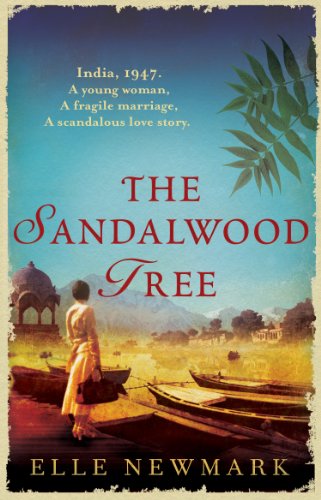
The Sandalwood Tree by Elle Newmark
The Sandalwood Tree tells two entwining stories of Western women in India at different times. The main story is that of American woman Evie, living in India in 1947 with her Fulbright scholar husband Martin and son Billy. A veteran of liberating the concentration camps in WW2, Martin is suffering from shell shock and their marriage is under strain. As India edges towards partition and the withdrawal of the British, the situation becomes increasingly volatile.
The other story, told around the main one, is a gem of a story about two unconventional Victorian women who grew up reading biographies of intrepid female explorers. Born in India, Felicity Chadwick takes the unusual step of living on her own, speaking Hindi and becoming involved in charity work. Seeking escape from the prospect of marriage, her friend Adela soon joins her and the two women become estranged from their fellow British settlers.
This was a book to read slowly and treasure. Both stories were fascinating, although I have to admit I preferred the Victorian story and would have liked to see a few more chapters about Felicity and Adela. Even though this was a historical fiction novel set in a different time and place, Newmark retained a strong focus on character and plot first. The book was really about love in all it's different forms, and the story of Martin and Evie trying to overcome his war experiences was touching.
There was also a vivid sense of place. Newmark visited India twice whilst writing this book and her writing is full of the sights and smells of the different locations. I enjoyed being transported away whilst reading and the descriptions of all of the different foods made me crave a curry! In fact, there was nothing I didn't enjoy about this book and it's one of my top reads of the year so far.
Verdict: A joy to read, highly recommended.
Source: Transworld Book Group Reading Challenge
Published: 2011
Score: 5 out of 5
Don't forget to enter my Back To The Books Giveaway HERE. It closes September 7th.
The other story, told around the main one, is a gem of a story about two unconventional Victorian women who grew up reading biographies of intrepid female explorers. Born in India, Felicity Chadwick takes the unusual step of living on her own, speaking Hindi and becoming involved in charity work. Seeking escape from the prospect of marriage, her friend Adela soon joins her and the two women become estranged from their fellow British settlers.
This was a book to read slowly and treasure. Both stories were fascinating, although I have to admit I preferred the Victorian story and would have liked to see a few more chapters about Felicity and Adela. Even though this was a historical fiction novel set in a different time and place, Newmark retained a strong focus on character and plot first. The book was really about love in all it's different forms, and the story of Martin and Evie trying to overcome his war experiences was touching.
There was also a vivid sense of place. Newmark visited India twice whilst writing this book and her writing is full of the sights and smells of the different locations. I enjoyed being transported away whilst reading and the descriptions of all of the different foods made me crave a curry! In fact, there was nothing I didn't enjoy about this book and it's one of my top reads of the year so far.
Verdict: A joy to read, highly recommended.
Source: Transworld Book Group Reading Challenge
Published: 2011
Score: 5 out of 5
Don't forget to enter my Back To The Books Giveaway HERE. It closes September 7th.
Friday, 2 September 2011
Lily Of The Nile by Stephanie Dray
Lily Of The Nile is part one in a series of books about the life of Cleopatra's daughter Selene. Born and raised in Alexandria as the daughter of Cleopatra and Mark Anthony, she lives a privileged life in a place where women are free to be as intelligent as men. After Cleopatra is defeated by Octavian, Selene is sent to Rome with her brothers and must learn to comply with the strict rules of Roman life, whilst coming to term with the loss of her parents, her throne and her country.
I love historical fiction but was slightly apprehensive about reading this book as I have read Michelle Moran's Cleopatra's Daughter, and liked her portrayal of Selene. But I shouldn't have worried - Dray's Selene is a strong character, heartsick over what has happened to her but determined to do all she can to make the best of her new situation. I liked all of the politics in this book and how Selene was able to use her intellect to manoeuvre something beneficial to her out of the emperor.
I also enjoyed the character of Selene's twin brother Helios, and liked how Dray used the two of them to show the reader two contrasting reactions to being defeated by the emperor - Selene chooses compliance in the hope of getting what she wants later on, but Helios chooses to fight. I would say that characterisation for me was the strength of this novel; Dray bought the historical figures to life and made each distinct. I particularly enjoyed Julia, the headstrong daughter of the emperor, and Octavia, the former wife of Mark Anthony who becomes devoted to helping his children.
The one thing that stopped me from really loving this book was the fantasy element of it. I enjoyed reading about the cult of Isis, especially the worship Selene witnesses in the temple, but I wasn't sold on the whole magic thing. I can believe that Selene believed that Isis could carve hieroglyphics on her arms, but not that it could actually happen.
Verdict: An enjoyable read more on the fiction side of historical fiction with a strong leading character.
Source: From the author in exchange for an honest review.
Score: 3.5 out of 5
And don't forget to enter my Back to the Books giveaway HERE.
I love historical fiction but was slightly apprehensive about reading this book as I have read Michelle Moran's Cleopatra's Daughter, and liked her portrayal of Selene. But I shouldn't have worried - Dray's Selene is a strong character, heartsick over what has happened to her but determined to do all she can to make the best of her new situation. I liked all of the politics in this book and how Selene was able to use her intellect to manoeuvre something beneficial to her out of the emperor.
I also enjoyed the character of Selene's twin brother Helios, and liked how Dray used the two of them to show the reader two contrasting reactions to being defeated by the emperor - Selene chooses compliance in the hope of getting what she wants later on, but Helios chooses to fight. I would say that characterisation for me was the strength of this novel; Dray bought the historical figures to life and made each distinct. I particularly enjoyed Julia, the headstrong daughter of the emperor, and Octavia, the former wife of Mark Anthony who becomes devoted to helping his children.
The one thing that stopped me from really loving this book was the fantasy element of it. I enjoyed reading about the cult of Isis, especially the worship Selene witnesses in the temple, but I wasn't sold on the whole magic thing. I can believe that Selene believed that Isis could carve hieroglyphics on her arms, but not that it could actually happen.
Verdict: An enjoyable read more on the fiction side of historical fiction with a strong leading character.
Source: From the author in exchange for an honest review.
Score: 3.5 out of 5
And don't forget to enter my Back to the Books giveaway HERE.
Subscribe to:
Posts (Atom)