Showing posts with label society. Show all posts

Thursday, 25 September 2014

Everyday Sexism by Laura Bates

In 2012 after being sexually harassed on London public transport Laura Bates, a young journalist, started a project called Everyday Sexism to collect stories for a piece she was writing on the issue. Astounded by the response she received and the wide range of stories that came pouring in from all over the world, she quickly realised that the situation was far worse than she'd initially thought. Enough was enough. From being leered at and wolf-whistled on the street, to aggravation in the work place and serious sexual assault, it was clear that sexism had been normalised. Bates decided it was time for change.  (from Goodreads).

Everday Sexism is a thoroughly depressing and yet important book.  Bates has collated the normal, run-of-the-mill experiences of countless  women, on a range of topics, and together it makes for pretty grim reading.  I was shocked to find out that one in three girls from 16-18 have experienced unwanted sexual touching at school, that women are still missing out on jobs in case they decide to take maternity leave, and that the unemployment rate for men in the recession has increased by only 0.32%, whilst for women it has jumped by almost 20%.  The statistics were shocking enough, but what makes this book more powerful is that Bates includes the individual stories of the women that have tweeted her and posted on the everyday sexism website.   I could identify with so many of the experiences - the newlywed woman being asked when she is going to start having babies, the pregnant woman who only ever gets asked about her pregnancy, and the teenage girls who know they are more than their looks, but can't escape their insecurities.   Bates also shows how these experiences are normalised in the context of 'banter', with women who protest to e.g. sexual comments getting responses like "can't you take a joke?" or "you should be flattered."


I think the chapter that made the most depressing reading was the one concerning teenage girls.  I was lucky enough to be a teenager before the internet was everywhere (the days of dial-up), and I'm sure that it's so much harder now social media means that sexual bullying is common.  I was shocked to read about the amount of rape jokes reported in secondary schools, but when I asked my husband about it (he's a secondary school teacher), his experience matched those in the book.  When I was at school, boys might have joked about how girls looked, and that is cruel, but to be the subject of jokes about raping you, or what they want to do to you, or to have private photos shared - I can't imagine how hard that must be.  Bates reports on the girls that have committed suicide as a result of all these things.


I've always known that if I had a girl, I would raise her to be a feminist, to value herself for more than her looks, and to know that she can do anything that she wants to do.  Reading Everyday Sexism, I've realised that it is just as important for me to raise my son to respect women, to see them as more than objects, but as friends, colleagues, partners and equals.  I don't care if my son wants to cry when he is upset or play with dolls, and I certainly will try my best to ensure that he judges men and women in the same way, as people.  


I'd definitely recommend Everyday Sexism.  It's depressing reading at times, but does end on a note of hope, with stories of how women are starting to protest against the current culture, and how things could change for the better.


Source: Personal copy (kindle)

Published: April 2014
Score: 5 out of 5

Saturday, 26 July 2014

Why Have Kids? by Jessica Valenti

I've been getting through a lot more kindle books lately. My most recent read was Why Have Kids: A New Mom Explores the Truth about Parenting and Happiness.  Written after the premature birth of Valenti's daughter Layla, the book explores the myths around motherhood from a feminist point of view.

The title of this book is somewhat misleading; it's not actually about whether or not you should have children, but about breaking down what society tells you should should feel and how you should act once you have them.  We have this big thing in our Western society about motherhood being the pinnacle of a woman's existence, and the notion that we should sacrifice everything for our children.  Valenti examines how unhealthy this viewpoint is, quoting research and giving anecdotes that show that children do best when they have parents who are well-rounded, who have their own interests, and who let them spend time with a variety of people.  It used to be that children were raised by whole communities ('it takes a village' and all that), but now more and more it is seen as best for just the parents, and particularly the mother, to bring them up, and to give up everything to do so.

Why Have Kids is written from a feminist perspective.  Valenti points out that even the most equal of relationships can take a traditional turn as far as gender roles are concerned when a baby is born. This is definitely true in my experience.  Prior to our son being born, we shared all the housework fifty-fifty.  But when my husband went back to work and I was at home with the baby, I found myself of course looking after the baby, but also doing the housework in the evening so he could have some time with the baby too.  This isn't because my husband doesn't want to help, it's just harder to share things evenly when a baby is involved. Things will change when I return to work as well, but for now that's just how it is.  But it's not just that - it's the way I am assumed to be the default parent.  If someone else is holding him and he cries, it's always "let's give you back to your mummy" rather than "let's give you back to your daddy". Questions about feeding or his weight are always directed to me.  I want us both to be equal parents, but society definitely doesn't see it that way.

Valenti also writes a lot about guilt.  As motherhood is built up to be the most important thing a woman will ever do, there's a lot of potential for self-punishment.  I found the chapter on breastfeeding particularly interesting, as this is something that causes a lot of guilt.  I'm not breastfeeding, for lots of reasons (mainly because my body physically couldn't do it after losing so much blood), and I still feel a bit guilty whenever I have to disclose this to anyone, like it makes me a bad mother.  If I was breastfeeding, I'd feel guilty about something else.  Valenti argues that there's this concept of a 'perfect' mother that is simply unreachable and that guilt is too much a part of being a Mum.  It doesn't help that parenting is one of those areas that everyone feels qualified to comment upon and judge.

I really enjoyed Why Have Kids?, it was well written and a good blend of research, commentary and the author's personal experience.  I'll definitely be hunting out other books by Valenti.

Source: Personal copy (kindle)
First Published: 2012
Score: 4 out of 5

Thursday, 20 February 2014

The Spirit Level by Richard Wilkinson & Kate Pickett


The Spirit Level is a non-fiction book that examines the prevalence of what we might think of as social problems in different countries (drug use, violence, obesity, poor educational performance, crime etc.). Wilkinson and Pickett argue that what matters is not how affluent a country is on average, but rather the level of inequality in the country.  All Western nations have reached a point where economic development has led to a comfortable standard of living, but the richest countries are not the happiest, or the ones with fewest social ills.   In fact, health and social problems are instead highly related to the difference in income between the top twenty and lowest twenty percent in that country, with richer countries like the USA and UK doing poorly compared to countries such as Japan and the Scandinavian nations.

This may all sound like common sense, but what Wilkinson and Pickett do in The Spirit Level is provide overwhelming evidence that inequality is damaging for all members of society, not just those at the bottom. Each chapter examines a different societal problem and time and time again, we see that inequality is strongly related to it.  Even things like the amount of trust you have in your community, your chances of developing a mental illness, the prevalence of chronic diseases and the rate of teenage pregnancies are highly correlated. And as Wilkinson and Pickett explained how the link between inequality and each 'problem' might work, the more I found myself nodding my head along with the book.  It just makes sense that the healthier societies are the ones where all members of society feel valued and like they have something to contribute.  Crucially, the authors show that inequality is damaging for the rich as well as the poor.

The sections dealing with the relationship between inequality and the different health and social problems were truly fascinating, and left me with lots to think about.  However, the book then moves on to discussing ways that inequality can be combated by ordinary members of the public, and here I felt it started to lose some steam.  I do agree with lots of their suggestions, especially employees having a stake/shares/voice in the company they work for, but this part of the book felt a bit meandering and at times, a little preachy, compared with the fast paced, factual arguments of the rest of the text.

On the whole, The Spirit Level is a truly thought provoking book that seeks to provide an answer to the question of why the richest countries aren't necessarily the happiest in the world.  It's thoroughly researched, fascinating to read and left me with lots to think about.  Recommended for anyone interested in society or politics.

Source: Personal Copy
First Published: 2009
Edition Read: Penguin Books, 2010
Score: 4 out of 5

Tuesday, 21 January 2014

The World Until Yesterday by Jared Diamond


For the vast majority of human history, we lived in traditional societies; small bands of people where everyone knew everyone else and survival came through hunting and gathering.  We like to think of our modern, Western societies as superior due to our technological and scientific breakthroughs, but do traditional societies have something to teach us after all?  In The World Until Yesterday, Diamond considers the topics of raising children, war, care for the elderly, health and religion, and questions whether there is anything we can learn from the way we lived for thousands of years.

The World Until Yesterday is definitely a thought provoking book.  Diamond has spent time among the traditional societies of New Guinea, and has also researched traditional societies still living in other parts of the globe.  He doesn't present them as a singular entity with no variation, and nor does he present a simple argument.  In each chapter, he looks at the different traditional societies and their approach and honestly compares it to modern life.  In some cases, modern life has undeniable benefits (e.g. a far smaller proportion of our populations die in wars) and sometimes, there is something to learn from the past.  It's a book to make you think and the chosen areas of focus are all interesting issues that we face in everyday life.

Personally, I found the chapters on childcare and care for the elderly to be the most interesting.  In traditional societies, parenting is shared among the extended family and also others in the community (alloparenting), which contrasts with our modern lifestyles, where distance and work commitments make this very difficult. This is something we've been thinking about a lot lately, as we're lucky enough to both have large families close by.  Child independence is also a bigger deal in traditional societies.  The chapter on the elderly was especially interesting as there was such a large variation among the societies mentioned; in some the elderly are deferred to without question and given the best of everything, but in others they are practically encouraged to commit suicide so as not to be a burden of resources.

What I liked best about The World Until Yesterday was the way that it was never preachy.  Diamond refrains from judging either modern or traditional societies, instead giving the reader the chance to think for themselves.  Some chapters identified small changes that we could all make to our lives (especially in regards to diet), and others were more broad.

Although The World Until Yesterday was full of fascinating information, it's a book to read for the ideas rather than the writing.  Diamond is keen to include examples from all of his research and personal experience, meaning that chapters can feel a bit repetitive sometimes.  If I've had an example of a society that practises infanticide, I don't need three additional examples too.  The writing is smooth and flowing, but it's not the best example of non-fiction writing I've ever read.  Still, it is extremely interesting and it's a great book to pick up if you're interested in society or how we live our lives.

Source: Personal copy
First Published: 2012
Edition Read: Penguin, 2013
Score: 4 out of 5

Saturday, 2 November 2013

The First Time: True Tales of Virginity Lost & Found by Kate Monro

Our modern societies are obsessed with virginity and the loss of virginity, but it's not something people talk about openly very often.  In The First Time, Kate Monro aims to shine a light on what virginity means to us by conducting interviews with men and women of all different ages, religions and experiences, be they straight, gay, disabled or asexual.  The interviews are organised into chapters on defining virginity, the changing roles of women during the twentieth century, virginity loss for men and the reasons people might decide to stay a virgin.  Each chapter contains interviews as well as some commentary on relevant social issues by Monro.

I actually really enjoyed The First Time.  I was impressed by the range of experiences that Monro was able to find and document; there is no heterosexual bias in the book and Monro goes out of her way to include experiences by disabled people as well as those who were coerced or even raped in situations of domestic violence.  Although not all of these experiences made for happy reading, the book was strengthened by the diversity of the interviewees and it meant that it could offer a more panoramic portrait of what virginity loss is like.

On the whole, the social commentary was informative but it was nothing ground-breaking, and this made it the weaker element of the book.  In particular, the chapter on women was full of information that anyone who has even a most basic knowledge of feminism would be familiar with.  It was interesting to see how women's attitudes towards virginity had changed over time as their roles in society changed, but the commentary itself was nothing new.  On the other hand, the chapter about asexuality was much more interesting, as this isn't something that is widely discussed in society.  We have a tendency to think anyone who doesn't have sexual urges is very strange, so it was good to see Monro exposing and challenging that mindset.  I also liked that Monro adopted a very open definition of virginity loss, acknowledging that it means different things to different people.

On the whole, The First Time is well worth reading for the interviews alone, as the commentary is a bit hit and miss.  Anyone particularly interested in social history or gender issues will surely get a lot from this book.

Source: Personal copy (kindle)
First Published: 2011
Score: 3.5 out of 5

Wednesday, 13 February 2013

Enslaved: True Stories of Modern Day Slavery edited by Jesse Sage and Liora Kasten

Most of us tend to think of slavery as something that happened in the past.  We imagine Africans at slave markets, on overcrowded ships or working on plantations.  In Enslaved, Jesse Sage and Liora Kasten, the directors of the American Anti-Slavery Group, hope to enlighten people to the fact that slavery still exists in the modern world in a number of forms, from the traditional to sex slavery to labour camps.  Inspired by the slave narratives of the nineteenth century, each chapter is the narrative of a person who has been a modern day slave, in a variety of different contexts.

Enslaved was certainly eye-opening.  Whilst I was aware that modern day slavery existed, I had no idea of the extent and scope of it.  To pick just a few narratives, in this book we meet: Micheline, a Haitian woman trafficked to the USA; Abuk, captured in a raid in Sudan; Jill, kept as a sex slave in suburban America; Beatrice, who thought she had got a job as a maid only to be enslaved and Harry, a victim of Chinese labour camps.  There's also a narrative of a slave owner in Mauritiana, that still operates what we would think of as a traditional slavery system.  Taken together, the chapters definitely raise awareness and they opened my mind to the suffering of millions of people around the world.

The more I read, the more the connection between slavery and poverty became clear.  People who are living in extreme poverty are the ones that will apply for au-pair or maid positions abroad, without knowing enough about the situation to know if they are safe.  They are the women driven to work as prostitutes, vulnerable to sex trafficking. The final chapter in the collection is about what we can do as readers and abolitionists, but it didn't really address this connection.  Whilst I agree that there's much Western citizens can do about slavery (raising awareness being the least of them), until poverty as a whole is tackled it will continue.  Corrupt governments and failing states have much to do with modern day poverty.

I think Enslaved is an important book, one to pass one and discuss with the people you see regularly.  Modern slavery is an invisible thing, suffered by people that generally aren't educated or literate enough to raise awareness or push for change.  It's not an easy read but it will make you think.

Source: Library
First Published: 2006

Sunday, 29 April 2012

The Origins of Sex by Faramerz Dabhoiwala

Subtitled A History of The First Sexual Revolution, The Origins of Sex promises to explain how the Western world, and England in particular, went from policing sexual behaviour to a more liberal viewpoint in the eighteenth and nineteenth centuries.  Drawing on court records, novels, newspapers, art and debate, Dahoiwala argues that the Enlightenment changed sexual behaviour in ways that still impact us today.

Thoughts:
I was excited about starting this book as I'm usually a big fan of social history.  I was instantly hooked by the descriptions of attitudes towards sex in the 1600s, of men and women hanged and beaten for engaging in adultery or pre-marital sex.  The idea of sex as part of public life, policed by the community rather than something private seems so foreign to us now.

Dabhoiwala then goes on to explain how attitudes changed.  There are four main arguments made throughout the course of the book; that the breakdown of religious authority led to people being allowed to have contrasting views, that the Enlightenment made society more liberal, that women started to have a public voice for the first time and that mass media publicised sex and made celebrities out of famous mistresses.  All these factors meant that sex came to be seen as something private, not something to be policed by the legal system or by members of the community.

I found the arguments convincing and the subject matter fascinating but unfortunately reading this book was a struggle.  The same arguments were repeated over and over again, just with the use of different examples.  I know Dabhoiwala had completed an impressive amount of research, but I don't think the reader needs to hear about all of it in order to appreciate the arguments.  The tone of the writing is also very academic and dry and I don't think I would have finished the book if I hadn't agreed to provide a review for it.  It's just a shame as the subject is so interesting but yet the writing makes it less so, by the time I was half way through I was wanting to move on to something else.

Verdict: Fascinating subject matter but hard to get through.
Source: From the publisher via NetGalley
Published: 1st May 2012
Score: 2.5 out of 5

Read Alongside:
City of Sin by Catharine Arnold - History of prostitution in London.

Tuesday, 20 March 2012

Half The Sky by Nicholas Kristof and Sheryl Wudunn


When I first saw Half The Sky mentioned on Eva's blog, A Striped Armchair, I knew it would be something I would want to read as soon as possible.  It's a non-fiction examination of problems facing women in the developing world and includes issues such as sex trafficking, female genital mutilation, honor killings, maternal health and rape.  The examination of these topics is enhanced by individual accounts of the women Kristof and Wudunn met and also success stories of organisations working at the front line improving lives for women across the world.

Half The Sky is a shocking book.  Even though I knew about most of these issues individually, it was still a shock to read such a comprehensive account of all of them together; when I closed the book I was very grateful to be a British woman living comfortably in the Western world.  The statistics on rape were the ones that really got to me - in the Congo over 90% of women past the age of puberty had been raped, often brutally in a way that meant their health was forever ruined.  I can't even get my head round that statistic.

Kristof and Wudunn make it clear that lots of these problems are easily overcome, that it's an issue around the way women are perceived around the world.  Young girls in families are more likely to be malnourished because what food there is goes to boys.  Women given treatment to prevent them passing on HIV to their newborn children often refuse to use the powdered milk because that's 'not how it's done in their village'.  Improved maternal health is relatively easy to provide, it's just not a priority because women are not seen as a priority.

But despite all of this, Half The Sky isn't all doom and gloom.  There are many stories of women who have overcome terrible situations (one story about a young girl trafficked into being a prostitute and then infected with HIV really got to me) but who have gone on to lead positive lives.  As well as this, there are organisational success stories of normal people saying 'enough is enough' and actually doing something to make the situation better.

Interestingly, Kristof and Wudunn seem to be against traditional aid agencies.  Whilst recognising that they can do a lot of good, the emphasis is on grassroots organisations and the ways that the West can support without 'going in there to sort it all out'.  There are links provided to organisations in the appendix and it's easy for the reader to find ways to support them (I am now offering a microloan through kiva and would recommend it to others).

This kind of book isn't really about the writing but it's clear, accessible and easy to read.  I would recommend this to everyone, male and female as it's something that is worth investing time in.  These issues aren't just women's issues, they are issues facing humanity as a whole.

Verdict: Powerful read about the role of women in the developing world.
Source: Library
First Published: 2010
Score: 4.5 out of 5

Sunday, 3 July 2011

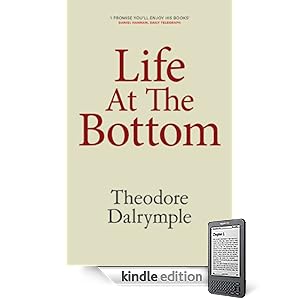
Life at the Bottom by Theodore Dalrymple

Theodore Dalrymple is a British consultant psychiatrist who works both at an inner city hospital and in a prison.  Life at the Bottom is a collection of essays about what he describes as the 'underclass' of British society - people without jobs or good education or stable family lives.

As you can guess from the way he labels them 'underclass', Dalrymple wasn't exactly an objective observer.  I'm sure his views come from decades of experience with thousands of patients but he came across as overly pessimistic.  He didn't seem to realise that as a psychiatrist, he would naturally see the patients that most need help i.e. those that are not responsible, functioning members of society.  From these patients, he has drawn big conclusions that aren't always true.  For example, he makes a lot of statements about the education system that as a teacher, I know are false.  If he has fabricated and exaggerated in that area, it's reasonable to think he would have in others too.

Putting his bias aside, Life at the Bottom was pretty depressive reading.  Dalrymple's main argument is that what is holding people back is not poverty or lack of opportunity, but ideas and attitudes.  And it did have a ring of truth - there are schools where your life would be made a misery if you do well in lessons, and families without aspiration, into their third generation of unemployment.  You absorb the values and attitudes of those you grow up with, and those attitudes can be a big brake on success.

In one essay, Dalrymple describes the experience of foreign doctors who come to do a year's placement in the NHS.  At first they are amazed at how well everyone is looked after, and at how no one is allowed to go hungry, sick or cold.  But as time goes on, their attitude changes as they see a poverty of ambition rather than a material poverty.  Dalrymple contrasts this with the poor he saw when he worked in Africa, who took pride in always trying to better themselves.  I do think too many people have poverty of ambition, in all sections of society, not just in the 'underclass'.

I will say that benefits and the sections of society that Dalrymple describes are an area I feel unsure of, politically.  I used to have very clear cut liberal views but experience has clouded that a bit.  Life at the Bottom hasn't made it any simpler, but it was interesting to read such a strong Conservative position.

Verdict: Interesting and a good conversation-starter
Source: Bought for my kindle
Score:  3 out of 5

Tiny Library

The Literary Blog Directory is now up to 30 blogs!  Thanks again to everyone who is taking part or publicising.  Click on the picture for blogs to read, more information or to sign up.

Saturday, 13 November 2010

What on Earth is Going On? by Tom Baird & Arthur House

My boyfriend and I are one of those sad couples that like to read aloud to each other.  We don't do it every day, and it takes us a long time to get through a book.  Therefore we have the following criteria when choosing a joint book:  topic has to interest us, the book has to be relatively short and chapters must be short enough to be read aloud in ten to fifteen minutes.  Previously we read Animal Farm (my pick) and enjoyed it, and this time he picked What on Earth is Going on?

Synopsis: The subtitle of this book is 'A Crash Course in Current Affairs', and it pretty much does what it says on the tin.  It's divided into chapters arranged alphabetically, each of which is about a different current affairs issue (from topics such as politics, health, the economy, other nations etc).  Each chapter is then divided into shorter sub-sections that give you a brief outline of the issue, assuming you have no prior knowledge of the subject whatsoever.

Score: 4 out of 5

I consider myself to be a relatively well-educated person and I both watch and read the news, but whilst reading this book I was amazed at how much I didn't know.  I found the history of nations with conflicts particularly interesting, especially the chapters on Sri Lanka, Burma and Georgia.  The chapters dealing with economics or finance were less interesting for me personally, but still informative.  I would like to say I now fully understand hedge funds, but that would be a lie!

The best thing about this book is that it gave you lots of information at a beginners level and beyond without being at all patronising.  The writing style was simple and straight-forward and the information chunked into short memorable sections.  There is also the odd touch of humor to keep things light and away from the academic zone.   There could always be arguments about what is kept in and what is omitted, but as an introduction or a refresher in current affairs, I don't think it could be beaten.

The major downfall is that this is the kind of book that will date extremely quickly.  Already reading it in 2010 rather than when it was published in 2009 there was some out of date information: Gordon Brown is no longer Prime Minister, and the last UK coalition goverment wasn't in 1945 anymore!  The whole book is written from a UK perspective, but I found there to be a good balance between domestic and foreign issues. 

Overall, it was easy to read, informative and a good refresher course in what is going on in the world.  Recommended.