Showing posts with label magic. Show all posts

Thursday, 6 February 2014

The Night Circus by Erin Morgenstern

In the late nineteenth century, Celia and Marco are protégés of magicians capable of wonderful feats.  Both have been raised with the knowledge that one day they will face an opponent in a competition testing their skills in every way.  That competition takes the form of a circus that opens only at night, and that contains a dazzling array of tents and performances; from ice gardens to a cloud maze and a wishing tree.  The circus is hugely popular with the public, who attend in droves, not quite understanding that magic is the basis of everything around them.  But as the years pass, the performers and circus workers start to notice something unusual, and the pressure of maintaining such a complex competition arena starts to tell on Celia and Marco.  Matters are further complicated when their feelings for each other start to intrude on their desire to win.

I've owned The Night Circus ever since it came out in hardback, because I am a sucker for hype.  I tend to buy hyped books when they are hyped (and this one is a beautiful hardback) but then wait a few years to read them, when I can approach the book with a clear head.  Despite having read many glowing reviews of The Night Circus in the past, I tried to approach it as I would any other novel.

And The Night Circus is a very good book.  I wouldn't say it's as strong as it has been made out to be, but it's distinctive and unique.  Morgenstern's writing is extremely visual and the circus just came to life in my imagination, with little effort on my part.  I adored the style of the circus, and the way all of the little details, like the clock and the red scarves, were described fully.  I longed to visit the circus and see the tents for myself.  The magical atmosphere matched the historical setting perfectly, and I can not fault Morgenstern's 'vision' for the novel at all.

As well as this, the plot was interesting and the competition element kept things moving along at a brisk pace; the story never dragged.  Celia and Marco were both well developed characters and although their romance was a little intense and overdone at times, it fit with the magical elements of the story.  The secondary characters were perhaps more interesting than the main ones, especially Celia's father and the twins, Poppet and Widget.  All the characters were described in the same visual way as the circus itself, and this made them really come to life.

Actually, there's not much I didn't like about the The Night Circus.  I think the only reason I didn't love it in a 5-out-of-5 star way is that I couldn't help but compare it to Jonathan Strange and Mr Norrell.  Both are stories of magic rooted in nineteenth century England, and The Night Circus just falls a bit flat by comparison.  It doesn't have the depth or mythology of Jonathan Strange, and comes across as more style over substance.  It's still an excellent book and one I would highly recommend, it's just not quite up there with my absolute favourites.

Source: Personal copy
First Published: 2011
Score: 4 out of 5

Tuesday, 4 January 2011

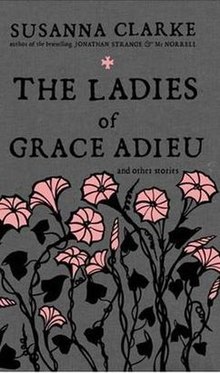
The Ladies of Grace Adieu and Other Stories by Susanna Clarke

Susanna Clarke's Jonathan Strange and Mr Norrell is one of my favourite books of all time, so as soon as I discovered that she had also written this collection of short stories set in the same world, I had to read it.  Better four years late than never!

The stories in The Ladies of Grace Adieu are all set in a green, forested England where the boundary between magic and reality is very blurred.  Before writing Jonathan Strange Clarke spent a lot of time researching English legends and folklore, and this has paid off as the stories read like authentic Grimm-style fairy tales.  Most of the stories centre on the world of Faerie and it's inhabitants, the kind of world where you might wander down a never-ending path, kill someone with embroidery or fall victim to a trickster Faerie prince.  There are eight stories in the collection.

Score: 4.5 out of 5

I had high hopes for this collection and it didn't disappoint.  I just love the world that Clarke has created and the sinister characters in it.  In some ways, the Faeries and the setting reminded me of all the Enid Blyton books I used to read as a child with fairies, goblins and dwarves (and I mean that in a good way).  Like Jonathan Strange, Clarke has made this book quasi-academic with an introduction by a "professor of faerie studies" and footnotes in some of the stories.  She also continues to copy the 19th century writing style.  Personally I enjoy these techniques, but I know they aren't for everyone.

The stories were varied in length and some were more engaging than others.  I particularly enjoyed Mr Simonelli, about a man who discovers his father was a fairy and does battle with a fairy prince.  Antickes and Frets was about Mary Queen of Scots attempting to kill Queen Elizabeth by embroidering a curse into a gift for her.  In The Ladies of Grace Adieu, a Jane Austen meets Brothers Grimm kind of tale, Jonathan Strange discovers that women have ancient magic too and The Duke of Wellington Misplaces His Horse is set in the village of Wall, from Neil Gaiman's Stardust. There wasn't a single story in the collection I didn't enjoy, although I thought Tom Brightwind  was a touch too long.

The theme of most of the stories was humans coming up against and battling wits with fairies and other forms of magic.  The secondary themes that I could see where the role of women in society and friendship between humans and fairies.  The main problem with the collection was that the stories didn't seem particularly organised and there was no over-arching plot or links between them.  Susanna Clarke had put together seven of these stories from previous publications and added the eighth for this collection, and it did have a slightly cobbled together feel.

But that's a minor complaint.  The writing was beautiful, the book itself was beautiful and I very much enjoyed reading it.  Definitely recommended for Jonathan Strange fans, it would also serve as a good introduction to Clarke's world for those put off by how long Jonathan Strange is.