Friday, 31 August 2012

Winner of the Historical Fiction Giveaway Hop


I used random.org to select the winner of the Partial to the Past Historical Fiction Giveaway Hop out of the 122 entries.

The winner is....Missy from Honeybee's Attic.

 Congratulations Missy!  She chose to receive a copy of Alice Hoffman's The Dovekeepers.  I've sent you an email asking for your address.


I loved this book, hope you enjoy it as much as I did.
 

Wednesday, 29 August 2012

The eNotated Alice in Wonderland by Lewis Carroll and Pam Sowers

I'm very familiar with the story of Alice in Wonderland.  I read it several times as a child and for the last two years, I've also taught it to my classes as part as a cross-curricular unit on the Victorians.  But here's the thing - whilst I know the story very well, I'm not familiar with critical interpretations of it.  My focus on teaching it to young children has always been to inspire creativity, to imagine wonderlands of our own, not to analyse it for meaning.  So I was pleased to be approached by eNotated Classics and offered a copy of The eNotated Alice in Wonderland to review.  It's an electronic version of the story with parts highlighted.  These direct you to notes that explain the text, offer context or give a theoretical viewpoint.  As well as this, there are two short essays after the story that give more interpretation.

This review isn't going to be about the story of Alice in Wonderland, but rather my experience with the notes themselves and how this added to my reading.  Believe it or not, this is the first time I've read an annotated version of a classic and on the whole I enjoyed it.  The notes that I appreciated the most where the ones that gave background context about Carroll himself and the inspiration for the story.  I knew Alice was a real girl, but I didn't know she kept rabbits as pets, actually had a cat called Dinah or that the Queen of Hearts was based on her rather overbearing mother (I hope the mother herself didn't find this out!).

I knew a fair bit about the Victorians before reading this, but added bits of context are always welcome.  For example, I wasn't aware that families often renamed their servants, even going so far as to give a string of servants the same name so that they would only have to learn one name.  Apparently, 'Mary Ann' was a popular name for a servant.  Alongside these context notes, I liked the ones about Carroll's construction of the story and how this changed over time; the tea party wasn't in the original draft, meaning the Mad Hatter and March Hare were initially absent.

My feelings about the notes offering critical interpretation were more mixed.  I was interested to see the theories but had I been reading the story for the first time, they would have stopped me coming up with my own ideas about what the story means.  For that reason, I think versions like this are best suited to those already familiar with the story.  Sometimes there were a lot of notes on each page and I didn't know which ones to select.  I read this on an old kindle so I don't know if this would work on colour devices, but it might be nice to somehow differentiate the context notes from the theory ones, so the reader can select just the notes they are interested in.   I also think the notes best suited to an American audience as there were a few explanations of British phrases that I personally didn't need the notes for; 'leave off' and 'box her own ears' were a few examples.

I do feel that I got more out of the text reading the notes alongside it.  The two essays at the end were very interesting (I wish there had been more) and I feel I have more of an understanding of Carroll and why he wrote the story he did.  The inclusion of many illustrations from early editions was a nice touch that made reading more pleasurable.  On the whole, I'd recommend this to others, especially those already familiar with the story.

Source: From the publisher for review
First Published: 2012
Score: 4 out of 5

Monday, 27 August 2012

The Vampire Lestat by Anne Rice

Last summer, I read and reviewed Interview with the Vampire.  I was a big fan of the film but unfortunately found the book disappointing.  Whilst I enjoyed the actual story, I thought the writing was long winded and Louie irritating.  Nevertheless, I decided to try the second volume of the series because Lestat is more appealing as a character to read about and several people mentioned that The Vampire Lestat is more action packed than Interview with the Vampire.

 The Vampire Lestat opens in San Francisco in 1984 with Lestat realising that the journalist from the first book has published Interview with the Vampire. It's riding high in the fiction charts and humans have no idea that the 'story' inside the pages is actually true.  Despite it being taboo, Lestat decides to respond by writing his own account of his life and this is what he bulk of The Vampire Lestat covers.  We follow him from his aristocratic beginnings in Revolution-era France through his travels around the world as he attempts to find out why vampires exist before finally settling in New Orleans.  Along the way we meet many more vampires and hear their stories as Lestat traces the source of vampirism back to Ancient Egypt.  But will the vampire population allow Lestat to publish his book?

The Vampire Lestat is a chunky book at 500+ pages but it reads quickly and fluently.  I enjoyed it much more than I enjoyed Interview with the Vampire.  One of the reasons for that is simply that Lestat is an easier character to read than Louie, he doesn't indulge in self-pity and is very impulsive, which leads to a lot more 'action'.  Lestat is also curious about the world around him and other vampires, which opens the door for Rice to bring in some more stories alongside his.  Although Lestat is the centerpiece of the novel he finds older vampires and they tell their story to him, meaning the book covers a wide time period and many perspectives.  I appreciated this variety.

There's also a lot more information about vampires in this book.  We find out why vampires exist, more about the rules that govern their existence and how vampires can differ from each other.  I don't know if world-building is the right world for a novel such as this, but the 'vampire theory' feels more thought-out than it did in Interview with the Vampire and it makes sense as a whole.  I especially appreciated that the vampires themselves couldn't agree about how best to be a vampire and what they should/shouldn't do.  This made for some interesting conflicts as the book progressed.

The Vampire Lestat is pure escapism.  I breezed through it and thoroughly enjoyed it.  However, some parts crossed the line into silly/tacky, especially the Lestat as a twentieth century rock-star sub-plot at the very beginning and end.  Having said that, I enjoyed it much more than Interview with the Vampire and would definitely read the third in the series, Queen of the Damned.

Source: Library
First Published: 1985
My Edition: Source Books, 2008
Score: 4 out of 5

Saturday, 25 August 2012

Colour: Travels Through the Paintbox by Victoria Finlay

When I saw this book reviewed at A Striped Armchair, I knew it was one I would have to hunt down and read immediately.  You see, I have a thing for colour.  I am not an artist but colour lights up something in my brain; when I lived with my parents and felt sad, I would go and lie in the bright yellow hallway and feel instantly better.  Colours can change my emotions and make me feel different things, calm me down, cheer me up or soothe me.  A whole book about the history of colours and how they are made sounded perfect.

Colour is part travel, part history.  Finlay has divided the book according to the rainbow and investigates how each colour was made in the time before synthetic colours.  Where possible, she visits countries of traditional production and learns how to make these colours herself and also about how colour production changed societies and cultures.  Finlay writes about why certain colours are given a high status (e.g. purple as the colour of royalty), compares how the same colours were made in different countries and why some became prized over others.

I really enjoyed Colour.  Finlay is an engaging writer who is fascinated by her subject matter and this comes across on the page.  Finding out how colours were made was truly compelling as I had no idea that humans were so inventive.  From sea snails to animal bones to bug blood to precious stones, there seems to be nothing colourful in nature that was not exploited for paint or dye at some time in history.  I was fascinated with the complicated process of making colour, of how you go from a rock of lapis lazuli to a blue oil paint and how artists used to make their own colours and tones according to what they wanted to paint.  Colour had power in history and there are plenty of accounts of countries and places become rich by making a fade-resistant paint that could be exported.  Finlay does a good job of explaining how these colours then became exulted and held up by society, part of the fabric of life.

Although I enjoyed the travel sections, where Finlay meets people living where colours were made in the past and discusses the legacy of colour with them, these sections took a backseat for me to the sections about actually making the paint or dye itself.  I would also have liked to learn more about modern paint making, about how many of the traditional colour sources are still used, and how the transition was made from natural to artificial colours.  Finlay clearly feels like something has been lost as we're forgetting the secrets of natural colours and I couldn't help but agree with her.  I'd be interested to see a modern paint-making factory to investigate how different things really are (I know you can still buy some traditional colours).

All in all, an absorbing and well written non-fiction book that I'm happy I picked up.  I'd recommend it to anyone who enjoys travel or history, or anyone who has ever mixed their own colours using a watercolour set. 

Source: Library
First Published: 2002
Score: 4 out of 5

Friday, 24 August 2012

Historical Fiction Giveaway Hop


One of my favourite genres is historical fiction, so I'm delighted to be taking part in the Partial to the Past Historical Fiction Giveaway Hop, hosted by Bippity Boppity Book.  Since starting this blog, I have read and reviewed 56 historical fiction books so I thought I would give the winner of my giveaway an opportunity to choose any book they like from the historical fiction books I have reviewed.  With 56 to choose from, there should be something to suit most historical fiction fans.

You can find my reviews by genre here, or by clicking on the 'reviews by genre' tab.  Scroll through the first few categories and you will come to the historical fiction section.

Rules:
* This is an international giveaway.  Anyone can enter as long as the book depository ships to your current address.
* One entry per person, enter by completing the form below
* If you win the giveaway, I will contact you by email and give you 48 hours to respond with your shipping address before another person is selected.
* You are free to change your choice of book if you win the giveaway so don't worry too much about it, I'm just interested in which books will be the most popular.
* You don't have to follow my blog although new followers are of course very welcome.  If you want me to visit your blog in return, make sure to leave your blog address :)
* Giveaway ends midnight, August 30th.

Enter:

Don't forget to visit the rest of the blogs hosting giveaways:

Thursday, 23 August 2012

A Suitable Boy: Part One


It's been exactly a month since the start of the Suitable Boy group read and I'm happy to say I have completed the 538 pages in the first section of our reading.  I was excited to start this book as I'm a fan of Indian literature and many times in the past I had picked it up off my shelf only to be daunted by the size - it's 1474 pages and the font is tiny.  But now I've started it, I'm so glad I did as it's well on the way to becoming a favourite.

The anchoring story is about Lata and her mother's search to find her a suitable husband but it's really a panoramic novel with four main families and many more secondary characters.  There are lots of  stories happening at once and Seth jumps between them (the family trees at the front are very helpful and mine are now covered in annotations!).  I'm enjoying the Chatterji family the most so far, they are more liberal than the other families and have some memorable characters, such as Meenakshi, who would have a lot in common with Scarlett O'Hara, Kakoli who has a German boyfriend, and writer Amit.   Their little quirk of speaking in rhyming couplets is cute.

I've been surprised at how much religious tension is right up there in the novel.  It's set straight after partition (Bangladesh doesn't exist at the moment) and there's some Hindi characters, like Kedarnath, who have had to flee from Pakistan to India and who have lost everything.  The theme is really hammered home when Lata falls in love with Kabir, a fellow student.  They have been dating for a while before she finds out he is a Muslim and when her family finds out too, there are serious repurcussions.   Her mother even thinks "it was one thing to mix socially with Muslims, entirely another to dream of polluting one's blood and sacrificing one's daughter."  Not quite a 'suitable boy' then!

I could go on for ages about this book and all the different characters in it as I'm completely loving it.  After a month, they feel like old friends and I have a feeling this book is going to be truly epic before we reach the finishing line.  My absolute favourite character is Lata's Mum, Mrs Rupa Mehra, who is the very definition of interfering busybody and martyr.  She would be so irritating to have as a mother but she's certainly funny to read about.  My favourite quote of hers:

"I have to do everything in this house, and no one cares for me.  Everything goes wrong and I have to make peace.  I have slaved for you all my life, and you don't care if I live or die.  Only when I'm burned on the pyre will you realise my worth!" This is basically said every time someone disagrees with her.  I think we are in for a long search for a suitable husband for Lata!

Coincidentally, this is the first time I have ever read two books at once as I was a strictly monogamous reader before this.  At first I found it difficult to read two things at once, and felt guilty for picking up another book, but now I have 'seen the light', so to speak.  Reading this alongside other books means the length and my progress do not bother me as I'm still completing other titles.  I'm free to sink into the story and read at a leisurely pace, which has been lovely.

If you're doing the group read, please leave me a link to any posts you've done - I'd love to see what you all think.  Which storyline and characters are you most closely following?

Tuesday, 21 August 2012

Top Ten Books I've Read Since Starting Blogging


What a great topic this week over at The Broke and the Bookish.  We're supposed to think back over all the books we've read since starting our blogs and select the best ten.  I enjoyed looking back over my review collection but found it very hard to narrow it down to only ten.  I've read over 200 books since starting blogging and many of them have been excellent.  My top ten isn't ranked or in any order, and clicking the title of the book will take you to my review.

Without further ado:


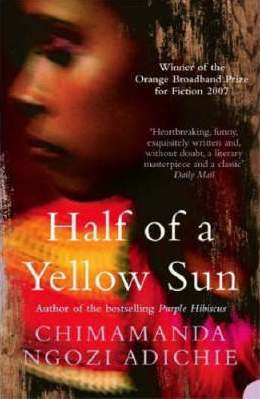
1. Half of a Yellow Sun by Chimamanda Ngozi Adichie - This is a fiction book about the Nigerian civil war told through several different narrators.  Although this novel is brutal in parts, it's beautifully written and was my first introduction to Adichie, now one of my favourite authors.  I've since read and loved Purple Hibiscus and The Thing Around Your Neck.


2. The Crimson Petal and the White by Michel Faber - This gothic story is set in Victorian London and recounts the rise of Sugar, a prostitue who is determined to make something of herself.  A chunkster at 600+ pages it's a real epic full of memorable characters from all classes in London.  I loved the grotty realism of it and how panoramic it was.


3. The Shadow of the Sun by Ryszard Kapuscinski - Kapuscinski is a Polish journalist and this book is a collection of dispatches written from Africa from the 1950s through to the 1990s.  He has a knack of being in historically important places at the right times and the book is full of coups, key players like Mugabe and also adventure and danger.  There's a good balance of fact and personal impressions and the whole book is full of Kapuscinski's admiration of Africa.


4. Shanghai Girls by Lisa See - I am a big historical fiction fan so was happy to discover Lisa See through recommendations on blogs.  Although most people seem to prefer Snow Flower and the Secret Fan I like Shanghai Girls, the story of two Chinese sisters fleeing to America during the war with Japan.  It's got more grit that you would expect and the two main characters, May and Pearl, are full of flaws and so feel very real.  The sequel, Dreams of Joy, is worth a read too.


5. The Song of Achilles by Madeline Miller - I picked this one up somewhat reluctantly as I was working my way through the Orange longlist earlier in the year; I didn't think of myself as a fan of classics (Greek and Roman).  A retelling of the Trojan war had limited appeal.  But, as regular readers will now, I fell in love with the love story in the book and the beautiful writing and spent months pushing it on my real life and blogging friends.  I was so pleased to see this win the Orange Prize this year.


6. Carmilla by Jospeh Sheridan Le Fanu - I love gothic classics and I love old-style vampire books so I was always going to enjoy Carmilla.  Set in a deserted castle in dark woods in Austria, Carmilla is a short book packed full of atmosphere. One for fans of Dracula.


 7. Small Island by Andrea Levy - I read this very early on in blogging and loved it.  Set in post WW2 London, it's the story of Jamaican immigrants Gilbert and Hortense and British residents Queenie and her soldier husband Bernard.  It's a fantastic examination of the immigrant experience and subtle prejudice.


8. In the Shadow of the Banyan by Vaddey Ratner - I read this one only last week but it's destined to be a favourite.  It's about the Cambodian genocide through the eyes of a child and it's heart-breaking and beautiful all at the same time.


9. Lords of the Horizon by Jason Goodwin - I love history and have always been fascinated by Asian/Middle Eastern history.  This history of the Ottoman Empire is simply the most well written history book I have ever read.  Full of interesting little facts (I loved the Sultan who named his children after major religions), it's both excellent history and excellent writing - a rare combination.


10. Annabel by Kathleen Winter - In my opinion, this is a seriously underrated book.  It's about a hermaphrodite baby raised as a boy in rural Canada in the 1960s and it's stunning.  It's about rural communities and self-identity and what it means to be a girl or boy.

So there you go, the top ten books I've read since starting blogging.
What's your top ten?