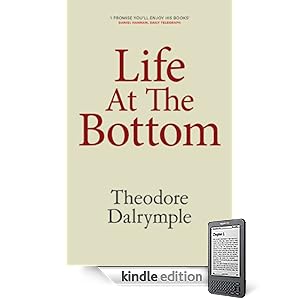
Theodore Dalrymple is a British consultant psychiatrist who works both at an inner city hospital and in a prison. Life at the Bottom is a collection of essays about what he describes as the 'underclass' of British society - people without jobs or good education or stable family lives.
As you can guess from the way he labels them 'underclass', Dalrymple wasn't exactly an objective observer. I'm sure his views come from decades of experience with thousands of patients but he came across as overly pessimistic. He didn't seem to realise that as a psychiatrist, he would naturally see the patients that most need help i.e. those that are not responsible, functioning members of society. From these patients, he has drawn big conclusions that aren't always true. For example, he makes a lot of statements about the education system that as a teacher, I know are false. If he has fabricated and exaggerated in that area, it's reasonable to think he would have in others too.
Putting his bias aside, Life at the Bottom was pretty depressive reading. Dalrymple's main argument is that what is holding people back is not poverty or lack of opportunity, but ideas and attitudes. And it did have a ring of truth - there are schools where your life would be made a misery if you do well in lessons, and families without aspiration, into their third generation of unemployment. You absorb the values and attitudes of those you grow up with, and those attitudes can be a big brake on success.
In one essay, Dalrymple describes the experience of foreign doctors who come to do a year's placement in the NHS. At first they are amazed at how well everyone is looked after, and at how no one is allowed to go hungry, sick or cold. But as time goes on, their attitude changes as they see a poverty of ambition rather than a material poverty. Dalrymple contrasts this with the poor he saw when he worked in Africa, who took pride in always trying to better themselves. I do think too many people have poverty of ambition, in all sections of society, not just in the 'underclass'.
I will say that benefits and the sections of society that Dalrymple describes are an area I feel unsure of, politically. I used to have very clear cut liberal views but experience has clouded that a bit. Life at the Bottom hasn't made it any simpler, but it was interesting to read such a strong Conservative position.
Verdict: Interesting and a good conversation-starter
Source: Bought for my kindle
Score: 3 out of 5
The Literary Blog Directory is now up to 30 blogs! Thanks again to everyone who is taking part or publicising. Click on the picture for blogs to read, more information or to sign up.
Sunday, 3 July 2011
Friday, 1 July 2011
Literary Blog Directory is Active!
The literary blog directory is now open!
Click on the picture above to be taken to the directory, where you can find lots of lovely blogs and the sign-up sheet if you want to be added to the list.
This has been a learning curve for me already. I've had a few YA blogs and blogs about children's books wanting to sign up, which surprised me because it is a directory for literary fiction and contemporary adult fiction. To keep it that way, I'm only adding blogs that meet this criteria. Sorry if you added your details but are not in the directory, it's nothing personal about you or your blog, it's just that you don't fit with what the directory is about.
There are 15 blogs listed already, which I'm amazed at. I'm pleased that there is a good mix of blogs I was already following and new blogs. Looking at all your favourite literary book choices has made me realise how much there is out there I still want to read! I'm also glad that I included the 'about' section rather than making it a straightforward list of links, it's much more interesting to look at because of it.
If you are in the directory, please check that you are happy with your entry and then grab the button from the right hand side of my blog. If you follow any new blogs because of the directory, let them know about it.
All publicity posts and comments very much appreciated.
Thursday, 30 June 2011
Literary Blog Directory
So I'm going for it with the literary blog directory! My idea is that each entry will have your blog title, a short sentence about you, your blog and your favourite literary books. So for example my entry would look like:
Name: Sam
About: I'm a primary school teacher from the UK who loves literary fiction, historical fiction and exciting non-fiction. I post mainly reviews and the odd discussion post. I read mainly books that are already published.
Favourite literary books: Small Island by Andrea Levy and Half of a Yellow Sun by Chimamanda Ngozi Adichie.
At the moment I plan to host this on my blog, but if it expands a lot it might end up needing it's own space. You'll need to bear with me, I've not organised anything like this before! If you want to be included, simply fill out the form below and I'll get things started. I will add blogs in the order they tell me they want to be added.
Of course, this directory will need a bit of publicising if I stand a chance of reaching blogs that I'm not already following. I'm going to do my bit on the book blogs website and by searching for new blogs, but if you know of a blog you think I should list, either let them know about my little project or let me know in the comments box and I'll get in touch with them. Brownie points for anyone who reposts or publicises :)
Any questions, email me at s.murray10@yahoo.co.uk
Wednesday, 29 June 2011
Purple Hibiscus by Chimamanda Ngozi Adichie
After reading and loving Half of a Yellow Sun (my review), I promised myself I would read more of Adichie's work. Purple Hibiscus was her debut novel and it tells the story of fifteen year old Kambili and her brother Jaja, who are growing up under the shadow of a strict religious father in politically unstable Nigeria.
It's soon clear that Kambili's father is abusive. The whole family walk on eggshells, scared to mispronounce a word during Mass, not look grateful enough whilst praying or come into contact with any heathens (Nigerians following their traditional beliefs). When Kambili's mother asks to not join the family on a visit to the Reverend as she has morning sickness, the father beats her so hard she has a miscarriage.
But this isn't a typical abusive-family story. Although I think the effects of the abuse were very well written - Kambili withdraws into herself and starts to police herself in the way her father would - there is more to the story than that. Although their father is abusive at home, he's somewhat of a hero to human rights organisations as he's one of the few prepared to stand up to an unelected government. He donates large percentages of his money to charities for the under-priviledged and goes out of his way to help his friends. I found this dichotomy the most interesting part of the novel - how good people can do bad things - and felt like Adichie was putting forward a message about how religion can corrupt when taken too literally or to extremes.
There was lots to like about this book. Aunty Ifeoma, who helps the siblings stand up for themselves, was a wonderful character. Like Half of a Yellow Sun, the whole thing was very well written in a simple yet engaging style.
Yet I do think it lacked that something special. The political situation of Nigeria was only a back-drop and was never fully explained - the story would have worked as well set in England, or America. The ending seemed rushed and unexpected based on what we knew about the characters.
Verdict: Worth a read, but go for Half of a Yellow Sun first.
Source: Owned
Score: 4 out of 5
It's soon clear that Kambili's father is abusive. The whole family walk on eggshells, scared to mispronounce a word during Mass, not look grateful enough whilst praying or come into contact with any heathens (Nigerians following their traditional beliefs). When Kambili's mother asks to not join the family on a visit to the Reverend as she has morning sickness, the father beats her so hard she has a miscarriage.
But this isn't a typical abusive-family story. Although I think the effects of the abuse were very well written - Kambili withdraws into herself and starts to police herself in the way her father would - there is more to the story than that. Although their father is abusive at home, he's somewhat of a hero to human rights organisations as he's one of the few prepared to stand up to an unelected government. He donates large percentages of his money to charities for the under-priviledged and goes out of his way to help his friends. I found this dichotomy the most interesting part of the novel - how good people can do bad things - and felt like Adichie was putting forward a message about how religion can corrupt when taken too literally or to extremes.
There was lots to like about this book. Aunty Ifeoma, who helps the siblings stand up for themselves, was a wonderful character. Like Half of a Yellow Sun, the whole thing was very well written in a simple yet engaging style.
Yet I do think it lacked that something special. The political situation of Nigeria was only a back-drop and was never fully explained - the story would have worked as well set in England, or America. The ending seemed rushed and unexpected based on what we knew about the characters.
Verdict: Worth a read, but go for Half of a Yellow Sun first.
Source: Owned
Score: 4 out of 5
Tuesday, 28 June 2011
Literary Blog Directory?
One of my favourite things about blogging is reading other people's blogs and getting book recommendations from them. The trouble is, I find it really hard to find new blogs to read. The majority of blogs seem to be centered around paranormal books, YA, genre fiction or lots of memes. And whilst that's great, and obviously popular, it's not for me. I like to read about literary and contemporary adult fiction and non-fiction. Does anyone else find this?
I was wondering if it would be a good idea to make a directory of sorts of blogs that review literary fiction? It wouldn't have to be the only thing you review (I'm as guilty of reading trash as the next person!), but you would read contemporary non-genre adult fiction or classics regularly. That way I, and anyone else that wants to, wouldn't have to plough through lots of paranormal YA blogs to find great blogs to read.
If you think you would use this (and it wouldn't just be me!), let me know in a comment. If there is a bit of interest I'll start compiling it and taking recommendations. I know Amanda at The Zen Leaf used to do a classics directory, I was thinking of something along those lines.
Saturday, 25 June 2011
Tiger, Tiger by Margaux Fragoso
The back of this memoir states that it is a book about a relationship between a fifty-one year old man and a seven year old girl. And it's controversial because it is about just that, a relationship. A socially unacceptable, manipulative, controlling relationship, but a relationship nonetheless and Fragoso writes about it honestly, resisting the temptation to paint herself sympathetically to appeal to readers.
Margaux is seven when she meets Peter at a swimming pool - she sees him playing a game with two boys and decides that she wants to join in. Over time Margaux and her mentally ill mother come to like and depend upon kind, generous Peter as a way of getting away from Margaux's father, who has good intentions but is at best absent and at worse an alcoholic brother. Gradually Peter makes himself indespensible to Margaux and starts to groom her. When their relationship becomes sexual, Margaux sees it as something she must just put up with in order to get the love and affection she craves. Even when she has a chance to get away from Peter, she can't bring herself to give up the only person in the world that she thinks truly cares for her, despite all of the things she hates doing. She shuts away that part of herself into a new persona and becomes slowly desensitised.
Although a memoir like this, in which conversations are recreated and events described in great detail, can only capture the essence of what happened, Tiger, Tiger felt like it had a lot of truth. I've read some other reviews of it and lots of people are reacting against Margaux for becoming sexually manipulative and not getting away when she had the chance. But for me, this only shows Peter's power as he has manipulated Marguax to the extent where she becomes the instigator and sexual behaviour is completely normalised, something to put up with to get treats. I think it was brave for Fragoso to write it like that and to show ambiguity in all of the people she includes, rather than making it just black and white, good and evil. There is a scene that people object to in particular, where Marguax tries to become sexually manipulative with someone else, but that is how children who are abused often react, and that's usually how the abuse comes to light.
The worst part for me was how lots of the adults knew what was going on, but decided not to know and to look the other way. All they do is spread gossip rather than help. I think that does happen in society - no one wants to think that a child could be getting abused, so people find reasons to think something else. In the afterword, Fragoso writes that she hopes the book will help people to become more aware that paedophiles don't look like monsters and don't act stereotypically, and I hope so too.
Verdict: A worthwhile read.
Source: Bookshelf
Score: 4 out of 5
Margaux is seven when she meets Peter at a swimming pool - she sees him playing a game with two boys and decides that she wants to join in. Over time Margaux and her mentally ill mother come to like and depend upon kind, generous Peter as a way of getting away from Margaux's father, who has good intentions but is at best absent and at worse an alcoholic brother. Gradually Peter makes himself indespensible to Margaux and starts to groom her. When their relationship becomes sexual, Margaux sees it as something she must just put up with in order to get the love and affection she craves. Even when she has a chance to get away from Peter, she can't bring herself to give up the only person in the world that she thinks truly cares for her, despite all of the things she hates doing. She shuts away that part of herself into a new persona and becomes slowly desensitised.
Although a memoir like this, in which conversations are recreated and events described in great detail, can only capture the essence of what happened, Tiger, Tiger felt like it had a lot of truth. I've read some other reviews of it and lots of people are reacting against Margaux for becoming sexually manipulative and not getting away when she had the chance. But for me, this only shows Peter's power as he has manipulated Marguax to the extent where she becomes the instigator and sexual behaviour is completely normalised, something to put up with to get treats. I think it was brave for Fragoso to write it like that and to show ambiguity in all of the people she includes, rather than making it just black and white, good and evil. There is a scene that people object to in particular, where Marguax tries to become sexually manipulative with someone else, but that is how children who are abused often react, and that's usually how the abuse comes to light.
The worst part for me was how lots of the adults knew what was going on, but decided not to know and to look the other way. All they do is spread gossip rather than help. I think that does happen in society - no one wants to think that a child could be getting abused, so people find reasons to think something else. In the afterword, Fragoso writes that she hopes the book will help people to become more aware that paedophiles don't look like monsters and don't act stereotypically, and I hope so too.
Verdict: A worthwhile read.
Source: Bookshelf
Score: 4 out of 5
Sunday, 19 June 2011
A Discovery of Witches, Or, Why are So Many New Books Part of a Series?
I placed a hold on A Discovery of Witches by Deborah Harkness from my library anticipating a cosy, bookish, supernatural read in the manner of The Historian. It was all of those things and I very much enjoyed the first 400 pages or so. Diana, a witch who refuses to use her powers, accidentally uncovers a rare and powerful alchemy manuscript in a library in Oxford. By breaking the spell on the book she attracts the attention of supernatural creatures, who all hope the manuscript can tell them something about their nature, reason for existing and future. There is abrooding anti-hero vampire, an evil witch, torture and lots of passages about books, manuscripts and meeting Shakespeare in person. It was a bit of a guilty pleasure, but I was loving it.
But then I got into the final section, in which Harkness left the realm of the cosy, Historian kind of story and veered into the epic battle realm. Lots of plot points were introduced and I was thinking that surely Harkness can't hope to resolve all of this within the next two hundred pages?
Sure enough, the ending was vague and a bit of a cliff-hanger. A quick look around the internet revealed that Harkness is intending to make her story into a trilogy. And maybe it's because I read The Passage recently and had the same issue, but I can't help but wonder:
Why can't anyone tell a story in a single volume anymore?
A Discovery of Witches has almost 600 pages and I'm sure Harkness could have told a great story in that space, especially if she had stuck to the cosy side of things. The Passage is even longer. Whenever I look for kindle books they always have brackets by them saying (series title #1). Now I don't mind reading a good series, but I'm sure they are becoming much more common than they used to be.
Maybe it's down to publishers? Maybe having found a lucrative stream of revenue they want to exploit it by having lots of books about the same characters. But it's definitely not what I as a reader want. A series shouldn't feel dragged out like lots of them do now.
What's your opinion? Do you agree that there are more series' now? Is it a good thing?
But then I got into the final section, in which Harkness left the realm of the cosy, Historian kind of story and veered into the epic battle realm. Lots of plot points were introduced and I was thinking that surely Harkness can't hope to resolve all of this within the next two hundred pages?
Sure enough, the ending was vague and a bit of a cliff-hanger. A quick look around the internet revealed that Harkness is intending to make her story into a trilogy. And maybe it's because I read The Passage recently and had the same issue, but I can't help but wonder:
Why can't anyone tell a story in a single volume anymore?
A Discovery of Witches has almost 600 pages and I'm sure Harkness could have told a great story in that space, especially if she had stuck to the cosy side of things. The Passage is even longer. Whenever I look for kindle books they always have brackets by them saying (series title #1). Now I don't mind reading a good series, but I'm sure they are becoming much more common than they used to be.
Maybe it's down to publishers? Maybe having found a lucrative stream of revenue they want to exploit it by having lots of books about the same characters. But it's definitely not what I as a reader want. A series shouldn't feel dragged out like lots of them do now.
What's your opinion? Do you agree that there are more series' now? Is it a good thing?
Subscribe to:
Posts (Atom)