Until today, I had not bought a single book since December 2010. I had been doing very well at requesting books from the library, reading from my shelves and requesting from NetGalley. I was even not wanting to go into bookshops anymore, and told myself I was over new books. But then I had a worrying time at the hospital today and decided to cheer myself up with new books. I fear the floodgates are open again! Summaries pinched from amazon.
From Oxfam (Charity Shop):
The Piano Teacher by Janice Lee
Claire Pendleton, newly married and arrived in Hong Kong in 1952, finds work giving piano lessons to the daughter of Melody and Victor Chen, a wealthy Chinese couple. While the girl is less than interested in music, the Chens' flinty British expat driver, Will Truesdale, is certainly interested in Claire, and vice versa. Their fast-blossoming affair is juxtaposed against a plot line beginning in 1941 when Will gets swept up by the beautiful and tempestuous Trudy Liang, and then follows through his life during the Japanese occupation. As Claire and Will's affair becomes common knowledge, so do the specifics of Will's murky past, Trudy's motivations and Victor's role in past events. Love the setting of this one...
African Laughter by Doris Lessing
After the wars fought by black nationalists for the liberation of Rhodesia ended in 1980 and the nation of Zimbabwe came into being, Lessing was able to return to the homeland that had officially exiled her 25 years earlier because of her opposition to the white government. The distinguished novelist ( The Fifth Child , etc.) details four trips she made to Zimbabwe in 1982, 1988, 1989 and 1992 in a series of haunting vignettes dealing with facets of life there: the corruption--and achievements--of the black government, poverty, land erosion, wildlife destruction, the emergence of feminism, the death of Marxism, AIDS and the daily problems of the people as they cope with social change
I love Doris Lessing, so can't wait to read this one.
Tess of the D'Urbervilles by Thomas Hardy
After her impoverished family learns of its noble lineage, naive Tess Durbeyfield is sent to make an appeal to a nearby wealthy family who bear the ancestral name d'Urberville. Tess is seduced by dissolute Alec d'Urberville and secretly bears a child, Sorrow, who dies in infancy. Later working as a dairymaid she meets and marries Angel Clare, an idealistic gentleman who rejects Tess after learning of her past on their wedding night
I'm not much of a Hardy fan, but want to try this.
From Waterstones:
The Wilderness by Samantha Harvey
It’s Jake’s birthday. He is sitting in a small plane, being flown over the landscape that has been the backdrop to his life – his childhood, his marriage, his work, his passions. Now he is in his mid-sixties, and he isn’t quite the man he used to be. He has lost his wife, his son is in prison, and he is about to lose his past. Jake has Alzheimer’s. As the disease takes hold of him, Jake struggles to hold on to his personal story, to his memories and identity, but they become increasingly elusive and unreliable.
Really hope this is as good as it sounds...
Tiger, Tiger by Margaux Fragoso
I still think about Peter, the man I loved most in the world, all the time. At two in the afternoon, when he would come and pick me up and take me for rides; at five, when I would read to him, head on his chest; in the despair at seven p.m., when he would hold me and rub my belly for an hour; in the despair again at nine p.m. when we would go for a night ride, down to the Royal Cliffs Diner in Englewood Cliffs where I would buy a cup of coffee with precisely seven sugars and a lot of cream. We were friends, soul mates and lovers.
I was seven. He was fifty-one.
I want to see for myself what all the controversy is about...
The Secret Life of Bees by Sue Monk Kidd
In Sue Monk Kidd's The Secret Life of Bees, 14-year-old Lily Owen, neglected by her father and isolated on their Georgia peach farm, spends hours imagining a blissful infancy when she was loved and nurtured by her mother, Deborah, whom she barely remembers. These consoling fantasies are her heart's answer to the family story that as a child, in unclear circumstances, Lily accidentally shot and killed her mother.
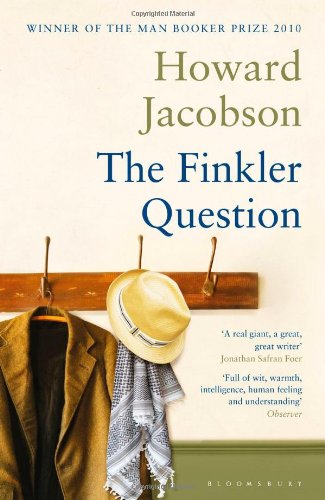
The Finkler Question by Howard Jacobson
He should have seen it coming. His life had been one mishap after another. So he should have been prepared for this one. Julian Treslove, a professionally unspectacular and disappointed BBC worker, and Sam Finkler, a popular Jewish philosopher, writer and television personality, are old school friends. Despite a prickly relationship and very different lives, they've never quite lost touch with each other - or with their former teacher, Libor Sevick, a Czechoslovakian always more concerned with the wider world than with exam results.
I've not had much luck with Booker winners, but Jacobson writes for the newspaper I read and I love his columns.
The Tiger's Wife by Tea Obreht
A tiger escapes from the local zoo, padding through the ruined streets and onwards, to a ridge above the Balkan village of Galina. His nocturnal visits hold the villagers in a terrified thrall. But for one boy, the tiger is a thing of magic - Shere Khan awoken from the pages of The Jungle Book. Natalia is the granddaughter of that boy. Now a doctor, she is visiting orphanages after another war has devastated the Balkans. On this journey, she receives word of her beloved grandfather's death, far from their home, in circumstances shrouded in mystery
I've always enjoyed Orange prize winners and hope this will be no exception!
I am now feeling a bit guilty for breaking my ban, but can't wait to read all of my new books!
Friday, 17 June 2011
Tuesday, 14 June 2011
Salem's Lot by Stephen King
You probably already know that this book is about vampires. And not sparkly, friendly, romantic vampires as in Twilight or True Blood, but proper, old-fashioned, rip your throat out vampires. As King says in his introduction to my copy (for which I sadly couldn't find the right cover for on the internet), he loved Dracula growing up, and it really shows.
In fact, the main vampire, Barlow, could be seen as a bit of a Dracula rip-off. He's Eastern European, has a smooth, persuasive voice and smells of decay. When he arrives in Salem's Lot, him and his human assistant, Straker, set about slowly taking over the town and infecting it's residents one by one until the town is deserted by day but active at night.
There are other Dracula parallels too - there's a band of heroes, including a pretty woman/love interest who gets attacked by the main vampire at some point. The vampire 'rules' are Stoker's as well- to become a vampire you only need to be bitten three times, none of this also drinking from the vampire stuff. But to be fair to King, the parallels read more as a homage than as copying. King's story is distinct enough for it not to matter.
The real strength of Salem's Lot was the setting, the Lot itself. It's made clear in the book that Barlow chose Salem's Lot because it was a town in the grip of lots of minor, human evils and therefore conducive to bigger evil. There's a great section at the beginning of the book where we meet all of the town characters (drunks, abusive parents, agnostic priests, loveless families), and for a minute I thought I was reading Peyton Place. This led to the uncomfortable feeling later in the book where as a reader you were glad that the characters were being harmed, and almost on Barlow's side.
This book was scary to me, but I am a bit of a wimp. I'd say it's amongst King's scarier books but not as scary as It or The Shining. Vampire horror is much more graphic than this now so for some it could seem a bit tame.
Verdict: Read it on a dark night
Source: Library
Score: 4 out of 5
In fact, the main vampire, Barlow, could be seen as a bit of a Dracula rip-off. He's Eastern European, has a smooth, persuasive voice and smells of decay. When he arrives in Salem's Lot, him and his human assistant, Straker, set about slowly taking over the town and infecting it's residents one by one until the town is deserted by day but active at night.
There are other Dracula parallels too - there's a band of heroes, including a pretty woman/love interest who gets attacked by the main vampire at some point. The vampire 'rules' are Stoker's as well- to become a vampire you only need to be bitten three times, none of this also drinking from the vampire stuff. But to be fair to King, the parallels read more as a homage than as copying. King's story is distinct enough for it not to matter.
The real strength of Salem's Lot was the setting, the Lot itself. It's made clear in the book that Barlow chose Salem's Lot because it was a town in the grip of lots of minor, human evils and therefore conducive to bigger evil. There's a great section at the beginning of the book where we meet all of the town characters (drunks, abusive parents, agnostic priests, loveless families), and for a minute I thought I was reading Peyton Place. This led to the uncomfortable feeling later in the book where as a reader you were glad that the characters were being harmed, and almost on Barlow's side.
This book was scary to me, but I am a bit of a wimp. I'd say it's amongst King's scarier books but not as scary as It or The Shining. Vampire horror is much more graphic than this now so for some it could seem a bit tame.
Verdict: Read it on a dark night
Source: Library
Score: 4 out of 5
Friday, 10 June 2011
How I Live Now by Meg Rosoff
For my 21st birthday (way back in 2007!), I got a lovely collection of Penguin Celebration paperbacks and most of them turned out to be great books (English Passengers, White Teeth, How to be Good, Notes on a Scandal, The Other Side of the Story). Sitting lonely beside them for all that time has been How I Live Now.
How I Live Now tells the story of fifteen year old Daisy, who is sent to England by her new Stepmother to live with her cousins in the countryside. Whilst she is there war breaks out and Daisy and her cousins must learn to survive and cope with all of the horror it brings.
The best and worst thing about this book was that it was written in the style of a stream of consciousness. At first this took a lot of getting used to and Daisy came across as superficial and silly and I did have to push myself through the first few chapters. But as the book progressed, I was really sucked into Daisy's world and I started to appreciate how Meg Rosoff has created one of the most realistic and touching portrayals of being a teenager I have ever read. Like most teenagers, Daisy is a bundle of contradictions; weak and strong, silly and serious and shallow but also capable of very profound insights in a no-nonsense kind of way. She matures massively throughout the book and feels almost like a real person by the end.
Even though we never get to find out much about the war and it's all a bit dystopian, Rosoff does a good job in a short number of pages of describing the reality and horror of war. There was one passage in particular where I could almost feel the emotion humming off of the page.
The one weak point for me was the love story. Not because Daisy and Edmond are cousins, but because this book was Daisy's book and we never really understood Edmond or the attraction between them. I much preferred the way Rosoff wrote about Daisy's relationship with her younger cousin, Piper, and how this sisterly relationship helped her work things out.
Verdict: A quirky, touching read.
Score: 5 out of 5
Source: Shelf.
How I Live Now tells the story of fifteen year old Daisy, who is sent to England by her new Stepmother to live with her cousins in the countryside. Whilst she is there war breaks out and Daisy and her cousins must learn to survive and cope with all of the horror it brings.
The best and worst thing about this book was that it was written in the style of a stream of consciousness. At first this took a lot of getting used to and Daisy came across as superficial and silly and I did have to push myself through the first few chapters. But as the book progressed, I was really sucked into Daisy's world and I started to appreciate how Meg Rosoff has created one of the most realistic and touching portrayals of being a teenager I have ever read. Like most teenagers, Daisy is a bundle of contradictions; weak and strong, silly and serious and shallow but also capable of very profound insights in a no-nonsense kind of way. She matures massively throughout the book and feels almost like a real person by the end.
Even though we never get to find out much about the war and it's all a bit dystopian, Rosoff does a good job in a short number of pages of describing the reality and horror of war. There was one passage in particular where I could almost feel the emotion humming off of the page.
The one weak point for me was the love story. Not because Daisy and Edmond are cousins, but because this book was Daisy's book and we never really understood Edmond or the attraction between them. I much preferred the way Rosoff wrote about Daisy's relationship with her younger cousin, Piper, and how this sisterly relationship helped her work things out.
Verdict: A quirky, touching read.
Score: 5 out of 5
Source: Shelf.
Sunday, 5 June 2011
Shelfari
After having a snoop around Library Thing, Goodreads and Shelfari, I've gone ahead and got a Shelfar account. There's not much on there at the moment as I'm still in the process of adding all of my books and reviews, but I'm hoping to use it regularly.
Does anyone else use it? If so, post your link and I'll follow you. At the moment I only have one follower :(
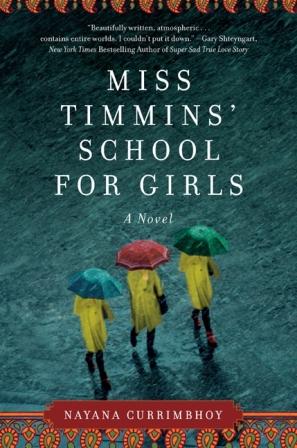
Miss Timmins' School for Girls by Nayana Currimbhoy
India, 1974. Miss Timmins' School for Girls is a throwback from the British colonial days; now Indian parents send their children there for a British style boarding education. Charulata Apte is a new teacher at the school and must find her own path away from the safety of her family home. Just as she starts finding her feet, a teacher she has befriended is murdered and suspicion falls on various members of the community.
This book was much broader in scope than I had anticipated. I expected a who-dunnit set in India but it was so much more - it was truly a coming of age novel, as Charu deals with sexuality, the role of women, becoming an effective teacher, relationships and subtle prejudices.
The novel is split into three broad sections. The first is narrated by Charu as she settles into the school, the second by a pupil, Nandita, in the immediate aftermath of the murder, and the final by Charu again as the truth comes out. In my opinion the first section was the best. As a teacher myself, I enjoyed the way Currimbhoy wrote honestly about the challenges of teaching and I liked the boarding school setting (it took me back to my Enid Blyton days!). I also though Currimbhoy wrote the relationships between Charu, the other teachers, her family and the pupils realistically, with emotional depth.
However as the book went on, the writing became a bit meandering and it seemed to lose focus. The same scenes were dwelled on by different characters, which became a bit repetitive. There was a clever twist at the end (I didn't manage to guess the murderer), but the book could have been edited down to make the final sections pacier and more engaging. The secondary 'mystery' of Charu's parents' background was almost more interesting to me than the primary mystery of who killed the teacher.
Verdict: Good debut novel by a talented writer.
Source: ARC via NetGalley
Publisher: Harper Collins
Available: 21st June 2011
Score: 3.5 out of 5
This book was much broader in scope than I had anticipated. I expected a who-dunnit set in India but it was so much more - it was truly a coming of age novel, as Charu deals with sexuality, the role of women, becoming an effective teacher, relationships and subtle prejudices.
The novel is split into three broad sections. The first is narrated by Charu as she settles into the school, the second by a pupil, Nandita, in the immediate aftermath of the murder, and the final by Charu again as the truth comes out. In my opinion the first section was the best. As a teacher myself, I enjoyed the way Currimbhoy wrote honestly about the challenges of teaching and I liked the boarding school setting (it took me back to my Enid Blyton days!). I also though Currimbhoy wrote the relationships between Charu, the other teachers, her family and the pupils realistically, with emotional depth.
However as the book went on, the writing became a bit meandering and it seemed to lose focus. The same scenes were dwelled on by different characters, which became a bit repetitive. There was a clever twist at the end (I didn't manage to guess the murderer), but the book could have been edited down to make the final sections pacier and more engaging. The secondary 'mystery' of Charu's parents' background was almost more interesting to me than the primary mystery of who killed the teacher.
Verdict: Good debut novel by a talented writer.
Source: ARC via NetGalley
Publisher: Harper Collins
Available: 21st June 2011
Score: 3.5 out of 5
Thursday, 2 June 2011
Wedding Overload!
I am on a one week holiday from work at the moment, the last before our wedding on the 27th July. Consequently, I've been rushing around trying to do all of the things that we just can't get done in term time as both of us are teachers and can't make daytime appointments.
This week, we have:
1. Ordered the cakes (we're having cupcakes)
2. Paid the registry office and confirmed details of the ceremony
3. Picked up my wedding dress
4. Been to two bridesmaids fittings
5. Bought my wedding make-up and had a trial
6. Booked the car
7. Booked the hairdresser
8. Sorted out the problem with the honeymoon flights
9. Got the flowers
Phew! The wedding at the moment just seems like one long list of things to do, hopefully it will settle soon. I am going for my first dress fitting on Sunday and can't wait :)
Wednesday, 1 June 2011
City of Sin: London and It's Vices by Catharine Arnold (Non-Fiction)
City of Sin is an examination of the oldest business in the world: prostitution. From brothels to Roman bath houses to modern day sex scandals and rent boys, Arnold tells the history of London through the eyes of it's sex workers. And it's a history of 'the more things change, the more they stay the same' with the same characters coming up in different guises throughout history; high class call girls, desperate working-class prostitutes, madams and aristocratic clients.
The book's main strength is that Arnold is a very good writer and each chapter is evocative of the time period it centers on. Arnold is especially good when describing the murky, sinister London of Jack the Ripper and Sweeney Todd, I almost felt as though I had been transported back in time. More importantly for a book like this, she doesn't judge or defend the people she is writing about - she just relates facts and experiences in an interesting way without being sensationalist. As I originally come from the East End of London myself, I particularly enjoyed the parts about the docks and sailors and working class families of the seventeenth and eighteenth centuries.
Another thing I enjoyed was the wide scope of the book - from Ancient Roman through to modern times and not just about prostitution in the traditional sense. There were also interesting sections on homosexuality, organised crime and writers such as Oscar Wilde.
My only criticism of the book is that I felt it was very obviously written by someone who had studied English Literature rather than history. Whilst I like English Lit and did enjoy some of the literary references and quotes, I felt like there were just too many and not enough actual history. Occasionally I did turn a page and think "oh, not another poem!".
Verdict: Very interesting and thorough read.
Source: Library
Score: 4 out of 5
The book's main strength is that Arnold is a very good writer and each chapter is evocative of the time period it centers on. Arnold is especially good when describing the murky, sinister London of Jack the Ripper and Sweeney Todd, I almost felt as though I had been transported back in time. More importantly for a book like this, she doesn't judge or defend the people she is writing about - she just relates facts and experiences in an interesting way without being sensationalist. As I originally come from the East End of London myself, I particularly enjoyed the parts about the docks and sailors and working class families of the seventeenth and eighteenth centuries.
Another thing I enjoyed was the wide scope of the book - from Ancient Roman through to modern times and not just about prostitution in the traditional sense. There were also interesting sections on homosexuality, organised crime and writers such as Oscar Wilde.
My only criticism of the book is that I felt it was very obviously written by someone who had studied English Literature rather than history. Whilst I like English Lit and did enjoy some of the literary references and quotes, I felt like there were just too many and not enough actual history. Occasionally I did turn a page and think "oh, not another poem!".
Verdict: Very interesting and thorough read.
Source: Library
Score: 4 out of 5
Subscribe to:
Posts (Atom)