Showing posts with label score: 1. Show all posts

Friday, 15 February 2013

The Last Werewolf by Glen Duncan

Jacob Marlowe is the last living werewolf.  For two hundred years he has wandered the world, amassing a fortune and murdering humans every full moon.  Now, as the last of his kind, he is a target for WOCOP (World Organisation for the Control of Occult Phenomenon).  Initially, he is willing to be hunted, fed up of a life without attachment and worn down by the mundane routine of everyday life.  But when Jacob realises that he may not be the last living werewolf at all, his eagerness to live returns, even as he is slowly drawn into a trap.

I'm going to be upfront and state that I did not like this book at all.  I thought there was a gem of a story in there but unfortunately it was hidden in the most unnecessarily pretentious writing I've come across in quite some time.  Duncan writes as though he has just ingested a thesaurus and we end up with sentences like this:

"It was getting the primary admission, that we knew what we were, that we had both felt the peace that passeth understanding, that this, now, sex in human form, was the imperfect forerunner, the babbling prophet, mere Baptist to the coming Christ."

That was just a random sentence from a randomly opened page.  They are all like this!  Duncan never writes one word if he can write ten, and each sentence has so many subordinate clauses and commas that reading it becomes quite difficult at times.  And I don't mind challenging writing (I like classics after all), but it seemed so unncessary in this case. Some of the metaphors Duncan uses are bizarre and there's many pages of Jacob complaining about how bored of life he is, full of overly descriptive prose.

It's frustrating as I like the general idea of taking a horror concept and making it more mainstream. It worked for Elizabeth Kostova in The Historian and Matt Haig in The Radleys and the concept here was a good one.  The execution was just lacking.  I didn't mind the violent sex or the strangeness of the ending but the writing was just too big of an obstacle for me to get over.  Too much description and too much philosophy.

On the whole a disappointment.  I don't think I've written a review as negative as this one for quite some time!

Source: Personal copy
First Published: 2011
Score: 1 out of 5

Saturday, 7 May 2011

The Murder of King Tut by James Patterson and Martin Dugard

This is the first James Patterson book I have ever read.  And it will probably be my last.  I chose it because I love Ancient Egypt, and because I've always found the mystery surrounding the death of Tutankhamun really interesting; all the conspiracy theories and suspicions.

Tutankhamun was an Egyptian pharaoh.  He came to power after the radical Akhenaten, who outlawed worship of the traditional range of Egyptian Gods and Goddesses, in favour of the Sun God, Aten.  He turned his back on war and Egypt's traditional cities, overseeing a period of decline.  His son, Tutankhamun, was only around eight years old when he became pharaoh, and died in his late teens.  His was the only intact Egyptian tomb to ever be discovered, by Howard Carter.  He also married his half-sister!

So it's not as though the subject matter wasn't interesting.  The problem I had with it was that it read as though Patterson had got a passing urge for Egyptology, read a few general books, and then attempted to pass himself off as an expert, writing the book very quickly.  I teach Ancient Egypt to my year 3 class (aged 7-8), and I can tell you that they definitely know more about Tut than James Patterson does.

And despite this lack of any in-depth facts, Patterson criticises Egyptologists and their theories.  Although no one will ever really know how Tut died (he had multiple injuries, including a blow to the head, leg injury and swollen tooth that could have been infected), Patterson absolutely claims that he was murdered and that he knew who did it.  This is all based on his 'hunch' and 'feelings'.  He dismisses the renowed Egyptologist Zahi Hawass (who has recently released some new DNA evidence), claiming that his research is all wrong.  I found all this completely arrogant and unscientific.  Patterson's theory about a murderous chief advisor is interesting, but it's just that, a theory. I certainly wouldn't claim to know more about a subject than someone who has studied it for years and years.

Another problem I had was with the way the book was put together.  I had a chunky hardback version from my library but the pages were deceptively thick.  The numerous chapters often had only one or two pages, with each chapter finishing near the top of a page and the next starting on a fresh.  This all felt suspiciously like padding out on the part of the publisher, making the book seem more substantial than it really was.  It was probably only the length of a novella.

I should say something positive - the writing wasn't bad, and Patterson would make a good historical fiction author.  He should just stay well away from non-fiction.

Verdict: Glad this one was a library book.
Score: 1 out of 5

Sunday, 17 October 2010

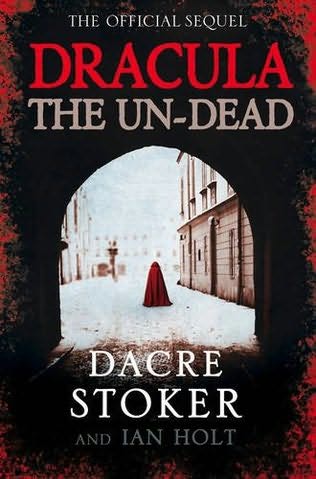
Dracula: The Un-Dead by Dacre Stoker & Ian Holt

Dracula: The Un-dead by Dacre Stoker & Ian Holt

The original Dracula by Bram Stoker is on my top ten list of all-time favourite novels.  I love slow-paced gothic literature, and for me, Dracula is the best of the bunch.   I love the characters, the letters/diaries style and when I first read it as a 12 or 13 year-old, I was scared.  I don't like the modern Twilight-style vampire stuff at all, but I did very much enjoy The Historian.  Given that this 'sequel' to the original bears the Stoker name, I was looking forward to reading it.

Synopsis: Quincey Harker, the son of Mina and Jonathan, starts working on a production of Bram Stoker's Dracula at the Lyceum Theatre.  There he starts to discover the secrets of his family as one by one the heroes from the original novel are destroyed.

Score: 1 out of 5

This may sound brutal, but here it is:  there is nothing to like about this book.  Please don't read it.  It is a blatant attempt on cashing in through the use of a famous surname and should never have been an authorised sequel to what is a classic and much-loved book.  

What offends me the most about it is how the original characters have been twisted and 'developed' into something completely beyond what Bram Stoker had imagined them to be.  Mina has become a sex-crazed vampire affecionado, Jonathan a sad drunk who likes prostitutes,  Jack a crazy morphine addict, Van Helsing a sell out and Arthur a sad and lonely old man.  And Dracula, an undeniable villain, has become a tragic romantic hero, 'God's crusader' who was merely misunderstood.  He doesn't even drink human blood anymore!  And Bram Stoker even appears in it as a plagerist! It all seems a bit disrespectful to me.

There was also a high proportion of silliness in the plot.  Don't get me wrong, I don't mind a bit of tackiness or suspending belief - but Jack the Ripper really being the Countess Elizabeth Bathory?  When the authors of a book take so much liberty with both the original story and the timeline of history that they have to provide an afterword to explain themselves away, you do start to wonder.

To sum up, I am sure Bram Stoker would have been appalled to have learned of this treatment of his novel if he was alive to witness it.  If you like the original, steer well clear of this one.