The Clan of the Cave Bear is not in my reading comfort zone. Whilst I like historical fiction, fantasy and big, complex multi-book epics are not my thing. I've been burned by Robert Jordan's Wheel of Time (I plodded through to book seven before admitting defeat). But I was in a picky reading mood and felt like a change, so Clan of the Cave Bear it was.
Ayla is a young girl orphaned by an earthquake in prehistoric times. Only five and left to wander helplessly looking for food and water, she is attacked by a cave lion before chancing upon a group of Neanderthal. Taken in by the medicine woman, Iza, and the holy man, Creb, Ayla is bought up as a Neanderthal, as one of the Clan. But despite her best efforts she is different and finds it hard to conform to all of their customs and rituals. The leader, Brun, is accepting and lenient, but the future leader Broud, develops a deep resentment towards Ayla. As she comes of age her differences become more apparent and tensions appear in the Clan. As they prepare for a Clan gathering with other groups of Neanderthals, things build to a head for Ayla and her adopted family.
I was ambivalent about The Clan of the Cave Bear. I found it to have a very slow start and it took me a good hundred pages or so out of five hundred to actually get involved with the story. It was hard to connect with Ayla properly until she was a bit older, but once I had connected with her I started enjoying the book a lot more as I did want to find out what would happen to her. The first time she got into trouble with the Clan, I was gripped, but as the book went on the structure became a bit repetitive. It basically went like this: Ayla breaks a Clan custom because she is different, Broud wants her to have a death curse, the men have extended deliberations, Brun finally decides to accept Ayla back. This happens two or three times and so the tension was lost; Ayla didn't seem to be in any danger of being cut off from the Clan whilst Brun was in charge.
I admire the world building in The Clan of the Cave Bear. The prehistoric times are bought back to life vividly and it's easy to tell that Auel has thought about every aspect of Clan life and ritual before writing. The slow pace meant that this world could be fully introduced and also that there was time for all the characters to shine and be developed, not just Ayla. I was fond of the leader, Brun, and the calm, logical approach he took to the people he was responsible for. Even the villain of the piece, Broud, is a balanced character and Auel takes the time to explain his motivation for acting in the way he does towards Ayla.
In fact, my main issue with The Clan of the Cave Bear was how long it took for me to read it - almost two weeks. This is unheard of for me, even if I did choose to read it during a busy time at work. To put it into perspective - I read Anna Karenina faster than I did this! And even more so than the time it took, Cave Bear felt like an effort to read and get through. There was so much background information that it became dense and at points it took me days to get through a single chapter. I wanted to finish it because of the characters and world building, but it was hard work and a book like this shouldn't be. So whilst there was a cliffhanger ending and I am interested to see what Ayla will do next, I'll hold off reading Valley of the Horses for a while yet.
Source: Personal copy
First Published: 1980
Score: 3 out of 5
Thursday, 28 June 2012
Monday, 25 June 2012
The Boy in the Dress by David Walliams
I always thought David Walliams was just some averagely funny comedian from the TV who had used his celebrity to get mediocre books published (mentioning no names, Katie Price!). But I needed something new to read to my class of ten year olds, so another teacher recommended The Boy in the Dress.
And it was, without a doubt, the best book I've read to my class all year. David Walliams had them hanging on to every word and begging me to read past home time in order to find out what would happen next. Some even went out in their own time and bought copies of this and other Walliams books; there's almost a Walliams book club going on during silent reading time now! I will meet fierce resistance if I read anything but another Walliams book next.
The Boy in the Dress is all about Dennis, who lives with his Dad and big brother John after his Mum has left the family. They are a very macho family with a strict no-hugging rule (except during football matches), but Dennis is different. When he becomes friends with budding fashion designer Lisa (who is also the prettiest girl in the school), she encourages him to just be himself. Before he knows it, Dennis is posing as French exchange student Denise, but will his disguise last?
As a teacher, there was so much I liked about the book. Walliams doesn't patronise his readers, but instead includes them in a jokey narrative and lets them think for themselves. There is plenty of humour, and enough rude/ slightly edgy jokes to keep them satisfied, but Walliams never goes too far. Quentin Blake's illustrations are of course marvellous. It appealed to everyone in the class, whatever their gender or interests as it's mainly about feeling different, and who hasn't ever felt different?
The cross dressing story is sensitively done too. Walliams wisely steers clear of any sexuality issue and makes Dennis just a typical, football loving boy who happens to like wearing dresses. My children thought it was strange at first (especially the boys) but by the end all of the children in my inner-city class were cheering for Dennis and his right to wear whatever he wanted. When he gets in trouble for wearing a dress, they were vocally outraged and angry on his behalf.
And that's what I loved; because without even knowing it, they had learned that everyone's different and that you don't have to conform with what everyone expects you to be. That boys don't have to love football and girls dresses, that boys and girls aren't too different after all.
Highly recommended for 8+
Thursday, 21 June 2012
An Apology
My reports have to be finished this weekend and after that the pressure should ease a bit and I'm looking forward to getting back to blogging then and to having some free time to spend as I choose. Four weeks and one day until the summer holidays start and I can't wait!
Monday, 18 June 2012
The Language of Flowers by Vanessa Diffenbaugh
Victoria has spent her life in the care system, rejected by many foster parents due to her difficult and violent behaviour. Now eighteen years old, she is left to fend for herself with nothing but her love of flowers. Flowers were used in Victorian times to express emotions and Victoria becomes fascinated with this language. Her talent is spotted by a florist but can Victoria ever learn to function in society?
I liked The Language of Flowers because of the main character, Victoria herself. I've read many a review of this book where the reviewer bemoans the fact that Victoria isn't likeable and that her actions don't make sense. And it's true - Victoria is a frustrating, passive individual who makes noises about wanting to improve her life but waits for said life to fall in her lap, that's if she's not busy pushing away people who care about her and rejecting opportunities. To a functional adult, this makes no sense. But I didn't mind that Victoria wasn't likeable or function because she was believable.
I don't teach children of Victoria's age but I've taught a few younger versions of her and for me, her character was completely plausible and I felt sorry for her. As a child she was violent to others and as an adult she's defensive and closed to the point where she can't relate to the people around her, even Renata, who offers her a job, and Grant, who tries to love her. She has many chances of happiness but at least early in the book, she throws them all away. I liked that Diffenbaugh chose such a complex individual to write about and think that she had some important points to make about the foster system and how a life lived in it can effect a person.
I found The Language of Flowers to be a gripping read. Diffenbaugh intersperses chapters about Victoria at eighteen with chapters about the time she spent at ten with the woman who nearly adopted her. I enjoyed both storylines and found the book hard to put down, even though at times it was like watching a car crash. The novel was effectively written and pacy, but the writing was secondary to the story and the story took a backseat to character development.
My only criticism is that things improved for Victoria too quickly; I don't think there's many eighteen year olds fresh out of the care system that have the opportunities that she does and I don't think there are many of us that learn to change the habits of a lifetime like Victoria did, even if she took her time to do so. I thought her character development was well written, but maybe overly optimistic. There's thousands of Victoria's out there that don't make it.
Source: Library (reserved)
First Published: 2011
Score: 4.5 out of 5
Saturday, 16 June 2012
A Lady Cyclist's Guide to Kashgar by Suzanne Joinson
I love to travel. I don't get a chance to do it very often, so armchair travelling is often the next best thing. As soon as I heard about A Lady Cyclist's Guide to Kashgar, I knew I would have to read it and was thrilled to be approved for a copy on Netgalley.
A Lady Cyclist's Guide to Kashgar is a dual narrative story set in the past and the present. In 1923, Evangeline (Eva) and her sister set out on a missionary trip to the Silk Road city of Kashgar, which has a fusion of Chinese and Islamic culture. But Eva is only pretending to be a missionary; she dreams of becoming an adventurer like her hero Richard Burton and of writing a best-selling account of her travels. In the present day, Frieda works for a think tank travelling around various Arab countries and producing reports. Returning to London after another long trip she finds Tayeb sleeping by her door and a letter informing her of an inheritance from someone she has never heard of.
A Lady Cyclist's Guide to Kashgar contains many elements that I generally love in fiction - a dual narrative, historical fiction elements, Islamic culture, travel and feminism/independent women. I was expecting to love it and it completely lived up to my expectations. After a bit of a slow start the pace picked up and I was soon completely engrossed in what would happen to Eva and Frieda. What I loved most was the way the author's love of travel completely suffused the whole novel and how Eva grew up reading travel books, just like I did;
"It was reading her descriptions of the candles and lights and the mysterious glittering interiors, the tapirs, silks, the jewels and hangings that had inspired my desire to travel."
As with any dual narrative book, one story was stronger than the other. Whilst I enjoyed reading about Frieda, it was Eva's story that captivated me. The woman in charge of their missionary trip, Millicent, has no concept of sensitivity to local culture and the three women soon find themselves in danger, forcing Eva to confront the darker side of travel ("despite a childhood of examining maps and reading adventure stories, I realise I am quite terrified of the desert"). I just flew through Eva's sections of the book.
Although I subjectively loved this book, I can see that it's not without fault. At times it feels like Joinson is trying to do too much, commenting on travel, motherhood, women's rights, prejudice against Muslims, alternative childhoods, cults and adultery. Some readers won't connect with Frieda's story. But despite all of this, I just loved A Lady Cyclist's Guide to Kashgar and would recommend it to anyone who enjoys travel books or historical fiction.
Source: From Bloomsbury, via Netgalley
Published: 4th June 2012
Score: 4.5 out of 5
Read Alongside:
1. The Sandalwood Tree by Elle Newmark - Another dual narrative travel story, this one set in India. One of the stories centers around two unconventional Victorian women and India is a character in it's own right.
2. The Mistress of Nothing by Kate Pullinger - Sally travels to Egypt with her mistress, Lady Duff Gordon and finds the restraints of Victorian society slightly loosened. Wonderful descriptions of Egypt.
Wednesday, 13 June 2012
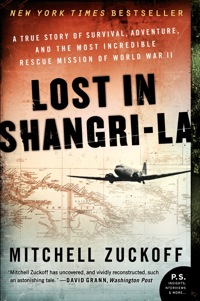
Lost in Shangri-La by Mitchell Zukoff
Lost In Shangri-La is a true life adventure story. In 1945, a group of American service men and women stationed in Dutch New Guinea got on a plane with the intention of seeing the mysterious 'hidden' valley of Shangri-La. They never made it - their plane crashed into the jungle and only three survived. Surrounded by hostile terrain, potentially unfriendly natives and with life-threatening injuries, they began battling to survive. Lost in Shangri-La chronicles what happened afterwards from their meetings with tribespeople who had no previous interaction with the outside world to the daring rescue mission put into place to try to save them.
I thoroughly enjoyed Lost in Shangri-La. It was a rare case of a non-fiction book where both the content and the writing exceeded expectations. What happened to the three survivors was fascinating and I found it hard to put the book down, so keen was I to find out what would happen to them next. This is one of those true stories you couldn't make up, full of adventure from the moment the plane crashed into the jungle.
I was also impressed with Zuckoff's writing style. He relays the events clearly and at a good pace, adding background information but not overwhelming the reader with it. I especially appreciated the sections where the survivors interact with the native tribespeople - Zuckoff included the impressions of the survivors and the natives, making it easy to see the frequent miscommunication. Given the amount of research Zuckoff had conducted and the fact that he had travelled to New Guinea to interview the native population, these sections fascinated me. The survivors were thought of as spirits descended from the sky heralding the end of their civilisation as it currently existed.
Whilst all of the book was written at a brisk pace, I much preferred the earlier sections straight after the crash as there was a greater sense of tension due to the danger the survivors found themselves in. I did enjoy reading about the resuce mission but at this point the danger had passed so I was less invested in the text. I would also liked to have read a bit more about what happened to the natives after the survivors left; Zuckoff does let us know what life is like for them now but I wanted the details - how did their way of life finally change forever?
Lost in Shangri-La is one of the most engaging non-fiction texts I've read for quite some time. It will appeal to anyone who enjoys a good adventure story.
Source: TLC book tours
First Published: 2011
Score: 4.5 out of 5
Want to read more?
The rest of the tour stops can be found here.
I thoroughly enjoyed Lost in Shangri-La. It was a rare case of a non-fiction book where both the content and the writing exceeded expectations. What happened to the three survivors was fascinating and I found it hard to put the book down, so keen was I to find out what would happen to them next. This is one of those true stories you couldn't make up, full of adventure from the moment the plane crashed into the jungle.
I was also impressed with Zuckoff's writing style. He relays the events clearly and at a good pace, adding background information but not overwhelming the reader with it. I especially appreciated the sections where the survivors interact with the native tribespeople - Zuckoff included the impressions of the survivors and the natives, making it easy to see the frequent miscommunication. Given the amount of research Zuckoff had conducted and the fact that he had travelled to New Guinea to interview the native population, these sections fascinated me. The survivors were thought of as spirits descended from the sky heralding the end of their civilisation as it currently existed.
Whilst all of the book was written at a brisk pace, I much preferred the earlier sections straight after the crash as there was a greater sense of tension due to the danger the survivors found themselves in. I did enjoy reading about the resuce mission but at this point the danger had passed so I was less invested in the text. I would also liked to have read a bit more about what happened to the natives after the survivors left; Zuckoff does let us know what life is like for them now but I wanted the details - how did their way of life finally change forever?
Lost in Shangri-La is one of the most engaging non-fiction texts I've read for quite some time. It will appeal to anyone who enjoys a good adventure story. Source: TLC book tours
First Published: 2011
Score: 4.5 out of 5
Want to read more?
The rest of the tour stops can be found here.
Sunday, 10 June 2012
Armchair BEA Giveaway Winner!
#72 - Rebecca
I've emailed Rebecca and she has 48 hours to respond with her email address. She chose Song of Achilles by Madeline Miller.
Subscribe to:
Posts (Atom)